Blog Summary: A hair transplant can be permanent when healthy follicles are taken from the true safe donor zone. These follicles are naturally resistant to DHT and keep that resistance even after being moved to thinning areas. At Neo Follicle Hair Transplant Clinic in Bangalore, Dr Sandeep Mahapatra plans each case to protect long-term density.
Is a Hair Transplant Permanent? The Real Science Behind Lifelong Results
One of the most common questions I hear at Neo Follicle Hair Transplant Clinic is this:
“Doctor, will my transplanted hair really last for life?”
It is a fair question.
A hair transplant is not just a cosmetic procedure. It is an emotional decision. It requires time, trust, planning, and financial investment.
Many working professionals who visit my Marathahalli clinic from Whitefield, Bellandur, Electronic City, Sarjapur Road, Indiranagar, Koramangala, and HSR Layout want one thing clearly answered:
“Will this result stay?”
My honest answer is this:
Yes, transplanted hair is usually permanent when it is taken from the true safe donor zone and transplanted correctly.
But there is one important clarification.
The transplanted hair can be permanent. Your existing native hair may still continue to thin with age or genetic hair loss.
This difference is very important. Once you understand it, the entire science of hair transplant becomes much clearer.
Let me explain this in a simple, scientific, and honest way.
Why Transplanted Hair Is Considered Permanent
The science behind permanent hair transplant results is based on a principle called donor dominance.
This is one of the most important concepts in hair restoration surgery.
In male and female pattern hair loss, the hair on the front, mid-scalp, and crown becomes sensitive to a hormone called DHT, or dihydrotestosterone.
DHT does not destroy every hair follicle.
It mainly affects genetically sensitive follicles.
That is why many people lose hair on the top of the scalp but still keep strong hair on the back and sides of the head.
You may have noticed this pattern.
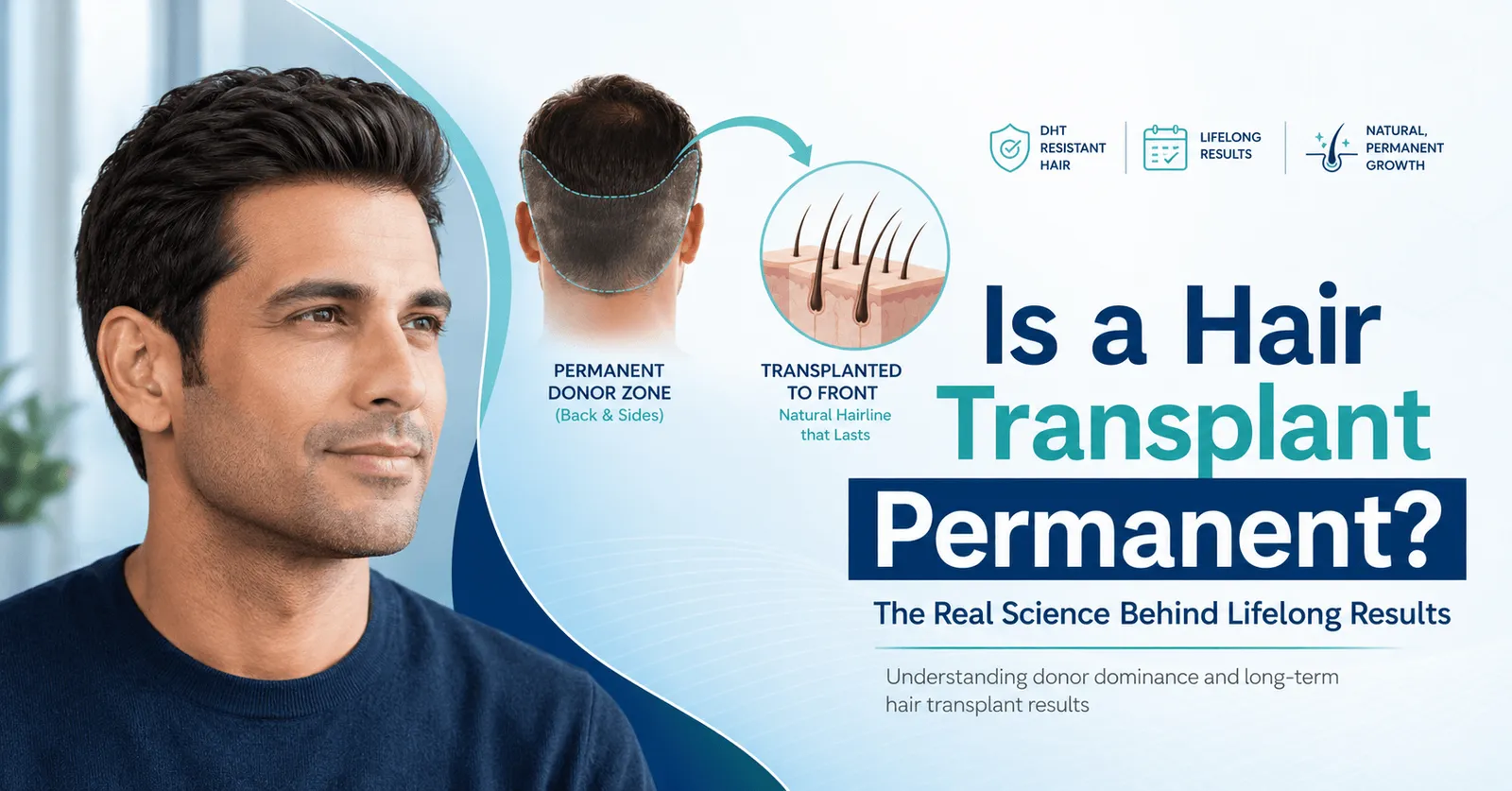
Even in advanced baldness, many men still retain a horseshoe-shaped band of hair around the back and sides.
This area is called the permanent donor zone.
The hair follicles in this zone are naturally resistant to DHT.
When we carefully extract follicles from this permanent zone and transplant them to the bald area, they carry their original genetic behaviour with them.
That means they continue to behave like back-and-side scalp hair.
Even after being moved to the front hairline or crown, they usually remain DHT-resistant.
This is the core reason transplanted hair lasts long-term.
A Simple Analogy: The Follicle Remembers Its Home
I explain it to patients like this.
Imagine moving a coconut tree from one garden to another.
If the tree is healthy and suitable for that climate, it does not suddenly become a rose plant.
It continues to behave like a coconut tree.
Similarly, a hair follicle taken from the true permanent zone does not forget its genetic identity.
It does not become weak simply because it is moved to the front.
It keeps the same resistance it had in the donor area.
That is donor dominance.
This is why transplanted hair can grow naturally for many years, often for life.
What Happens After Hair Transplant Surgery?
Many patients become anxious when transplanted hair sheds after surgery.
This is normal.
In the first few weeks, the transplanted hair shafts may fall out. This is called shock shedding.
But the follicle root remains alive under the skin.
Think of it like a plant losing leaves after being moved.
The root is still there.
After a resting period, new hair begins to grow from the transplanted follicles.
Most patients see early growth around 3 to 4 months.
Visible improvement usually appears between 6 and 9 months.
The final result often takes 12 to 15 months.
In some crown cases, it may take even longer.
Once the transplanted follicles mature, they behave like permanent donor hair.
The Big Truth: Transplanted Hair Is Permanent, But Native Hair Is Not Always Safe
This is where many patients get confused.
A hair transplant does not stop the original genetic tendency for baldness.
It only restores hair in areas where follicles are implanted.
If your existing native hair is still genetically sensitive to DHT, it may continue thinning over time.
This can happen around the transplanted hair.
For example, a patient may get a strong new hairline. But if the hair behind that hairline continues to thin, a gap may slowly appear.
This does not mean the transplant failed.
It means the native hair continued its natural genetic course.
That is why planning matters.
At Neo Follicle Hair Transplant Clinic, we do not look only at today’s baldness.
We study your future hair loss risk.
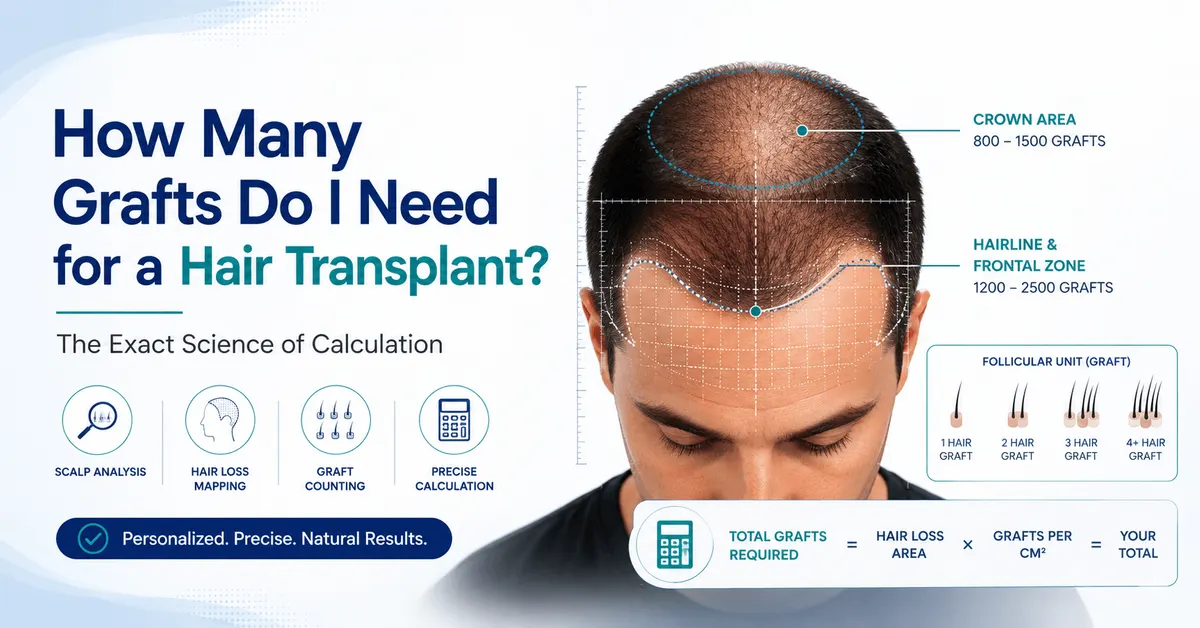
We assess your age, family history, donor strength, hair calibre, scalp condition, and pattern of thinning.
A good hair transplant is not just about filling empty areas.
It is about planning for the next 10, 20, and 30 years.
Why Medical Maintenance Matters After Hair Transplant
If your native hair is still thinning, maintenance can help protect it.
This may include medical management, lifestyle correction, scalp health treatment, and regenerative therapies such as PRP or GFC where appropriate.
The goal is not to “protect the transplanted hair.”
The goal is to protect the non-transplanted existing hair.
This distinction is very important.
The transplanted hair usually does not depend on medication for survival if it was harvested correctly.
But your native hair may need support.
Depending on the patient, I may discuss:
- DHT-control medications where suitable
- PRP or GFC maintenance sessions
- Anti-inflammatory scalp care
- Nutritional correction
- Dandruff or seborrheic dermatitis control
- Lifestyle and stress management
- Periodic review of hair density
Not every patient needs the same plan.
Some need active medical support.
Some need only observation.
Some need a staged transplant approach.
Ethical care means customising the plan, not giving everyone the same package.
The Aging Factor: What Happens in Your 60s and 70s?
Even permanent hair is still human hair.
So it can age.
As we grow older, hair may naturally become finer, lighter, or slightly less dense.
This can happen in the 60s and 70s.
It can happen to both transplanted and non-transplanted hair.
But this is different from genetic baldness.
In genetic baldness, sensitive follicles miniaturise progressively and may disappear from visible growth.
In natural aging, the hair may thin mildly, but it usually does not vanish in the same patterned way.
So yes, transplanted hair may age.
It may become slightly thinner with time.
But if taken from the true permanent donor zone, it should not fall out completely like DHT-sensitive bald scalp hair.
This is why correct donor selection is so important.
The Most Important Red Flag: Wrong Donor Harvesting
This is one area where I want patients to be very careful.
Permanence depends on where the grafts are taken from.
Not all hair at the back and sides is equally permanent.
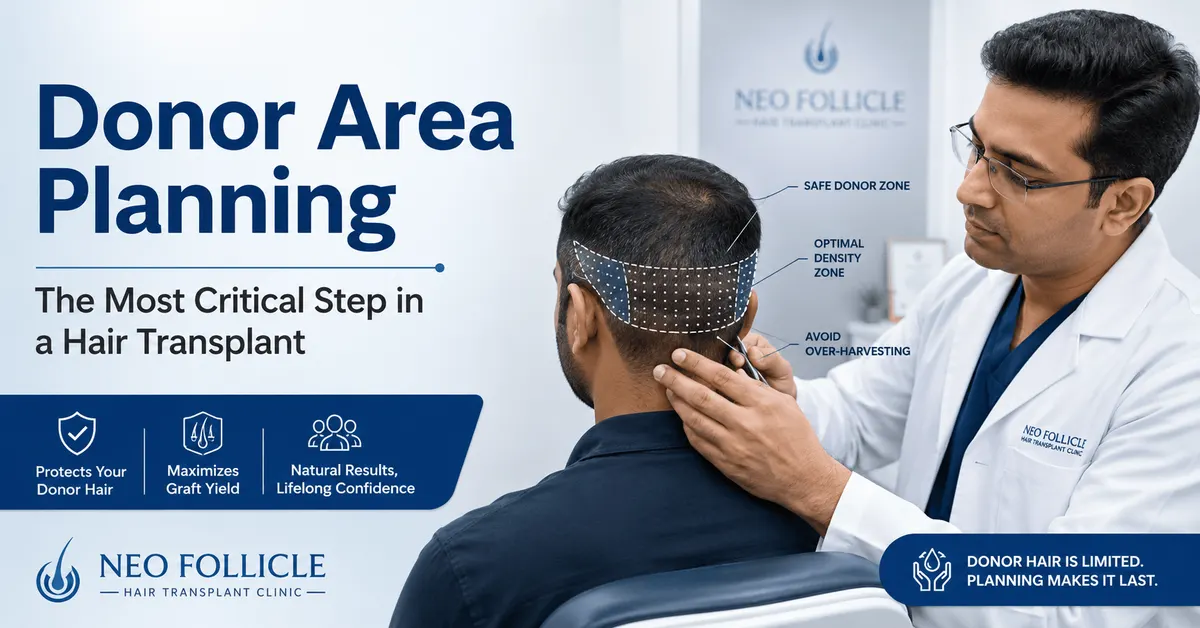
There is a specific safe donor zone.
If grafts are taken too high, they may come from an area that can thin later.
If grafts are taken too low, near the neck, those follicles may also be unstable.
If a clinic harvests aggressively from unsafe areas, the transplanted hair may look good initially.
But after a few years, some of those grafts may thin out.
Patients then feel cheated.
They were promised “permanent hair,” but the grafts were not taken from a truly permanent zone.
This is one of the biggest problems I see with cut-rate, commercialised hair transplant centres.
Many focus only on graft numbers.
They advertise high-density packages.
They promise unrealistic coverage.
But they may compromise donor safety.
A hair transplant is not a race to extract the maximum grafts.
It is a medical procedure that must preserve your donor area for life.
Why Surgeon Skill Decides Lifelong Results
Permanent results depend on much more than graft survival.
They depend on correct planning.
The surgeon must know:
- Where the true safe donor zone begins and ends
- How much donor hair can be safely used
- Which grafts are suitable for the hairline
- Which grafts are better for density
- How to avoid overharvesting
- How to plan for future baldness
- How to protect native hair
- How to design age-appropriate density
A natural and lasting hair transplant needs science, experience, and restraint.
Sometimes, saying “no” is part of ethical hair restoration.
If a young patient from Koramangala or HSR Layout comes with early hair loss and wants a very low, aggressive hairline, I may advise caution.
If a patient from Whitefield or Bellandur has advanced baldness and weak donor hair, I may recommend a conservative plan.
If someone from Electronic City or Sarjapur Road wants complete coverage in one sitting, we first assess whether it is medically realistic.
The goal is not just to create a good result today.
The goal is to create a result that still looks sensible years later.
Key Factors That Help Guarantee a Permanent Hair Transplant Result
A hair transplant is most likely to last when these factors are respected:
- Grafts are taken from the true safe donor zone
- The donor area is not overharvested
- The surgeon plans for future hair loss
- The hairline is natural and age-appropriate
- Native hair is protected with medical management
- The procedure is performed by an experienced surgical team
- The patient has realistic expectations
- Follow-up care is taken seriously
- PRP, GFC, or medication is used when clinically needed
- The clinic does not chase only high graft numbers
These points matter more than discounts, advertisements, or package claims.
Can a Hair Transplant Fail Even If the Hair Is Permanent?
Yes, poor results can happen.
But we must understand the reasons.
A transplant may look poor if:
- The grafts were taken from the wrong donor zone
- Grafts were damaged during extraction
- Implantation was done at poor angles
- Density was planned badly
- The donor area was weak
- The patient had uncontrolled scalp disease
- Native hair continued falling rapidly
- Post-operative care was ignored
- Unrealistic promises were made
This is why experience matters.
At Neo Follicle Hair Transplant Clinic, my team and I spend time on diagnosis before surgery.
We do not treat hair transplant like a simple cosmetic shortcut.
It is a long-term medical restoration plan.
My Honest Advice Before You Choose a Hair Transplant
Before deciding, ask your surgeon four questions:
1. Is my donor area strong enough?
2. Are you harvesting only from the safe donor zone?
3. What will happen if my existing hair continues to fall?
4. Will I need medical maintenance after surgery?
If these questions are answered clearly, you are in safe hands.
If the clinic only talks about discounts, graft count, or “one-day transformation,” be careful.
Hair transplant results should be permanent, natural, and future-proof.
That requires honest counselling.
It also requires surgical discipline.
Final Thoughts: Is a Hair Transplant Permanent?
Yes, a hair transplant can be permanent.
But only when the science is respected.
The transplanted follicles must come from the true permanent donor zone.
They must be handled gently.
They must be implanted with precision.
And the patient’s future hair loss must be planned carefully.
The transplanted hair usually keeps growing because it carries DHT resistance from its original donor area.
But your native hair may still need protection.
That is why hair restoration is not just about surgery.
It is about long-term care.
At Neo Follicle Hair Transplant Clinic in Marathahalli, Bangalore, my goal is never to simply fill bald areas. My goal is to help you understand your hair loss clearly, choose wisely, and achieve results that look natural today and remain sensible for years to come.
A good hair transplant should not create anxiety.
It should give you confidence.
And that confidence begins with knowing the science.
FAQs: Is a Hair Transplant Permanent?
Will the transplanted hair ever fall out after 5 or 10 years?
If the grafts are taken from the true safe donor zone, transplanted hair usually remains long-term. It may shed temporarily after surgery, then regrow. Years later, it can age naturally, but it should not disappear like DHT-sensitive bald scalp hair. If grafts are taken from unsafe areas, they may thin later.
Do I need to take hair loss medications forever to keep my transplanted hair?
Usually, medications are not needed to keep correctly transplanted hair alive. But they may be needed to protect your existing native hair. If your original hair is still thinning, medical management can help preserve density. The need for medication depends on your age, hair loss pattern, donor strength, and progression risk.
What happens if my native hair keeps receding behind the permanent transplanted hairline?
This can happen if progressive hair loss is not controlled. The transplanted hairline may remain, but the native hair behind it may thin. That can create a visible gap. This is why we plan hairlines carefully and may recommend medications, PRP, GFC, or future staged restoration when needed.
How does the surgeon determine if my donor area is strong enough for a permanent result?
We examine the density, hair caliber, scalp laxity, donor stability, family history, age, and pattern of hair loss. We also check whether the donor hair lies within the true safe zone. A responsible surgeon does not just count grafts. The surgeon studies whether those grafts are likely to remain stable for life.
Blog Author & Medical Reviewer

Written by: Dr. Sandeep Mahapatra
Senior Dermatologist, Hair Transplant Surgeon & Founder – Neo Follicle Hair Transplant Clinic, Bangalore
Dr. Sandeep Mahapatra is a senior dermatologist and hair transplant surgeon in Bangalore with extensive experience in hair restoration, dermatology, and aesthetic treatments. As the founder of Neo Follicle Hair Transplant Clinic, he has successfully performed over 10,000 hair transplant procedures and regularly guides patients on safe, ethical, and natural-looking hair restoration.
Medically reviewed by: Dr. Sandeep Mahapatra
Senior Dermatologist & Hair Transplant Surgeon
Date Reviewed: 2026-06-19
This article has been medically reviewed by Dr. Sandeep Mahapatra to ensure that the information is clinically accurate, patient-friendly, and aligned with safe hair transplant practices. The content is intended for educational purposes and should not replace a personal consultation with a qualified hair transplant surgeon.
References:
- International Society of Hair Restoration Surgery - Androgenetic Alopecia Guide
URL: https://ishrs.org/androgenetic-alopecia/ - International Society of Hair Restoration Surgery - Hair Restoration Glossary
URL: https://ishrs.org/patients/glossary/ - NCBI / StatPearls - Hair Transplantation
URL: https://www.ncbi.nlm.nih.gov/books/NBK547740/ - PubMed Central - Is Every Patient of Hair Loss a Candidate for Hair Transplant?
URL: https://pmc.ncbi.nlm.nih.gov/articles/PMC8719975/ - PubMed Central - Assessment of Safe Donor Zone of Scalp and Beard for FUE in Indian Men
URL: https://pmc.ncbi.nlm.nih.gov/articles/PMC6484564/
Share this article :