Blog Summary: PRP and GFC both help early hair thinning by strengthening weak, living follicles, but GFC is a more refined growth-factor treatment. PRP releases growth factors after injection, while GFC delivers concentrated growth factors prepared beforehand. At Neo Follicle Hair Transplant Clinic in Bangalore, Dr Sandeep Mahapatra can assess which suits your stage.
Hair thinning can be emotionally exhausting. For many men and women, it does not begin as “baldness.” It begins quietly - a wider parting, more hair on the pillow, a visible scalp under bright office lights, or a receding hairline that slowly changes the way you see yourself in the mirror.
As a dermatologist and hair transplant surgeon, I meet many patients at Neo Follicle Hair Transplant Clinic in Bangalore who come with one common question:
“Doctor, should I choose PRP or GFC for my hair loss?”
This is a very valid question. Both PRP and GFC are regenerative hair therapies. Both use healing components derived from your own blood. Both are designed to strengthen weak follicles, reduce hair fall, improve hair thickness, and support better scalp health.
But they are not exactly the same.
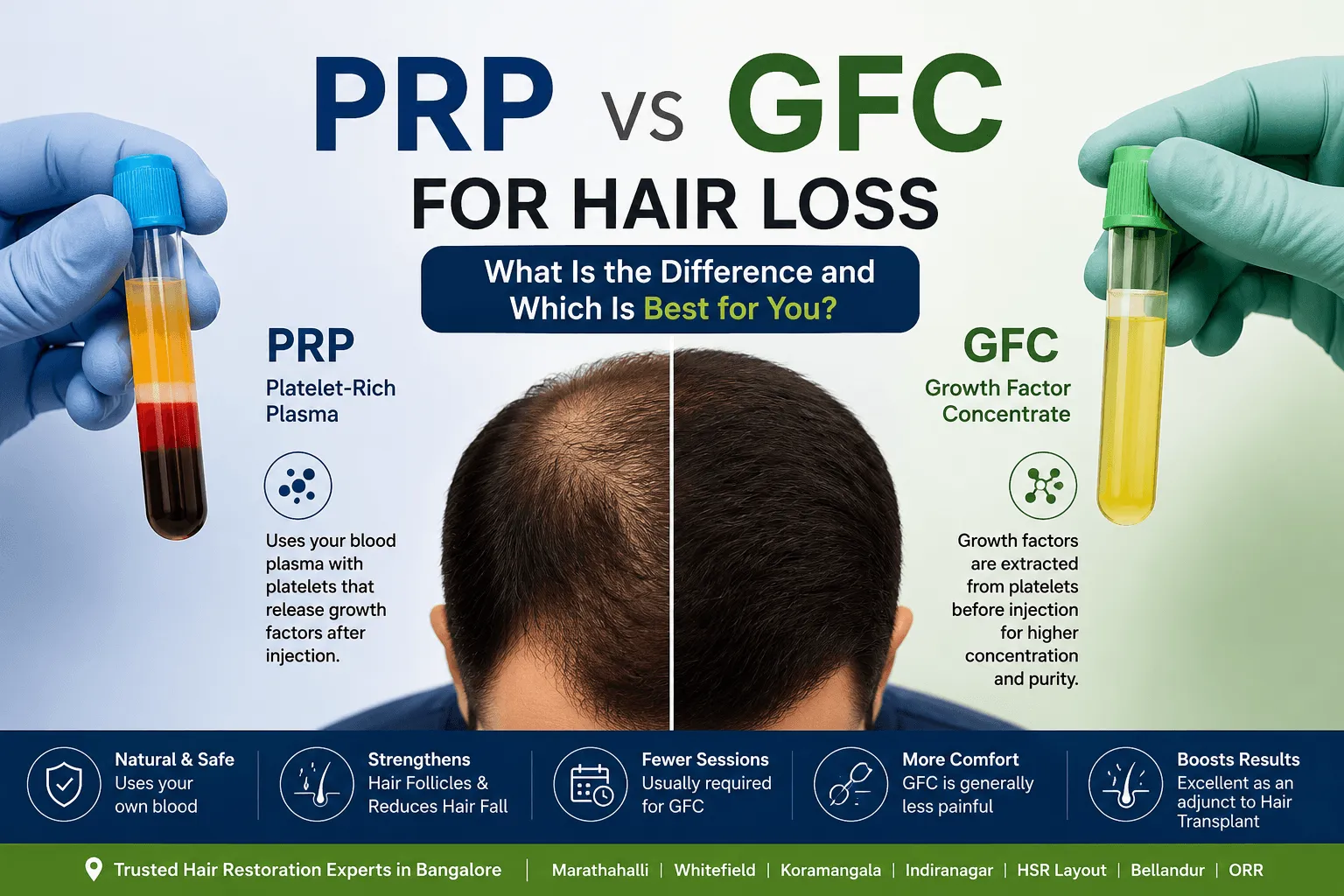
PRP, or Platelet-Rich Plasma, has been used for many years in dermatology and hair restoration. GFC, or Growth Factor Concentrate, is a more refined and standardized advancement of the same biological principle. In simple terms, PRP uses platelet-rich plasma, while GFC uses a more concentrated growth factor serum extracted from platelets before injection.
In this blog, I will explain the difference between PRP and GFC in a simple, honest, and medically practical way - so that you can understand which treatment may suit your stage of hair thinning.
First, Let Us Understand Why Hair Falls in the First Place
Before comparing PRP and GFC, it is important to understand what these treatments are trying to improve.
Most patients who visit my team at Neo Follicle have one of these patterns:
- Gradual hair thinning on the crown
- Receding hairline
- Diffuse hair fall across the scalp
- Reduced hair density after stress, illness, weight loss, or nutritional deficiency
- Early male or female pattern hair loss
- Weakening of existing hair after a hair transplant
- Seasonal or stress-related shedding
In many cases, especially in male and female pattern hair loss, the problem is not that all follicles are dead. The problem is that many follicles are becoming weak, miniaturized, and less active.
Think of a hair follicle like a plant root. If the root is alive but weak, we can nourish it, stimulate it, and help it produce thicker hair. But if the root is completely gone, no injection can bring it back.
This is where PRP and GFC play an important role.
They are most useful when the follicle is still alive but struggling.
What Is PRP Hair Treatment?
PRP stands for Platelet-Rich Plasma.
It is a treatment where we take a small amount of your own blood, process it in a centrifuge machine, and separate the platelet-rich portion of the plasma. This platelet-rich plasma is then injected into targeted areas of the scalp.
Platelets are small blood components that help in healing and tissue repair. They contain growth factors that can support cellular repair, blood supply, collagen activity, and follicular stimulation.
How PRP Works for Hair Loss
In PRP therapy, the platelets are injected into the scalp along with plasma. Once inside the scalp, these platelets become activated and release growth factors gradually.
These growth factors may help by:
- Improving the activity of weak hair follicles
- Supporting the growth phase of the hair cycle
- Reducing excessive shedding in suitable patients
- Improving hair thickness and density
- Enhancing scalp healing after hair transplant
- Supporting better follicle health when combined with medicines
PRP is not a “hair-growing magic injection.” It is a biological stimulation therapy. It works best when the follicles are still alive and capable of responding.
Why PRP Results Can Vary
This is one of the most important points patients must understand.
Because PRP depends on your own blood quality, results can vary from person to person. The concentration and quality of platelets may differ based on:
- Age
- General health
- Platelet count
- Nutritional status
- Smoking
- Stress
- Sleep
- Chronic illness
- Medications
- Hair loss stage
- Technique used for PRP preparation
This does not mean PRP is ineffective. It simply means that PRP is more biologically variable.
Two people may receive PRP, but their platelet concentration and growth factor release may not be exactly the same.
What Is GFC Hair Treatment?
GFC stands for Growth Factor Concentrate.
It is a newer and more refined regenerative treatment for hair loss. Like PRP, GFC also starts with your own blood. But the preparation method is different.
In GFC therapy, your blood is collected in a specialized kit. The platelets are then processed in a controlled manner so that the growth factors are extracted from the platelets before the solution is injected into the scalp.
This produces a concentrated growth factor serum.
How GFC Is Different from PRP
In PRP, platelet-rich plasma is injected into the scalp, and the platelets release growth factors after injection.
In GFC, the growth factors are extracted from platelets beforehand using a specialized kit. The final injectable solution is usually more refined, concentrated, and acellular, meaning it does not contain many cellular components.
This makes GFC more standardized than traditional PRP.
Why GFC Is Called a Next-Generation Treatment
At Neo Follicle, I often explain GFC to patients in this way:
PRP delivers platelets that release growth factors inside the scalp. GFC delivers the extracted growth factors more directly.
This difference matters because GFC may offer:
- Better concentration of growth factors
- More standardized preparation
- Less inflammatory response
- Less pain during injection
- Cleaner injectable serum
- More predictable session-to-session quality
- Fewer sessions in selected patients
For many working professionals coming to our Marathahalli clinic from Whitefield, Mahadevapura, Bellandur, Outer Ring Road, HSR Layout, Koramangala, or Indiranagar, GFC is attractive because it is comfortable, quick, and usually requires minimal downtime.
PRP vs GFC: Simple Comparison Table
| Parameter | PRP Hair Treatment | GFC Hair Treatment |
|---|---|---|
| Full Form | Platelet-Rich Plasma | Growth Factor Concentrate |
| Source | Patient’s own blood | Patient’s own blood |
| Preparation | Blood is centrifuged to concentrate platelets in plasma | Growth factors are extracted from platelets using a specialized kit |
| What Is Injected? | Platelet-rich plasma | Concentrated growth factor serum |
| When Growth Factors Are Released | Mostly after injection into the scalp | Extracted before injection |
| Cellular Content | Contains platelets and plasma components | More refined and largely acellular |
| Pain/Comfort | Mild to moderate discomfort possible | Generally more comfortable |
| Inflammation After Treatment | Mild redness, swelling, or tenderness may occur | Usually less inflammation |
| Consistency | Can vary based on platelet count and preparation method | More standardized |
| Sessions Needed | Usually multiple sessions | Often fewer sessions in suitable patients |
| Best For | Early hair thinning, maintenance, mild to moderate hair fall | Patients wanting refined, comfortable, concentrated therapy |
| Advanced Baldness | Cannot revive dead follicles | Cannot revive dead follicles |
| Role After Hair Transplant | Can support healing and existing hair | Can support healing and existing hair |
The Biggest Difference: Platelets vs Extracted Growth Factors
The central difference between PRP and GFC lies in what we inject.
In PRP, we inject platelet-rich plasma. The platelets are expected to release growth factors after they are injected into the scalp.
In GFC, we extract the growth factors from the platelets beforehand and inject a more concentrated growth factor solution.
This is why GFC is often considered more refined.
A simple analogy may help.
Imagine you want sugarcane juice.
PRP is like giving the sugarcane to the machine and allowing the juice to come out gradually.
GFC is like extracting the juice first and giving you the concentrated juice directly.
Both come from the same source. But the final form is different.
Pain and Comfort: Is GFC Less Painful Than PRP?
Many patients ask me, “Doctor, which one is less painful?”
In general, both PRP and GFC are tolerable procedures. We use fine injections and take measures to keep the patient comfortable.
However, GFC is generally considered more comfortable than traditional PRP because the injected solution is more refined and contains fewer cellular components. This may reduce post-procedure inflammation, heaviness, and tenderness.
After PRP, some patients may feel mild tightness, soreness, or swelling for a short time. After GFC, many patients report a lighter, more comfortable experience.
This is one reason why many busy professionals from IT and corporate hubs like Whitefield, ORR, Bellandur, Mahadevapura, and Marathahalli prefer GFC. They want a treatment that fits into a working day without making them feel conscious or uncomfortable after the session.
Number of Sessions: PRP vs GFC
The number of sessions depends on the stage of hair loss, diagnosis, scalp condition, age, medical history, and treatment goal.
Typical PRP Session Plan
PRP usually requires a series of sessions. Many patients may need:
- 3 to 5 initial sessions
- Sessions spaced around 3 to 4 weeks apart
- Maintenance sessions every few months, depending on response
PRP is often planned as a gradual stimulation therapy.
Typical GFC Session Plan
GFC may require fewer sessions in many suitable patients because the growth factor concentration is more refined and standardized.
A common plan may include:
- 3 initial sessions
- Sessions spaced around 4 weeks apart
- Maintenance depending on the patient’s response and ongoing hair loss pattern
At Neo Follicle, I do not recommend sessions mechanically. My team first evaluates the scalp, hair density, miniaturization pattern, donor area, medical history, and hair loss progression before suggesting a treatment plan.
Consistency of Results: Why GFC May Be More Predictable
One limitation of PRP is variability.
The quality of PRP depends on how the blood is processed, how much platelet concentration is achieved, and how the patient’s own blood biology responds.
GFC attempts to reduce this variability by using a standardized kit-based process that extracts growth factors more directly.
This may improve consistency from session to session.
However, I want to be clinically honest here. GFC is promising and refined, but no treatment can guarantee identical results for every patient. Hair growth depends on many biological factors, including genetics, hormone sensitivity, nutrition, stress, sleep, scalp inflammation, and compliance with medical advice.
The right expectation is not “miracle hair growth.”
The right expectation is:
- Reduced hair fall
- Improved hair thickness
- Better scalp health
- Strengthening of miniaturized follicles
- Slowing progression in suitable cases
- Better support when combined with medicines or hair transplant
Which Treatment Works Faster: PRP or GFC?
Most patients want to know when they will see visible improvement.
With both PRP and GFC, hair improvement is gradual. Hair follicles work in cycles, so visible changes take time.
Typically, patients may notice:
- Reduced hair fall within 4 to 8 weeks
- Better hair texture within 2 to 3 months
- Visible density improvement around 3 to 6 months
- Better results when combined with proper medical treatment
GFC may feel faster for some patients because of its concentrated growth factor delivery, but the actual visible change still depends on the hair cycle.
I always tell patients: hair restoration is biological, not cosmetic instant fixing.
We are working with living follicles. They need time to respond.
Who Is an Ideal Candidate for PRP or GFC?
PRP and GFC are not for every hair loss case. The best results are usually seen when follicles are weak but still alive.
Good Candidates Include:
- Men with early-stage male pattern hair loss
- Women with diffuse thinning
- Patients with increased hair fall but preserved follicles
- Patients with thinning crown or widening parting
- Patients with weak hair after illness, stress, or nutritional deficiency
- Patients with early miniaturization
- Patients who want to improve hair thickness
- Patients undergoing medical hair loss treatment
- Patients who have had or are planning a hair transplant
PRP or GFC After Hair Transplant
Both PRP and GFC can be useful as supportive therapies after a hair transplant.
They may help improve scalp healing, reduce shock loss in selected cases, support existing native hair, and enhance the overall environment for transplanted follicles.
However, they do not replace a technically well-performed hair transplant. The foundation of transplant success is still proper planning, safe donor extraction, correct angle, depth, direction, graft handling, and artistic hairline design.
At Neo Follicle, we use regenerative treatments as part of a broader hair restoration strategy, not as isolated shortcuts.
When PRP or GFC May Not Be Enough
This is where clinical honesty is very important.
PRP and GFC cannot revive completely dead follicles.
If the scalp area is shiny, smooth, and bald for many years, and there are no active follicles left, injections cannot create new follicles from nothing.
In such cases, a hair transplant remains the gold standard.
Advanced Baldness Requires a Different Plan
If a patient has advanced baldness, we assess:
- Donor area strength
- Hairline design
- Graft requirement
- Scalp laxity
- Expectations
- Age and future hair loss progression
- Whether medical therapy is needed
- Whether PRP or GFC can support existing hair
For advanced cases, PRP or GFC may still help improve the quality of surrounding weak hair, but they cannot replace transplantation in fully bald zones.
This is why a proper diagnosis matters more than simply choosing between PRP and GFC.
PRP vs GFC: Which Is Better for Early Hair Loss?
For early hair thinning, both PRP and GFC can be useful.
PRP is a time-tested and widely used option. It may be suitable for patients who want a cost-effective regenerative treatment and are comfortable with multiple sessions.
GFC may be preferred when the patient wants a more refined, standardized, and comfortable approach.
In my clinical experience, patients with early thinning, diffuse hair fall, and mild to moderate miniaturization often respond well when the treatment is combined with the right diagnosis, medications, nutrition correction, and follow-up.
If the patient’s priority is affordability, PRP may be considered.
If the patient’s priority is comfort, standardization, and fewer sessions, GFC may be a better choice.
PRP vs GFC for Female Hair Loss
Female hair loss is often more complex than male pattern baldness.
Women may experience hair thinning because of:
- Hormonal imbalance
- Thyroid disorders
- Iron deficiency
- Vitamin D deficiency
- PCOS
- Post-pregnancy changes
- Stress
- Crash dieting
- Menopause
- Genetic hair thinning
- Chronic scalp inflammation
For female patients, I never advise PRP or GFC without evaluation. We may need blood tests, scalp examination, trichoscopy, medical history, and lifestyle review.
When follicles are active but weak, PRP or GFC can support hair thickening. But if the underlying cause is not corrected, results may be incomplete.
For example, if a woman has severe iron deficiency and receives only PRP, the response may be limited. The follicle needs internal nutrition as much as external stimulation.
This is why at Neo Follicle, we approach hair loss medically - not cosmetically alone.
PRP vs GFC for Men with Pattern Hair Loss
In men, the most common cause of progressive thinning is androgenetic alopecia, also called male pattern hair loss.
This usually affects:
- Hairline
- Temples
- Crown
- Mid-scalp
PRP and GFC can help in early to moderate stages where follicles are miniaturizing but still alive.
However, if DHT sensitivity is actively shrinking the follicles, regenerative injections alone may not be enough. Medical treatment may be required to control progression.
In many male patients, the best results come from a combination plan:
- Diagnosis with trichoscopy
- Medical hair loss control
- PRP or GFC for follicle strengthening
- Hair transplant if bald areas are already established
- Maintenance plan to protect native hair
This is especially important for younger men in their 20s and 30s. The goal is not just to grow some hair now; the goal is to protect hair for the long term.
Can PRP or GFC Stop Hair Fall Permanently?
No treatment should be presented as permanent for progressive genetic hair loss.
PRP and GFC can reduce hair fall and improve thickness in suitable patients, but if the underlying condition is progressive, maintenance may be needed.
Hair loss is often a long-term condition. Like skin health, dental health, or fitness, it requires ongoing care.
Some patients need maintenance sessions every 6 to 12 months. Others may need medical treatment along with regenerative therapy. Some may later need a hair transplant if baldness progresses.
My advice is simple: do not look for a one-time miracle. Look for a correct long-term plan.
Which Is Better for Busy Bangalore Professionals?
Many patients who visit our Marathahalli clinic come from Whitefield, Bellandur, Mahadevapura, Outer Ring Road, Koramangala, Indiranagar, and HSR Layout. They often work in demanding professional environments and cannot afford visible downtime.
For such patients, GFC is often preferred because:
- The session is quick
- Discomfort is usually lower
- Inflammation is usually minimal
- There is generally no major downtime
- Fewer sessions may be required
- It fits better into a busy work schedule
PRP is also a good option, especially for patients looking for a more economical regenerative therapy.
The decision should not be based only on convenience. It should be based on diagnosis, stage of hair loss, expected response, budget, and long-term goals.
Cost Consideration: Is GFC Worth Paying More Than PRP?
In Bangalore, GFC is usually more expensive than traditional PRP because it uses specialized kits and a more refined preparation process.
Whether it is worth the investment depends on the patient.
GFC may be worth considering if:
- You want a more comfortable experience
- You prefer fewer sessions
- You want a more standardized preparation
- You have tried PRP but had limited response
- You have a busy schedule and want minimal downtime
- You want a refined regenerative option before or after hair transplant
PRP may be a practical choice if:
- You are in early thinning
- You want a more cost-effective therapy
- You are comfortable with multiple sessions
- Your doctor feels your platelet quality and hair loss stage are suitable
At Neo Follicle, I prefer to explain both options clearly and then recommend what is medically appropriate - not what is simply more expensive.
Safety: Are PRP and GFC Safe?
Because both PRP and GFC use your own blood, the risk of allergic reaction is very low.
However, safety depends on proper medical protocol.
The procedure should be done in a sterile clinical setting by trained professionals. Blood handling, centrifugation, kit usage, injection technique, scalp preparation, and post-procedure care must be done properly.
Possible mild side effects may include:
- Temporary redness
- Mild pain or tenderness
- Slight swelling
- Pinpoint bleeding
- Mild heaviness of scalp
- Temporary itching
- Rare infection if sterility is not maintained
Most patients return to normal activities quickly.
However, PRP or GFC may not be suitable for everyone. Patients with certain blood disorders, active scalp infections, uncontrolled medical conditions, or specific medication histories may need special evaluation.
Can PRP or GFC Be Combined with Medicines?
Yes, in many cases, PRP or GFC works better when combined with appropriate medical treatment.
Depending on the diagnosis, a dermatologist may recommend:
- Topical minoxidil
- Oral medications where appropriate
- Anti-dandruff or anti-inflammatory scalp treatment
- Nutritional correction
- Supplements if deficiencies are present
- Lifestyle and stress management
- Hair transplant planning in advanced cases
Please do not self-medicate. Hair loss medicines should be used only after medical evaluation because the right treatment depends on your diagnosis, age, gender, medical history, and future hair loss risk.
My Practical Recommendation: PRP or GFC?
Here is how I usually simplify the decision for patients.
Choose PRP if:
- You have early hair thinning
- You want a cost-effective regenerative therapy
- You are comfortable with multiple sessions
- You have realistic expectations
- Your doctor feels your hair loss stage is suitable
Choose GFC if:
- You want a more refined version of platelet-based therapy
- You prefer better comfort
- You want a standardized preparation
- You want fewer sessions where possible
- You have a busy work schedule
- You want stronger support for existing weak follicles
- You are considering regenerative support after hair transplant
Choose Hair Transplant if:
- You have advanced baldness
- The follicles are no longer active in bald areas
- The hairline has significantly receded
- The crown is fully bald
- You want restoration in areas where follicles are permanently lost
In many patients, the best answer is not PRP or GFC alone. It may be a combination of medical treatment, regenerative therapy, and hair transplant planning when needed.
Final Thoughts from Dr. Sandeep Mahapatra
If you are confused between PRP and GFC, please do not feel overwhelmed. You are not expected to diagnose yourself.
Your job is to notice the change early and seek proper medical advice.
My job, and my team’s job at Neo Follicle Hair Transplant Clinic in Bangalore, is to evaluate your scalp carefully, understand the cause of hair loss, assess whether the follicles are still active, and guide you toward the most suitable option.
PRP and GFC are both valuable treatments. PRP is established, accessible, and useful in many early hair loss cases. GFC is more refined, more standardized, and often more comfortable for patients who want an advanced regenerative option.
But the most important factor is not the name of the injection.
The most important factor is the correct diagnosis.
If your follicles are weak, we may be able to strengthen them. If your follicles are gone, we should honestly discuss hair transplant. If your hair loss is due to a medical cause, we must correct that cause first.
Hair restoration is not about selling a procedure. It is about creating a plan that respects your biology, your expectations, your confidence, and your long-term hair health.
FAQs: PRP vs GFC for Hair Loss
1. Is GFC therapy more expensive than traditional PRP in Bangalore, and is it worth the investment?
Yes, GFC therapy is usually more expensive than traditional PRP in Bangalore because it uses specialized kits and a more refined process to extract concentrated growth factors from platelets.
Whether it is worth the investment depends on your hair loss stage, expectations, comfort preference, and treatment goals. GFC may be a good choice if you want a more standardized, comfortable, and advanced regenerative therapy. PRP may still be a good option if you are looking for a more economical treatment and your hair loss stage is suitable.
At Neo Follicle, we recommend the treatment based on diagnosis - not simply based on cost.
2. How many sessions of GFC vs PRP will I need before I see visible hair growth?
Most PRP patients need around 3 to 5 initial sessions, usually spaced a few weeks apart. GFC patients may need around 3 sessions in many cases, depending on the severity and response.
Visible improvement usually takes time. Many patients first notice reduced hair fall within 4 to 8 weeks. Improvement in thickness and density may become more visible over 3 to 6 months.
Hair growth is gradual because follicles follow a biological cycle. Patience and consistency are important.
3. Are there any side effects, downtime, or risk of infection with these injections?
PRP and GFC are generally safe when performed in a sterile medical setting because they use your own blood.
Mild temporary side effects may include redness, tenderness, swelling, pinpoint bleeding, or scalp heaviness. These usually settle quickly. GFC is generally associated with less discomfort and inflammation compared to traditional PRP.
The risk of infection is low when proper sterilization, blood handling, and injection protocols are followed. This is why the procedure should always be done at a qualified dermatology or hair restoration clinic.
4. Can I combine PRP or GFC treatments with my ongoing hair loss medications?
Yes, PRP or GFC can often be combined with hair loss medications such as minoxidil or other dermatologist-prescribed treatments.
In fact, combination treatment often gives better results than injection therapy alone, especially in genetic hair loss. However, you should not start, stop, or change hair loss medicines without consulting a dermatologist.
At Neo Follicle, we personalize the plan based on your scalp condition, hair loss pattern, medical history, and long-term goals.
Blog Author & Medical Reviewer

Written by: Dr. Sandeep Mahapatra
Senior Dermatologist, Hair Transplant Surgeon & Founder – Neo Follicle Hair Transplant Clinic, Bangalore
Dr. Sandeep Mahapatra is a senior dermatologist and hair transplant surgeon in Bangalore with extensive experience in hair restoration, dermatology, and aesthetic treatments. As the founder of Neo Follicle Hair Transplant Clinic, he has successfully performed over 10,000 hair transplant procedures and regularly guides patients on safe, ethical, and natural-looking hair restoration.
Medically reviewed by: Dr. Sandeep Mahapatra
Senior Dermatologist & Hair Transplant Surgeon
This article has been medically reviewed by Dr. Sandeep Mahapatra to ensure that the information is clinically accurate, patient-friendly, and aligned with safe hair transplant practices. The content is intended for educational purposes and should not replace a personal consultation with a qualified hair transplant surgeon.
References
The following medical and scientific sources were referred to while preparing this educational article on PRP and GFC therapy for hair loss:
- Platelet Rich Plasma and Its Use in Hair Regrowth: A Review
https://pmc.ncbi.nlm.nih.gov/articles/PMC8922312/ - Platelet-Rich Plasma for Androgenetic Alopecia: A Systematic Review and Meta-Analysis
https://pubmed.ncbi.nlm.nih.gov/37533146/ - Evaluation of Platelet-Rich Plasma as a Treatment for Androgenetic Alopecia: A Randomized Controlled Trial
https://pubmed.ncbi.nlm.nih.gov/32653577/ - The Role of Platelet-Rich Plasma in Androgenetic Alopecia
https://pubmed.ncbi.nlm.nih.gov/38284294/ - A New Regimen Utilizing Growth Factor Concentrate for Hair Growth in Androgenic Alopecia
https://pmc.ncbi.nlm.nih.gov/articles/PMC11283646/
Share this article :