Blog Summary: Male pattern hair loss is a common genetic condition that can be managed when diagnosed early. It happens when DHT-sensitive follicles gradually shrink, causing thinning at the hairline and crown. At Neo Follicle Hair Transplant Clinic in Bangalore, Dr Sandeep Mahapatra, Hair Transplant Surgeon, can guide you on medical treatment, PRP/GFC, or FUE restoration.
Hair loss is not just about hair.
I have met young professionals who avoid photographs. I have met men who change their hairstyle every few months just to hide a widening forehead. I have met patients who wear caps to the gym, avoid bright lights at office meetings, or constantly check their crown in the washroom mirror.
If this sounds familiar, I want you to know one thing clearly:
You are not alone. And you are not at fault.
Male Pattern Hair Loss, medically called Androgenetic Alopecia, is one of the most common types of hair loss in men. It is not caused by weakness, poor hygiene, lack of confidence, or something you did wrong.
It is a medical condition influenced mainly by genetics, hormones, and follicle sensitivity.
At Neo Follicle Hair Transplant Clinic in Bangalore, my team and I see men from Marathahalli, Whitefield, Bellandur, Outer Ring Road, Electronic City, HSR Layout, Indiranagar, Jayanagar, and many other parts of the city who come with the same worry:
“Doctor, am I going bald? Can I still save my hair?”
The answer depends on your stage, your donor area, your scalp health, and how early you begin the right treatment.
This blog will help you understand the science, stages, and proven treatment options for male pattern hair loss - without fear, shame, or internet confusion.
What Is Male Pattern Hair Loss?
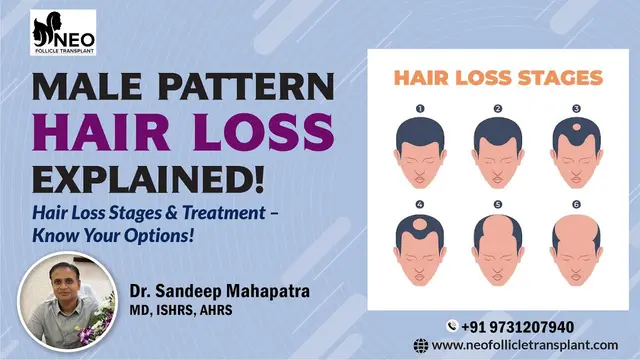
Male Pattern Hair Loss is a progressive form of hair thinning that usually follows a recognizable pattern.
It often starts with:
- Receding hairline
- Thinning at the temples
- Reduced density in the crown area
- Gradual widening of the bald area
- Eventually, merging of the frontal and crown baldness in advanced stages
Unlike sudden hair fall due to fever, stress, illness, crash dieting, or nutritional deficiencies, male pattern hair loss is usually slow and progressive.
You may first notice:
- More scalp visibility under bright light
- Hair becoming thinner in texture
- Hairline moving backward
- Crown appearing sparse in photographs
- Reduced styling volume
- More hair fall during shampooing or combing
However, the real problem is not just hair fall.
The real problem is hair miniaturization.
That means your thick, healthy hair gradually becomes thinner, shorter, weaker, and less visible over time.
The Science Behind Male Pattern Hair Loss: Genetics and DHT
To understand male pattern hair loss, we need to understand one key hormone:
DHT, or Dihydrotestosterone.
DHT is derived from testosterone. Testosterone itself is a normal male hormone and is important for many body functions.
The issue is not that DHT is “bad.”
The issue is that in genetically sensitive men, certain hair follicles become overly sensitive to DHT.
Think of your hair follicle like a small factory.
A healthy follicle produces thick, strong hair. But when that follicle is sensitive to DHT, the hormone slowly affects the factory’s productivity.
Over time:
- The hair growth cycle becomes shorter
- The hair strand becomes thinner
- The follicle becomes smaller
- The hair becomes weak and miniaturized
- Eventually, the follicle may stop producing visible hair
This is why some men lose hair on the front and crown but retain hair at the back and sides of the scalp.
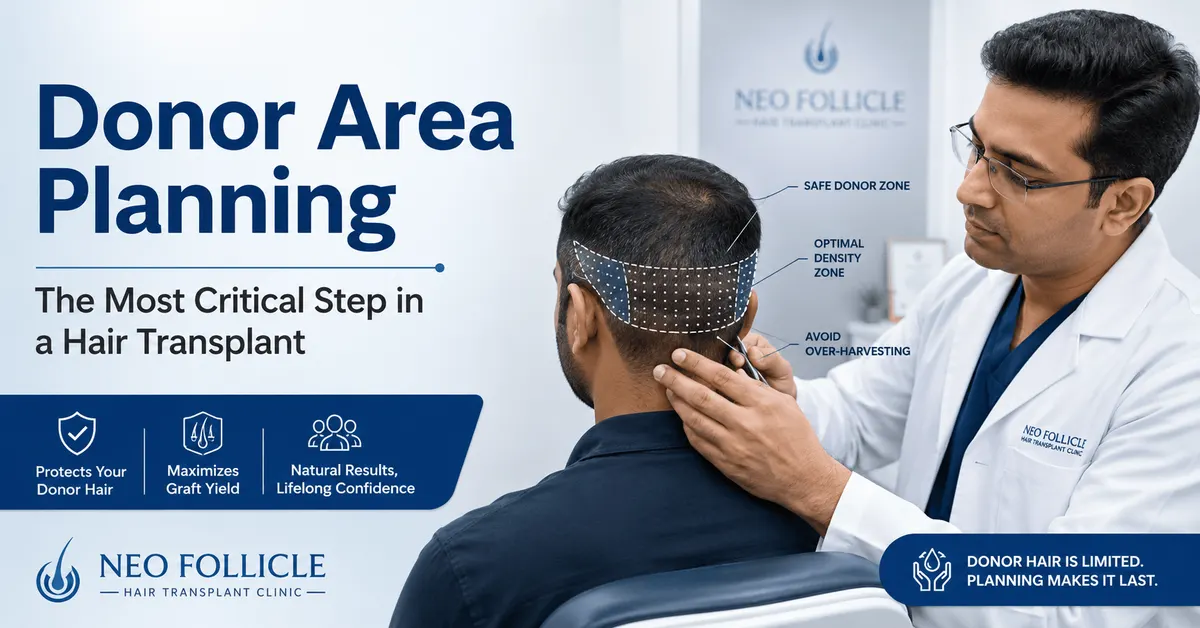
The follicles at the back and sides are usually more resistant to DHT. This is also why we use this donor area in hair transplant surgery.
A Simple Analogy
Imagine your scalp as a garden.
Some plants are strong and resistant. Others are sensitive to the environment.
In male pattern hair loss, DHT acts like a repeated stress signal to the sensitive plants. The plants do not disappear immediately. First, they become smaller. Their leaves become thinner. Their growth slows down.
Similarly, your hair does not vanish overnight.
It slowly becomes thinner, weaker, and less visible.
That is why early treatment matters so much.
When follicles are still alive but miniaturized, medical treatment can often help preserve and improve them.
But once follicles are completely inactive for a long time, medicines cannot magically recreate them.
Is Male Pattern Hair Loss Genetic?
Yes, genetics play a major role.
But genetics does not mean you must helplessly accept baldness.
It means you may have inherited follicle sensitivity to DHT.
You may notice hair loss patterns in:
- Father
- Mother’s side of the family
- Grandparents
- Brothers
- Maternal uncles
Sometimes patients tell me:
“Doctor, my father has full hair. So why am I losing hair?”
The answer is that hair loss inheritance is not always simple. It can come from either side of the family, and the pattern can vary from person to person.
Two brothers in the same family can have very different levels of hair loss.
One may have mild temple recession. Another may develop advanced baldness in his twenties.
That is why treatment should be personalized, not copied from a friend, influencer, or online forum.
Why Young Men in Bangalore Are Noticing Hair Loss Earlier
Many young professionals visiting my clinic from Whitefield, Electronic City, Bellandur, and Outer Ring Road often ask me:
“Doctor, is my work stress causing baldness?”
This is an important question.
Stress, poor sleep, long screen hours, irregular food habits, smoking, nutritional gaps, dandruff, and hard water may not directly cause genetic male pattern baldness.
But they can worsen overall hair health.
They may trigger additional hair shedding or make existing genetic hair loss appear faster.
In Bangalore, I commonly see young men dealing with:
- High-pressure tech jobs
- Long commutes on ORR
- Late-night work calls
- Poor sleep cycles
- Frequent food delivery and low-protein diets
- Hard water exposure
- Dandruff and scalp inflammation
- Gym supplements used without medical advice
- Crash dieting for weight loss
For men who are already genetically prone to hair loss, these lifestyle factors may add fuel to the fire.
That is why we do not treat hair loss only by looking at the scalp.
At Neo Follicle, we assess the pattern, stage, scalp condition, medical history, family history, lifestyle, and treatment expectations before recommending a plan.
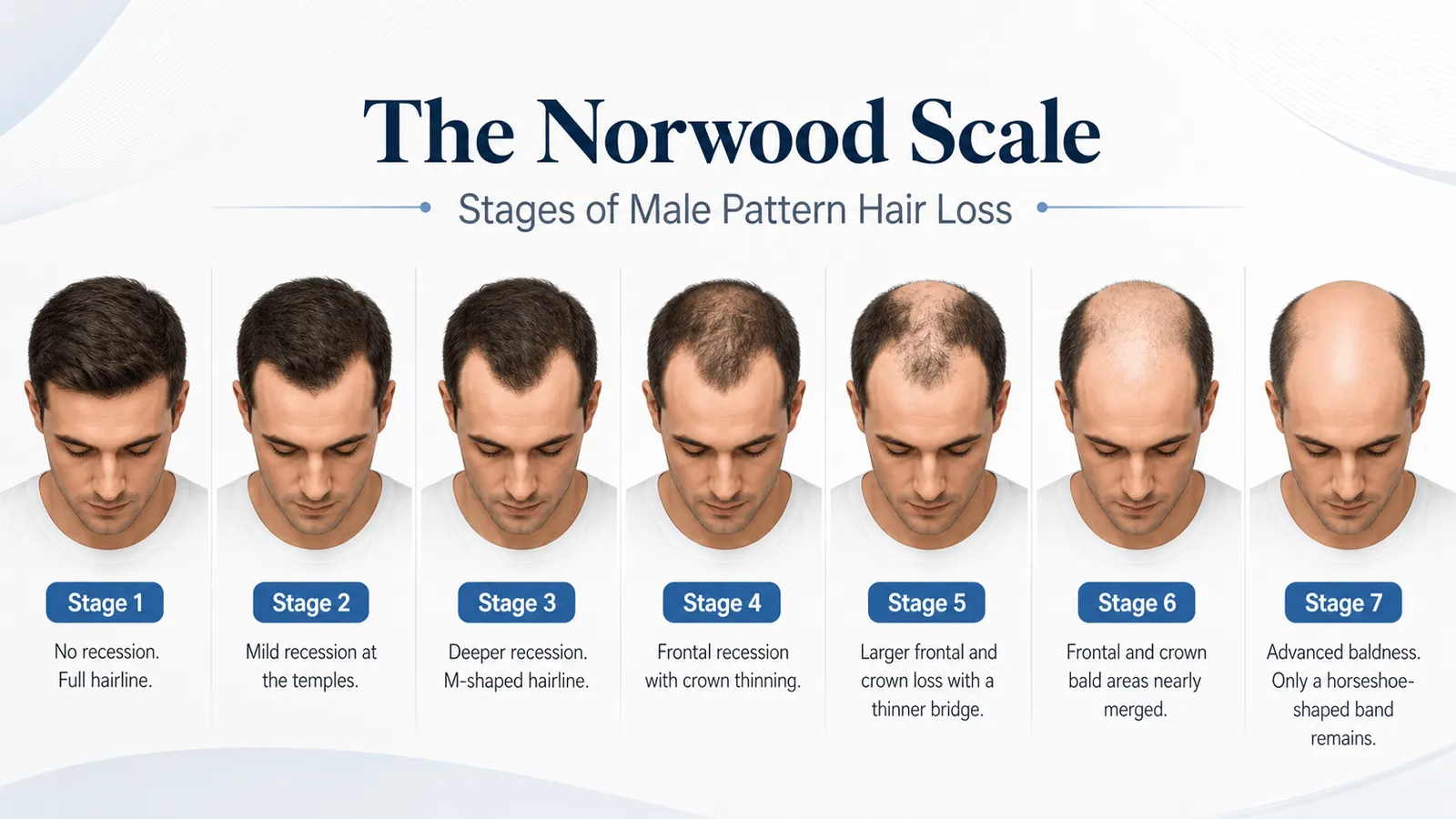
The Norwood Scale: Understanding the 7 Stages of Male Pattern Baldness
The Norwood Scale is a commonly used classification system to describe the stages of male pattern hair loss.
It helps doctors and patients understand how far hair loss has progressed.
Please remember: this is only a general guide. A dermatologist’s examination is still important.
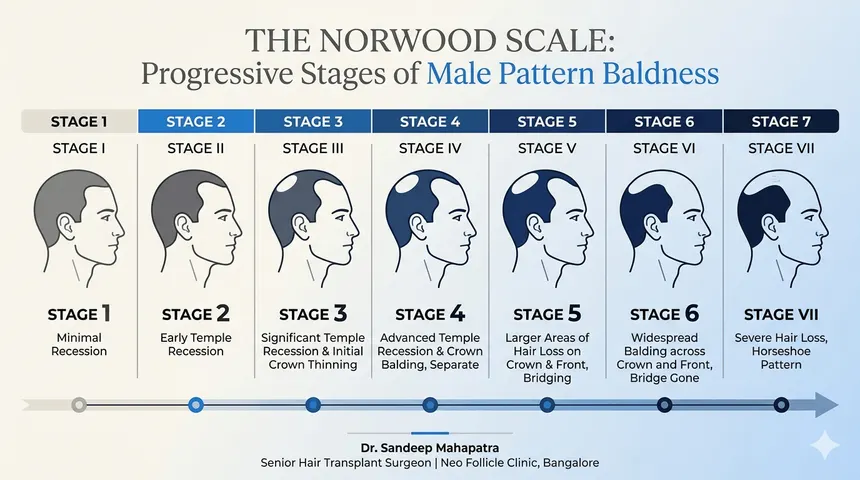
Stage 1: Minimal or No Visible Hair Loss
At this stage, the hairline is mostly intact.
There may be very slight recession, but it is often not noticeable.
Many men at Stage 1 do not need active treatment unless there is a strong family history or early signs of thinning.
What to do:
- Monitor your hairline
- Take photographs every 3 to 6 months
- Avoid self-medication
- Consult a dermatologist if you notice increased shedding or thinning
Stage 2: Early Hairline Recession
This is where many men first become concerned.
The temples may begin to move slightly backward. The hairline may form a mild “M” shape.
This stage is often called a mature hairline, but in some men it may be the beginning of male pattern hair loss.
What to do:
- Get an early diagnosis
- Consider medical treatment if miniaturization is seen
- Improve scalp health
- Avoid wasting time on home remedies
This is one of the best stages to intervene medically.
Stage 3: Noticeable Receding Hairline
At Stage 3, hairline recession becomes more visible.
The temple areas are deeper, and styling becomes more difficult.
Some men may also develop thinning at the crown. This is called Stage 3 Vertex.
What to do:
- Start structured medical management if suitable
- Consider PRP or GFC therapy if follicles are still active
- Track progress with clinical photographs
- Discuss long-term planning with a hair restoration specialist
At this stage, many men can still preserve a good amount of existing hair if they act early.
Stage 4: Advanced Front and Crown Thinning
In Stage 4, hair loss becomes more obvious.
There may be significant frontal recession along with crown thinning. A bridge of hair may still separate the front and crown areas.
This is the stage where many patients begin actively exploring hair transplant options.
What to do:
- Medical treatment may help stabilize existing hair
- PRP or GFC may support weaker follicles
- Hair transplant may be considered depending on donor area and goals
- A long-term plan is essential
A transplant without stabilization is not ideal because native hair may continue thinning.
Stage 5: Larger Bald Areas
Stage 5 shows more extensive hair loss.
The frontal and crown areas may be larger, and the bridge between them becomes thinner.
At this stage, medicines alone may not provide full cosmetic coverage.
What to do:
- Assess donor hair carefully
- Plan hairline design realistically
- Combine transplant with medical maintenance when needed
- Focus on natural density and age-appropriate results
In advanced stages, planning matters more than simply “adding grafts.”
Stage 6: Front and Crown Baldness Merge
In Stage 6, the frontal bald area and crown bald area join together.
The top of the scalp has significant hair loss, while the back and sides usually retain hair.
What to do:
- Hair transplant may be possible if donor area is strong
- Expectations must be realistic
- Coverage planning is important
- Multiple sessions may be needed in some patients
At Neo Follicle, we carefully assess the donor area before recommending surgery.
The goal is not just coverage.
The goal is natural, safe, and sustainable restoration.
Stage 7: Advanced Male Pattern Baldness
Stage 7 is the most advanced stage.
Only a band of hair remains at the back and sides of the scalp.
The donor area may be limited, so surgical planning must be very careful.
What to do:
- Detailed donor assessment is essential
- Full youthful density may not be possible
- Strategic coverage can still improve appearance in selected patients
- Beard or body hair may be considered in special cases, depending on suitability
At this stage, honest counselling is very important.
A good surgeon should tell you what is possible - and what is not.
Why Early Intervention Is the Key to Saving Existing Hair
One of the biggest mistakes men make is waiting too long.
They try oils, shampoos, home remedies, salon therapies, online supplements, and “guaranteed regrowth” products for months or years.
By the time they reach a dermatologist, many follicles have already miniaturized severely.
Please understand this clearly:
Hair follicles are easier to protect than to recreate.
If you come early, we may be able to preserve your existing hair with medical treatment.
If you wait until the area is completely bald, medicines may not bring back lost follicles. At that stage, hair transplant may become the main option.
Early consultation does not mean you need surgery.
In fact, early consultation often helps avoid or delay surgery.
Proven Treatment Options for Male Pattern Hair Loss
Treatment depends on your stage, age, family history, donor area, scalp condition, and expectations.
There is no single “best treatment” for everyone.
The right plan may include medical treatment, regenerative therapies, lifestyle correction, and in advanced cases, hair transplant.
1. Medical Management for Early Hair Loss
For early-stage male pattern hair loss, medical management is often the first line of treatment.
The aim is to:
- Slow down progression
- Reduce miniaturization
- Improve hair thickness
- Maintain existing hair
- Delay the need for surgery
Commonly used evidence-based treatments include topical minoxidil and oral medicines such as finasteride, when appropriate and prescribed by a qualified doctor.
These treatments should not be started casually.
They require proper diagnosis, counselling, dosage planning, monitoring, and follow-up.
Minoxidil
Minoxidil is commonly used as a topical treatment for male pattern hair loss.
It helps prolong the growth phase of hair and may improve hair thickness in suitable patients.
However, it must be used consistently.
Stopping treatment suddenly may lead to loss of maintained hair over time.
Finasteride
Finasteride works differently.
It reduces the conversion of testosterone to DHT, thereby reducing the DHT effect on sensitive hair follicles.
It may help slow down hair loss and improve density in selected men.
But it is a prescription medicine and should be taken only after medical consultation.
Not every patient needs it. Not every patient is suitable for it.
A dermatologist can explain benefits, risks, precautions, and alternatives based on your health profile.
2. PRP and GFC Therapy
PRP and GFC are regenerative therapies used to support hair growth in suitable patients.
They are not magic cures.
They do not create new follicles in completely bald areas.
But they may help improve the quality, thickness, and activity of existing weak follicles.
PRP Therapy
PRP stands for Platelet-Rich Plasma.
A small amount of your blood is taken, processed, and the platelet-rich portion is injected into the scalp.
Platelets contain growth factors that may support hair follicles.
GFC Therapy
GFC stands for Growth Factor Concentrate.
It is a more refined form of growth-factor-based therapy.
At Neo Follicle, we may recommend PRP or GFC in selected patients where follicles are still active and miniaturized.
These therapies often work best when combined with proper medical management.
They are not substitutes for diagnosis.
They are not replacements for transplant in advanced baldness.
3. FUE Hair Transplant for Advanced Hair Loss
When hair loss reaches an advanced stage and the follicles in the bald area are no longer active, medical treatment alone may not give enough visible coverage.
This is where hair transplant becomes an option.
FUE, or Follicular Unit Extraction, is a modern hair transplant technique where individual follicular units are extracted from the donor area, usually the back and sides of the scalp, and implanted into thinning or bald areas.
The transplanted hair is usually taken from DHT-resistant zones.
That is why it can continue to grow in the new area.
What a Hair Transplant Can Do
A well-planned hair transplant can:
- Rebuild a receding hairline
- Improve frontal density
- Cover crown baldness in selected cases
- Restore facial framing
- Improve styling confidence
- Create natural-looking results
What a Hair Transplant Cannot Do
A hair transplant cannot:
- Stop future genetic hair loss in untreated native hair
- Create unlimited density if donor hair is limited
- Replace poor planning with high graft numbers
- Give the same result to every patient
- Correct unrealistic expectations
This is why donor assessment, hairline design, graft planning, and long-term maintenance are so important.
At Neo Follicle, our focus is not just transplantation.
Our focus is safe, natural, ethical, and long-term hair restoration.
Beware of Internet Myths and “Miracle Cures”
I say this with warmth, but also with seriousness:
Please do not lose precious time chasing miracle cures.
Every week, I meet patients who have spent months or years on:
- Overnight hair growth oils
- Random online serums
- Salon “stem cell” treatments
- Unregulated scalp therapies
- Social media supplements
- Onion juice routines
- Expensive shampoos promising regrowth
- Influencer-based hair kits
- Devices without proper medical guidance
Some of these may improve scalp comfort or hair texture.
But they do not treat the root cause of male pattern hair loss.
They do not block the DHT-driven miniaturization process.
They do not revive completely inactive follicles.
The danger is not only money loss.
The bigger danger is time loss.
Male pattern hair loss is progressive. If you delay proper diagnosis, the window to save existing hair becomes smaller.
A simple rule:
If a treatment promises dramatic regrowth without diagnosis, photographs, scalp examination, or follow-up, be cautious.
Real hair restoration is medical.
It requires assessment, planning, patience, and monitoring.
When Should You See a Dermatologist?
You should consult a dermatologist if you notice:
- Receding hairline
- Crown thinning
- Sudden increase in hair fall
- Hair becoming thinner and weaker
- Scalp visibility under light
- Family history of baldness
- Dandruff with hair fall
- Patchy hair loss
- Itching, scaling, redness, or scalp pain
- Hair loss starting in your twenties or thirties
Do not wait for complete baldness.
A qualified dermatologist can check whether your hair loss is due to male pattern baldness or other causes such as telogen effluvium, dandruff, thyroid issues, nutritional deficiency, alopecia areata, or scalp disease.
Correct diagnosis is the foundation of correct treatment.
How We Approach Male Pattern Hair Loss at Neo Follicle
At Neo Follicle Hair Transplant Clinic in Bangalore, my approach is simple:
First diagnose. Then stabilize. Then restore if needed.
We do not recommend hair transplant to every patient.
Many early-stage patients benefit from medical treatment and regenerative therapy.
For advanced-stage patients, we evaluate whether a transplant is suitable.
Our assessment usually includes:
- Hairline evaluation
- Crown evaluation
- Donor area assessment
- Scalp examination
- Family history
- Age and progression pattern
- Previous treatments
- Lifestyle and medical history
- Photographic documentation
- Long-term planning
Whether you are a young software engineer from Whitefield, a founder from Indiranagar, a manager from Bellandur, a student from Jayanagar, or a professional working around ORR or Electronic City, the principle remains the same:
Your treatment should match your diagnosis, not your anxiety.
The Emotional Side of Hair Loss Matters
Many men hesitate to talk about hair loss because they feel embarrassed.
Some are told:
“It is just hair. Why are you so worried?”
But as a dermatologist and hair transplant surgeon, I know it is not “just hair” for many men.
Hair affects identity.
It affects age perception.
It affects confidence in meetings, relationships, photographs, and social situations.
Wanting to treat hair loss is not vanity.
It is a valid personal choice.
At the same time, treatment should be done safely, scientifically, and ethically.
My advice is this:
Do not panic.
Do not hide.
Do not self-treat endlessly.
Get clarity.
Once you know your stage and options, the fear reduces.
A clear diagnosis is often the first step toward emotional relief.
Final Thoughts: Male Pattern Hair Loss Is Manageable
Male pattern hair loss is common, progressive, and deeply personal.
But it is also manageable when approached correctly.
If you are in the early stages, medical treatment may help preserve your existing hair.
If your follicles are weak but still active, PRP or GFC may support improvement.
If you have advanced baldness, FUE hair transplant may help restore natural-looking coverage when planned carefully.
The most important step is not choosing a product.
The most important step is choosing the right diagnosis.
At Neo Follicle Hair Transplant Clinic in Bangalore, my team and I are here to guide you with medical honesty, empathy, and long-term planning.
You do not have to fight hair loss alone.
And you certainly do not have to feel ashamed about seeking help.
FAQs on Male Pattern Hair Loss
Does stress or Bangalore’s hard water cause Male Pattern Baldness?
Stress and hard water do not directly cause genetic male pattern baldness.
Male pattern baldness is mainly caused by genetic sensitivity to DHT.
However, stress, poor sleep, nutritional deficiency, dandruff, and hard water exposure can worsen hair shedding, scalp health, and hair quality.
Many patients from Marathahalli, Whitefield, Bellandur, ORR, and Electronic City experience lifestyle-related shedding along with genetic thinning.
So the answer is: stress and hard water may worsen the situation, but they are usually not the root cause of male pattern baldness.
A dermatologist can help identify whether you have genetic hair loss, temporary shedding, dandruff-related hair fall, or a combination of factors.
Can Male Pattern Hair Loss be reversed permanently without surgery?
Early male pattern hair loss can often be controlled and improved with medical treatment.
But “permanent reversal” without ongoing treatment is not realistic in most genetic cases.
Medicines and therapies can help maintain existing hair and improve miniaturized follicles while treatment continues.
If the area is completely bald and follicles are inactive, medicines usually cannot recreate new follicles.
In such cases, hair transplant may be required for visible restoration.
The best results often come from early diagnosis and long-term treatment planning.
Are there any permanent side effects to medical hair loss treatments?
Most patients tolerate medical hair loss treatments well when they are properly prescribed and monitored.
However, like all medicines, treatments such as minoxidil or finasteride may have side effects in some individuals.
That is why these should not be started blindly based on online advice.
Before prescribing treatment, we consider your age, medical history, expectations, risk factors, and comfort level.
If side effects occur, the treatment plan can often be adjusted or stopped under medical supervision.
The safest approach is to consult a qualified dermatologist, understand the benefits and risks clearly, and follow up regularly.
At what stage of hair loss should I consider a transplant at Neo Follicle?
A hair transplant is usually considered when hair loss is visibly advanced, the bald area has poor follicle activity, and the donor area is strong enough to support restoration.
Many patients begin discussing transplant options around Norwood Stage 3, Stage 4, or beyond, depending on their pattern and expectations.
However, not every Stage 3 patient needs surgery immediately.
Some patients may first need medical stabilization.
At Neo Follicle, we assess your hairline, crown, donor area, age, progression, and future hair loss risk before recommending transplant.
The right time for transplant is not decided by stage alone.
It is decided by medical suitability, donor strength, long-term planning, and your personal goals.
Blog Author & Medical Reviewer

Written by: Dr. Sandeep Mahapatra
Senior Dermatologist, Hair Transplant Surgeon & Founder – Neo Follicle Hair Transplant Clinic, Bangalore
Dr. Sandeep Mahapatra is a senior dermatologist and hair transplant surgeon in Bangalore with extensive experience in hair restoration, dermatology, and aesthetic treatments. As the founder of Neo Follicle Hair Transplant Clinic, he has successfully performed over 10,000 hair transplant procedures and regularly guides patients on safe, ethical, and natural-looking hair restoration.
Medically reviewed by: Dr. Sandeep Mahapatra
Senior Dermatologist & Hair Transplant Surgeon
This article has been medically reviewed by Dr. Sandeep Mahapatra to ensure that the information is clinically accurate, patient-friendly, and aligned with safe hair transplant practices. The content is intended for educational purposes and should not replace a personal consultation with a qualified hair transplant surgeon.
References
This article has been prepared using clinical experience, patient consultation insights, and guidance from respected medical and hair restoration sources.
NCBI Bookshelf – Androgenetic Alopecia
https://www.ncbi.nlm.nih.gov/books/NBK430924/
International Society of Hair Restoration Surgery – Androgenetic Alopecia Guide
https://ishrs.org/androgenetic-alopecia/
Mayo Clinic – Hair Loss Diagnosis and Treatment
https://www.mayoclinic.org/diseases-conditions/hair-loss/diagnosis-treatment/drc-20372932
PMC / NIH – Treatment Options for Androgenetic Alopecia
https://pmc.ncbi.nlm.nih.gov/articles/PMC9298335/
PubMed – Effectiveness of Treatments for Androgenetic Alopecia
https://pubmed.ncbi.nlm.nih.gov/28396101/
Share this article :