Blog Summary: Donor area planning is the most critical step in a safe hair transplant because donor hair is limited and does not grow back once extracted. Poor planning or over-harvesting can permanently thin the back of the scalp. At Neo Follicle Hair Transplant Clinic in Bangalore, Dr Sandeep Mahapatra plans graft use carefully for long-term natural results.
Introduction – Donor Area Planning Matters in Hair Transplant
Hair transplant surgery is not just about adding hair.
It is about protecting hair.
That is the first thing I explain to every patient who visits Neo Follicle Hair Transplant Clinic in Bangalore.
Most patients focus on the bald area.
They ask: “How many grafts do I need?”
“Can I get full coverage?”
“Can I get dense hair in one sitting?”
These are valid questions. But as a hair transplant surgeon, my first focus is different. I look at the donor area.
The donor area is the foundation of the entire transplant. If it is planned well, the result can look natural for years.
If it is damaged, the problem can become permanent. That is why I always say this clearly:
A successful hair transplant begins at the back of the head. Not at the hairline. Not at the crown. Not at the bald patch.
It begins with donor area planning.
What Is the Donor Area?
The donor area is the region from where hair grafts are taken.
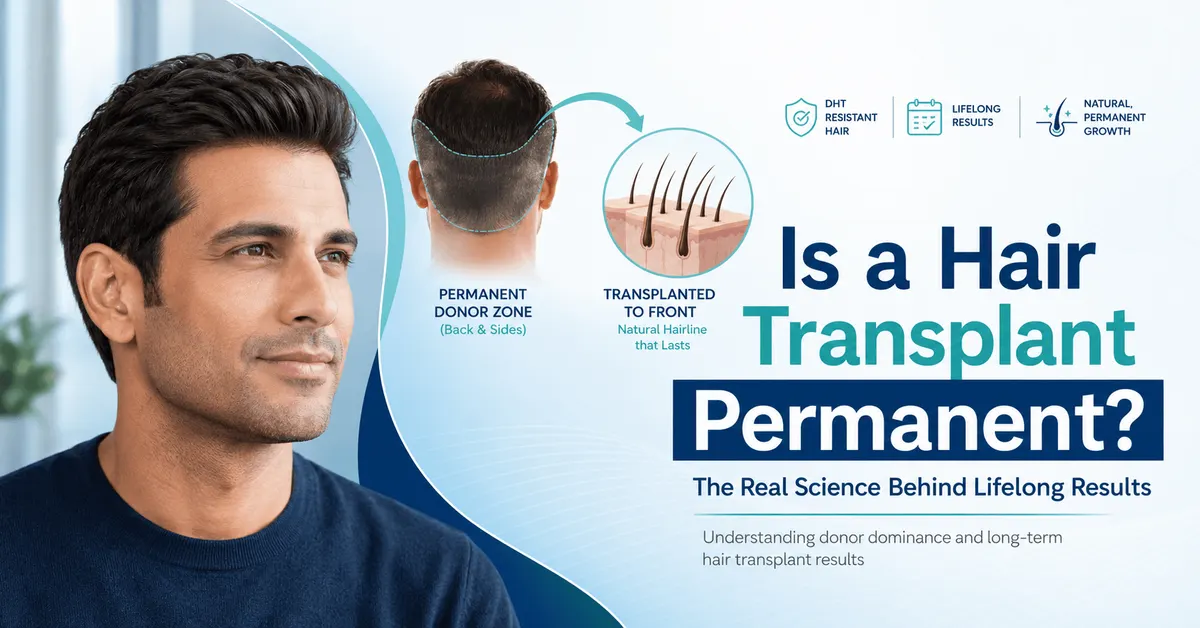
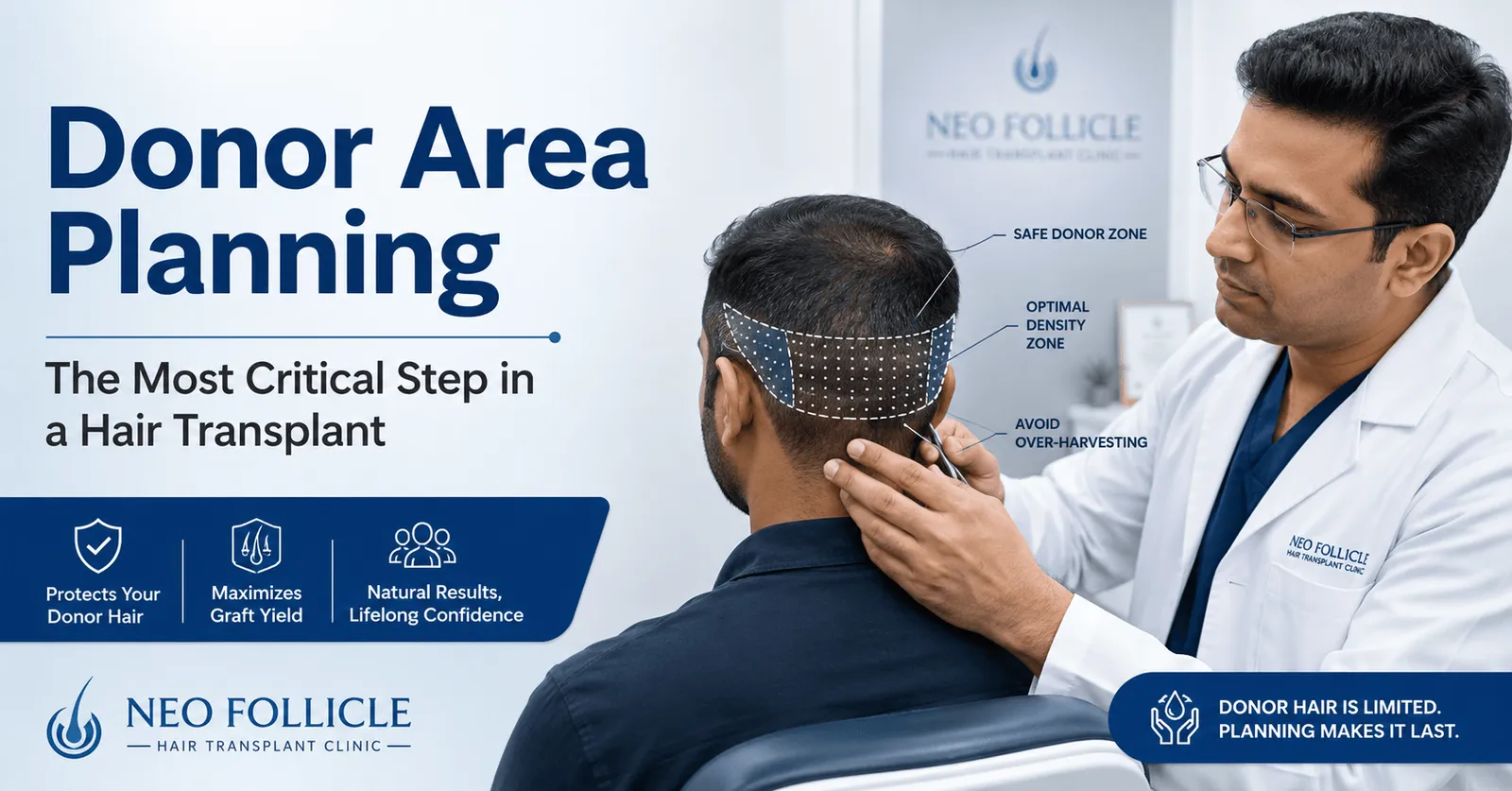
In most patients, this is the back and sides of the scalp. This area is called the safe donor zone.
Hair in this zone is usually more resistant to genetic hair loss. That is why these grafts are used for transplantation.
When these grafts are moved to the bald area, they continue to grow.
This is the basic principle of hair transplantation.
But there is one very important truth.
The donor area is not unlimited. It is finite. It is precious. It is non-renewable.
Once a graft is extracted, it does not grow back in the donor area.
This is the point many patients do not know. And unfortunately, some clinics do not explain it clearly.
Donor Hair Does Not Regrow After Extraction
Let me explain this simply.
A hair graft contains the root. When we extract that graft, we remove it permanently.
That graft can grow in the transplanted area. But the original donor spot remains empty.
The surrounding hair may cover that tiny empty space. That is why a well-planned extraction looks normal.
But if too many grafts are taken, the camouflage is lost. The scalp starts showing through.
The back of the head looks thin. Sometimes it looks patchy. Sometimes it looks scarred. Sometimes it looks permanently damaged.
This is called over-harvesting. And in many cases, it is avoidable.
Why Donor Planning Matters More Than Graft Numbers
Many patients come to my Marathahalli clinic from Whitefield, Bellandur, Sarjapur Road, HSR Layout, Electronic City, Indiranagar, and Koramangala.
Many are working professionals. They are busy. They want a quick solution. Some bring quotes from other clinics.
The quote may say:
“5,000 grafts in one sitting.”
“Maximum coverage guaranteed.”
“Unlimited grafts.”
“Mega session at low cost.”
I understand why this sounds attractive.
But I always pause the consultation. Then I explain the medical reality.
The question is not: “How many grafts can we remove?”
The correct question is: “How many grafts can we safely remove?”
That word matters.
Safely.
A good surgeon does not chase graft numbers. A good surgeon protects the donor area.
The Donor Area Must Last a Lifetime
Hair loss is usually progressive.
A young patient may come with frontal hair loss today. But crown thinning may happen later. Mid-scalp thinning may progress later.
The hairline may need refinement later. The patient may need another session later.
This is why lifetime planning is essential.
I never plan only for today. I plan for the next 10, 20, or 30 years.
A hair transplant should not solve one problem today and create a bigger problem tomorrow.
That is why donor area planning must include:
- Current baldness grade
- Age of the patient
- Family history
- Donor density
- Hair shaft thickness
- Scalp laxity
- Future hair loss risk
- Medical treatment response
- Crown involvement
- Beard or body hair availability
This is not guesswork. This is surgical planning.
The Biggest Mistake: Using Too Many Grafts Too Early
One common mistake is aggressive early harvesting. This happens often in young patients.
A 24-year-old may want a low, dense hairline.
A commercial clinic may promise it. They may take too many grafts. The result may look good for one year.
But hair loss continues. By age 30 or 35, the patient may lose more native hair.
Now he needs more grafts. But the donor area is already depleted.
This creates a difficult situation.
The front looks transplanted. The mid-scalp looks empty. The crown looks thin.
The donor area looks patchy. Repair becomes complex. Sometimes repair is limited.
That is why I prefer conservative, intelligent planning. Especially in younger patients.
What Is Over-Harvesting?
Over-harvesting means removing too many grafts.
It may happen in one large session. It may also happen across multiple sessions.
The donor area becomes visibly thin. The scalp starts showing. The back of the head may look uneven.
This is sometimes described as a moth-eaten appearance. It can look like small empty patches.
It can also look like see-through scalp. This is not a minor cosmetic issue. It can affect confidence deeply.
Patients may feel afraid to cut hair short. They may avoid bright light. They may feel embarrassed from the back. Some wear caps constantly.
This is why donor safety is critical.
Why Over-Harvesting Can Be Permanent
The donor area has limited grafts. Once those grafts are removed, they are gone.
If too many are extracted, density drops. The surrounding hair cannot cover the gaps.
The damage becomes visible. In some cases, scars also become visible.
Repair may be possible. But full reversal is not always possible.
That is the difficult truth. I tell patients this clearly.
The best repair is prevention.
The “See-Through” Scalp Effect
A healthy donor area has balanced density.
Light does not pass through easily. Hair overlaps naturally. The scalp stays camouflaged.
But when extraction is excessive, balance is lost. The donor area becomes transparent.
Light reflects from the scalp. The head looks sparse from behind.
This is the see-through effect. It becomes worse with short haircuts.
It becomes more visible under harsh lighting. It becomes obvious in photographs.
This is why I plan extraction patterns carefully.
I do not remove grafts randomly. I do not create empty zones. I do not chase numbers blindly.
Why Trichoscopy Is Essential Before Surgery
At Neo Follicle Hair Transplant Clinic, donor assessment is not casual. We do not just look at the scalp.
We examine it properly. Trichoscopy helps us study the donor area closely.
It allows us to evaluate:
- Donor density
- Follicular unit count
- Hair shaft thickness
- Miniaturization
- Scalp condition
- Safe donor zone quality
- Extraction feasibility
- Risk of poor healing
This examination matters.
A patient may appear to have good hair. But trichoscopy may show weak donor quality.
Some patients have diffuse thinning. Some have miniaturization in the donor area. Some have poor donor density. Such patients need careful counselling.
Sometimes surgery must be delayed. Sometimes medical treatment comes first.
Sometimes the plan must be reduced. Sometimes surgery is not advisable.
Saying “no” is also ethical medicine.
The Danger of “Unlimited Grafts”
Please be very careful with this phrase. There is no such thing as unlimited grafts.
Every patient has a biological limit. The donor area has a safe capacity. Crossing that capacity is dangerous.
A clinic promising unlimited grafts is not respecting anatomy.
It is selling hope. Not medical planning.
I strongly advise patients to be cautious of claims like:
- Unlimited grafts
- Maximum grafts guaranteed
- Full head coverage in one sitting
- 5,000 to 6,000 grafts for everyone
- No need for donor testing
- Technician-led extraction
- Same package for every patient
- Very low-cost mega sessions
A hair transplant is not a commodity. It is a medical procedure.
It should never be sold like a discount package.
Why Unsupervised or Poorly Planned Graft Extraction Is Risky
Graft extraction is one of the most sensitive steps in a hair transplant.
It is not a mechanical process. It requires planning, training, angle control, depth control, and constant monitoring.
At Neo Follicle Clinic, graft extraction is performed by trained hair transplant technicians under my direct surgical planning and supervision.
This distinction is very important.
Technician assistance is common in hair transplant surgery.
But the surgeon must remain responsible for the medical plan.
The surgeon must decide:
- The safe donor zone
- The number of grafts to extract
- The extraction pattern
- The punch size
- The spacing between extractions
- The density that must be preserved
- When to stop extraction
The danger begins when extraction is done blindly.
Or without proper donor mapping.
Or without surgeon supervision.
Or only to meet a promised graft number.
That is when donor damage can happen.
Poorly planned extraction can lead to:
- Graft transection
- Damage to nearby follicles
- Patchy donor thinning
- Uneven extraction zones
- Visible donor scars
- Permanent see-through scalp
This is why I caution patients against clinics where graft extraction is treated like a high-speed production line.
The issue is not whether a technician assists. The issue is whether the procedure is medically planned, supervised, and controlled by an experienced surgeon.
At Neo Follicle Clinic, my responsibility is to protect your donor area.
My team follows a planned extraction map. We avoid over-concentrated harvesting.
We preserve spacing. We monitor graft quality. We respect the donor limit.
Because every graft removed must be justified. And every graft left behind protects your future.
What Is Graft Transection?
A graft is delicate. It must be removed with precision.
If the punch angle is wrong, the root can be cut. That graft may not grow well. This is called transection.
Transection wastes donor hair. And donor hair is precious.
It is like losing capital permanently.
A good transplant uses grafts wisely. A poor transplant wastes grafts.
This is why low-cost surgery can become expensive later. Not financially alone. Emotionally too.
The Right Way to Plan Donor Extraction
Good donor planning is systematic. It is not guesswork.
My team and I consider:
1. The Safe Donor Zone
We identify stable donor regions. We avoid risky zones. We avoid areas likely to thin later.
2. Donor Density
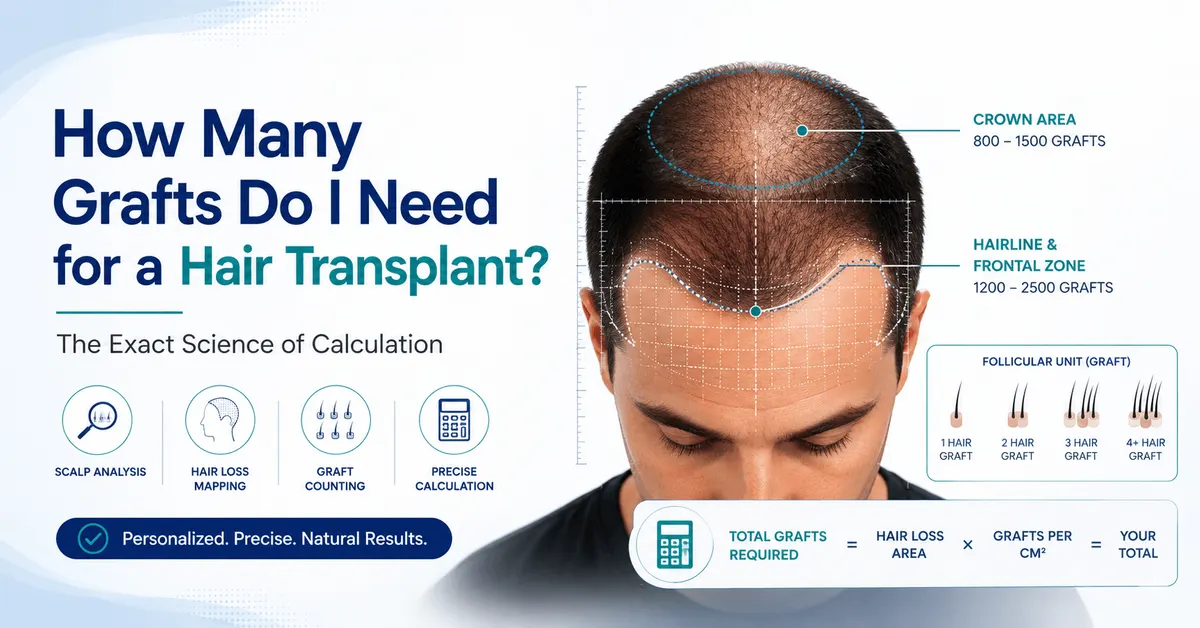
We calculate available follicular units. Not every patient has the same capacity.
3. Hair Thickness
Thicker hair gives better coverage. Fine hair may need different planning.
4. Baldness Stage
Advanced baldness needs conservative graft use. Hairline, mid-scalp, and crown must be balanced.
5. Future Hair Loss
We preserve reserve grafts. This is essential in younger patients.
6. Extraction Pattern
Grafts must be spread evenly. Concentrated harvesting creates visible thinning.
7. Medical Treatment Plan
Stabilizing hair loss matters. Surgery alone is not always enough.
Why Crown Coverage Needs Extra Caution
The crown is graft-hungry. It can consume many grafts.
But it may not provide dramatic visual impact.
The frontal hairline frames the face.
The mid-scalp adds density.
The crown is visible from above.
So, planning must be balanced.
In advanced baldness, I often prioritize:
- Natural hairline
- Frontal framing
- Mid-scalp coverage
- Conservative crown blending
This gives a better long-term result. It also protects donor supply.
Trying to fill everything densely may be unsafe. Especially in one session.
Multi-Source Harvesting in Advanced Baldness
Some patients have advanced baldness. Their scalp donor area may not be enough.
In such cases, we may consider other sources.
These include:
- Beard hair
- Chest hair
- Body hair
This is called body hair transplantation.
Beard hair can be useful. It is often thicker. It can add volume. It is commonly used for mid-scalp support.
Chest or body hair may be used selectively. But body hair is not identical to scalp hair.
It has different texture. It has different growth cycles. It must be used carefully. It should support the result.
It should not replace artistic planning.
How Beard Hair Helps Preserve Scalp Donor Density
In selected patients, beard hair is very valuable. It can reduce pressure on scalp donor hair.
This is useful in advanced Norwood stages. It is also useful in repair cases.
For example:
A patient may need 4,000 grafts. But the scalp donor can safely give only 2,500.
In such cases, beard grafts may help. They can be blended strategically.
This preserves scalp donor balance. It also improves total coverage.
But patient selection is important. Not everyone is suitable.
Donor Planning for Bangalore Professionals
Many patients I see are from Bangalore’s busy professional hubs.
They work in Whitefield tech parks. They commute from Bellandur. They come from Marathahalli and Sarjapur Road. Some travel from Electronic City. Some visit from Indiranagar, Koramangala, and HSR Layout.
Most want minimal downtime. They want natural results. They want long-term safety.
I understand that.
But I always tell them one thing. Speed should not replace safety.
A fast transplant is not always a good transplant.
A large session is not always a better session.
A responsible plan may look conservative. But it protects your future.
Questions Every Patient Should Ask
Before choosing a clinic, ask these questions.
They can protect you.
- Will my donor area be checked by trichoscopy?
- What is my safe donor capacity?
- How many grafts can be safely removed?
- Who will extract the grafts?
- Will the surgeon be involved?
- What is my future hair loss risk?
- Will some donor hair be preserved?
- Is beard hair needed?
- What happens if I need another transplant later?
- Can I see similar long-term cases?
If a clinic avoids these questions, be careful.
If they only discuss price, be careful.
If they promise unlimited grafts, be careful.
If they rush you, be careful.
My Ethical Approach at Neo Follicle
At Neo Follicle Hair Transplant Clinic, I believe in safe restoration.
Not aggressive harvesting. Not false promises. Not short-term density at any cost.
My responsibility is not only to create hair growth. It is to protect your scalp.
Your donor area must remain healthy. Your result must age naturally.
Your future options must remain open.
That is why I may sometimes say:
“You need fewer grafts.”
“Let us stage the procedure.”
“Let us first stabilize hair loss.”
“Let us not lower the hairline too much.”
“Let us preserve donor grafts for future needs.”
These answers may not sound glamorous.
But they are honest. And honesty matters in hair transplant surgery.
The Final Message
Your donor hair is limited. It does not grow back after extraction.
It must be planned carefully. It must be protected surgically.
A successful hair transplant is not about taking maximum grafts.
It is about using the right grafts. In the right areas. At the right time. With the right long-term plan.
If you are considering a hair transplant in Bangalore, do not begin with the question of cost alone.
Begin with donor safety.
Ask if your donor area is strong enough.
Ask how many grafts can be safely removed.
Ask who will perform the extraction.
Ask what happens ten years later.
Because a hair transplant is not only about today. It is about your lifetime appearance.
And your donor area is the key.
FAQs on Donor Area Planning in Hair Transplant
Does hair grow back in the donor area after it is extracted?
No. Once a graft is extracted, it does not regrow in that donor spot. The transplanted graft may grow in the recipient area. But the donor site loses that graft permanently. This is why donor planning is critical.
A safe extraction pattern allows surrounding hair to cover the tiny gaps. But excessive extraction can create visible thinning.
How can a surgeon test if my donor area is strong enough for a transplant?
A surgeon should examine your donor area clinically.
Trichoscopy is also very useful. It helps assess donor density, follicular unit count, hair shaft thickness, and miniaturization. It also helps identify weak donor zones.
At Neo Follicle Transplant Clinic, we do not plan graft numbers blindly. We assess donor strength before recommending surgery.
What is a moth-eaten appearance?
A moth-eaten appearance means patchy donor thinning. The back of the scalp may look uneven. Small empty-looking areas may become visible. The scalp may show through.
This usually happens due to over-harvesting. It can also happen due to poor extraction technique.
In some cases, repair is possible. But complete reversal may not always be possible. Prevention is always better.
Can an over-harvested donor area be repaired?
Sometimes, yes.
But repair depends on the damage. Options may include camouflage grafting, beard hair support, scalp micropigmentation, or hairstyle changes.
But results vary. A severely depleted donor area is difficult to restore fully.
That is why choosing the right surgeon first matters.
Can beard or chest hair be used if my scalp donor area is depleted?
Yes, in selected patients.
Beard hair can be useful in advanced baldness. It can also help in repair cases.
Chest or body hair may be used selectively. But body hair is different from scalp hair.
It has different texture and growth behavior. It must be used carefully.
A skilled surgeon blends it strategically.
Is taking more grafts always better?
No. More grafts do not always mean better results.
Unsafe harvesting can damage the donor area permanently.
A good hair transplant uses the correct number of grafts.
The goal is natural coverage and long-term safety. Not maximum extraction.
Why do some clinics promise 5,000 grafts in one session?
Some clinics use large graft numbers as a selling point. But every patient has a different donor capacity.
A 5,000-graft session may be safe for one patient. It may be dangerous for another.
The decision must be based on donor assessment. Not marketing claims.
What should I check before choosing a hair transplant clinic?
Check these points carefully:
- Proper donor area examination
- Trichoscopy-based planning
- Surgeon involvement
- Transparent graft calculation
- Long-term hair loss planning
- Ethical counselling
- No false “unlimited graft” claims
- Clear explanation of risks
- Realistic coverage expectations
Your donor area is your lifelong resource. Choose a clinic that protects it.
Blog Author & Medical Reviewer
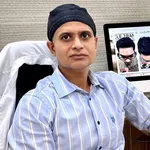
Written by: Dr. Sandeep Mahapatra
Senior Dermatologist, Hair Transplant Surgeon & Founder – Neo Follicle Hair Transplant Clinic, Bangalore
Dr. Sandeep Mahapatra is a senior dermatologist and hair transplant surgeon in Bangalore with extensive experience in hair restoration, dermatology, and aesthetic treatments. As the founder of Neo Follicle Hair Transplant Clinic, he has successfully performed over 10,000 hair transplant procedures and regularly guides patients on safe, ethical, and natural-looking hair restoration.
Medically reviewed by: Dr. Sandeep Mahapatra
Senior Dermatologist & Hair Transplant Surgeon
Date Reviewed: 2026-06-25
This article has been medically reviewed by Dr. Sandeep Mahapatra to ensure that the information is clinically accurate, patient-friendly, and aligned with safe hair transplant practices. The content is intended for educational purposes and should not replace a personal consultation with a qualified hair transplant surgeon.
References:
- International Society of Hair Restoration Surgery (ISHRS) – FUE Hair Transplant Overview
URL: https://ishrs.org/fue-what-is-it/ - ISHRS – Surgical Treatments for Hair Loss
URL: https://ishrs.org/patients/treatments-for-hair-loss/surgical-treatments/ - FUE Clinical Practice Guidelines – ISHRS PDF
URL: https://ishrs.org/wp-content/uploads/2019/08/July-15-2019-FUE-Guidelines.pdf - Effect of Follicular Unit Extraction on the Donor Area – PMC / NIH
URL: https://pmc.ncbi.nlm.nih.gov/articles/PMC6066700/ - Assessment of Safe Donor Zone of Scalp and Beard for Hair Transplantation – PMC / NIH
URL: https://pmc.ncbi.nlm.nih.gov/articles/PMC6484564/
Share this article :