Blog Summary: GFC, Exosome and QR678 are advanced non-surgical hair loss treatments, but the best choice depends on your stage of thinning and follicle activity. They work by sending growth signals to weak, living follicles, not dead bald areas. Consult Dr Sandeep Mahapatra at Neo Follicle Hair Transplant Clinic in Bangalore for diagnosis-based guidance.
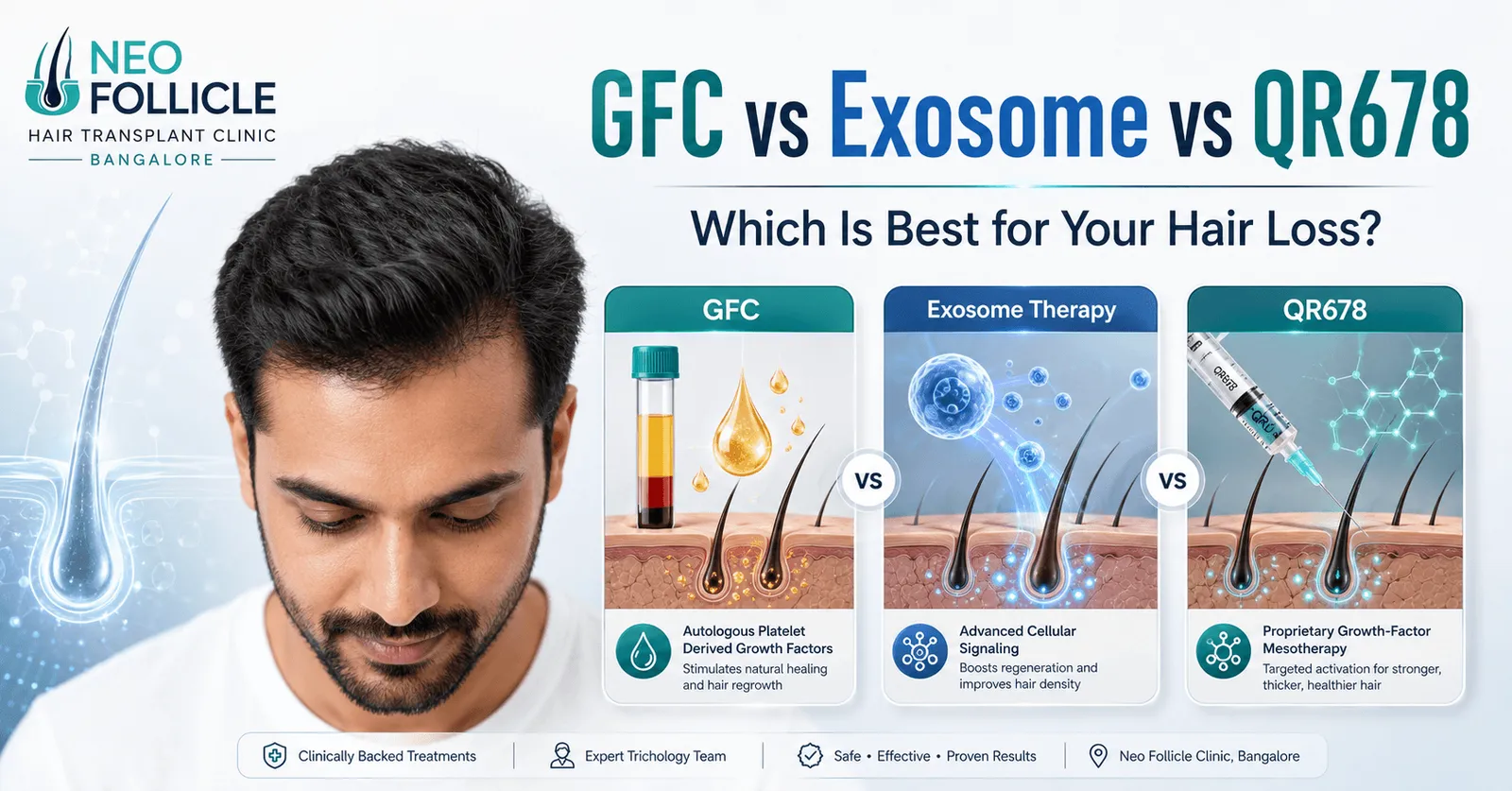
GFC vs. Exosome vs. QR678 Hair Treatment: Which Is Best for Your Hair Loss?
Hair loss is no longer treated with one standard solution.
Today, we have advanced regenerative treatments. These include GFC, Exosome therapy, and QR678. Each works differently. Each has a different biological source. Each suits a different stage of hair thinning.
At Neo Follicle Hair Transplant Clinic in Bangalore, I often meet patients from Marathahalli, Whitefield, Bellandur, Outer Ring Road, HSR Layout, Koramangala, Indiranagar, and Electronic City. Many are busy IT professionals.
They want a fast, scientific, zero-downtime treatment. They want to stop hair fall without affecting work, meetings, or travel.
But they also feel confused.
“Doctor, is Exosome better than GFC?”
“Is QR678 stronger than PRP?”
“Can these treatments avoid a hair transplant?”
These are important questions.
As a dermatologist and hair transplant surgeon, my answer is simple. No treatment is “best” for everyone. The best treatment depends on your diagnosis, stage of hair loss, donor area, scalp health, age, hormones, nutrition, and expectations.
In this blog, I will explain GFC, Exosome therapy, and QR678 in a simple, honest, and scientific way.
My goal is not to promote one treatment blindly. My goal is to help you choose wisely.
First, Understand the Hair Follicle Problem
Hair loss is not just a surface problem.
The hair follicle is a living mini-organ. It has blood supply, stem cell activity, growth signals, immune balance, and hormonal sensitivity.
In early thinning, the follicle is still alive. It becomes weak, thin, and slow. I often compare it to a tired factory. The machines are still present. But the power supply is weak. The workers are inactive. Production is low.
Regenerative treatments try to restart this factory.
They send biological signals. These signals may improve blood supply, reduce inflammation, support follicle cells, and prolong the growth phase.
But there is one important truth.
If the follicle is completely dead, no injection can bring it back.
In advanced baldness, where the scalp is shiny and follicles are absent, a hair transplant remains the gold standard. GFC, Exosome therapy, and QR678 can support existing follicles. They cannot create new follicles from nothing.
This distinction is critical.
What Is GFC Hair Treatment?
GFC stands for Growth Factor Concentrate.
It is an advanced platelet-derived treatment. It uses your own blood. That makes it autologous, meaning it comes from your own body.
In a GFC session, a small blood sample is taken. It is processed in a specialized GFC kit. The goal is to extract a pure, highly concentrated growth factor solution from your platelets.
Unlike traditional PRP, GFC is usually designed to produce a cleaner and more acellular serum. This means fewer unwanted cells. It is rich in useful platelet-derived growth factors.
These growth factors act like repair instructions.
They do not force hair to grow magically. They support weak follicles. They improve the follicle environment. They may reduce shedding and improve thickness in selected patients.
How GFC Works
Platelets contain natural growth factors. These include signals that help healing, tissue repair, and blood vessel support.
When injected into the scalp, GFC delivers these signals near weakened follicles.
Think of GFC like giving your scalp a concentrated dose of your own repair messengers.
The body recognizes these signals because they are yours. That is why GFC has a very strong safety profile. Since it comes from your own blood, the risk of allergy is extremely low.
Who Benefits Most from GFC?
GFC works best when follicles are weak but alive.
I usually consider it for:
Early male pattern hair loss
Female pattern hair thinning
Diffuse hair fall
Post-illness shedding
Post-transplant maintenance
Patients needing safer biological stimulation
Many professionals from Whitefield, ORR, and Bellandur choose GFC because it is quick. Most sessions are short. There is minimal downtime. You can return to work the same day.
Limitations of GFC
GFC is not a miracle treatment.
It may not work well in advanced bald areas. It also needs proper diagnosis. If hair loss is due to thyroid disease, iron deficiency, autoimmune disease, severe dandruff, or medication side effects, we must treat the cause.
GFC supports follicles. It does not replace medical evaluation.
What Is Exosome Hair Therapy?
Exosome therapy is one of the most discussed areas in regenerative medicine.
Exosomes are tiny extracellular vesicles. You can imagine them as microscopic courier packets. Cells use them to communicate with other cells.
These packets may carry proteins, lipids, growth factors, mRNA, microRNA, and other signaling molecules.
In hair restoration, exosomes are used for their potential to send strong regenerative signals to the scalp.
The aim is to wake up tired follicles. The treatment may help reduce inflammation, improve follicle signaling, and support hair growth pathways.
How Exosome Therapy Works
If GFC is like using your own repair signals, exosome therapy is like delivering advanced cellular messages from an external source.
Many exosome products are derived from purified cellular sources, often linked to mesenchymal stem cell technology. The final product should not contain live stem cells. Instead, it contains the communication vesicles released by cells.
These vesicles may influence follicle cells. They may support dermal papilla activity. They may help the scalp microenvironment.
This is why exosome therapy is often called a next-generation regenerative treatment.
Why Patients Ask About Exosomes
Many patients come to my Marathahalli clinic after reading about exosomes online. They want something stronger, faster, and more advanced than PRP or GFC.
Some are corporate leaders from Indiranagar and Koramangala. Some are IT professionals from Electronic City or Outer Ring Road. They want visible improvement without surgery.
Exosome therapy is attractive because sessions are quick. Downtime is minimal. The concept is scientifically exciting.
But excitement must be balanced with caution.
The Biggest Safety Concern with Exosomes
Not all exosome products are equal.
This is very important.
There are many unverified exosome brands in the market. Some have poor documentation. Some may not have proper quality control. Some may be counterfeit. Some may be marketed with exaggerated claims.
With exosome therapy, product sourcing matters deeply.
Sterility matters. Storage matters. Cold chain matters. Batch quality matters. Regulatory documentation matters.
At Neo Follicle Hair Transplant Clinic, my approach is conservative. A treatment must be traceable, sterile, scientifically reasonable, and clinically appropriate.
Limitations of Exosome Therapy
Exosome therapy is promising. But it should not be oversold.
Long-term data is still evolving. Standardization is still improving. Results vary from patient to patient.
It is not a guaranteed cure. It cannot revive completely absent follicles. It should be used only after a proper medical diagnosis.
What Is QR678 Hair Treatment?
QR678 is a proprietary hair growth formulation.
It is a patented formulation developed to support hair growth using a specific blend of growth factors and biomimetic peptides. These are delivered into the scalp using mesotherapy.
Mesotherapy means small controlled injections into the skin. In hair treatment, these injections are placed into the scalp near affected follicles.
QR678 aims to mimic natural growth signals involved in the hair cycle.
You can think of it like providing the follicle with a prepared instruction manual. Instead of using your own platelets, like GFC, QR678 provides a ready-made blend of specific growth signals.
How QR678 Works
Hair growth depends on signaling.
Follicles need the right messages at the right time. These messages tell the follicle to stay in the growth phase. They support thicker shaft formation. They may improve follicle activity.
QR678 attempts to provide a controlled set of such signals.
This makes it different from GFC.
GFC depends on your own platelet quality. QR678 is a standardized external formulation. The same formulation is used across patients, provided it is genuine and properly sourced.
Who Benefits Most from QR678?
QR678 may be considered for patients with early to moderate thinning.
It may suit patients who want a non-surgical option. It may also support patients who are not ideal candidates for transplant yet.
It can be useful in selected cases of:
Male pattern hair loss
Female pattern hair loss
Diffuse thinning
Early miniaturization
Maintenance after stabilization
However, case selection is everything.
QR678 should not be seen as a shortcut. It must be part of a complete hair loss plan.
Limitations of QR678
QR678 is not a replacement for transplant in advanced baldness.
It also requires repeated sessions. Results take time. It works best when follicles still exist.
Also, authenticity matters. Patients must ensure the treatment is performed by a qualified dermatologist or hair restoration doctor using genuine products and sterile technique.
GFC vs. Exosome vs. QR678: Core Comparison Table
| Parameter | GFC Hair Treatment | Exosome Hair Therapy | QR678 Hair Treatment |
|---|---|---|---|
| Base Source | Patient’s own blood platelets | External purified extracellular vesicles | Proprietary growth factor and peptide formulation |
| Biological Type | Autologous | External biological signaling product | Standardized biomimetic formulation |
| Main Mechanism | Delivers platelet-derived growth factors | Delivers cellular communication signals | Mimics hair growth signaling pathways |
| Preparation | Blood draw and kit-based processing | Ready product, depends on brand protocol | Ready formulation, delivered by mesotherapy |
| Allergy Risk | Very low, as it is from your own blood | Depends on product quality and source | Usually low, but depends on formulation safety |
| Pain Level | Mild to moderate injection discomfort | Mild to moderate injection discomfort | Mild to moderate injection discomfort |
| Downtime | Minimal | Minimal | Minimal |
| Sessions Required | Usually multiple sessions | Often fewer sessions, protocol-dependent | Usually multiple sessions |
| Best Suited For | Early thinning and maintenance | Selected early to moderate thinning | Early to moderate pattern hair loss |
| Major Caution | Results depend on platelet quality | Product authenticity and regulation matter | Must use genuine formulation and proper technique |
| Not Suitable For | Completely bald areas | Completely bald areas | Completely bald areas |
Which Treatment Is Most Natural?
GFC is the most natural in source.
It comes from your own blood. There is no external biological donor material. This makes it very reassuring for many patients.
For patients worried about foreign substances, GFC is often a comfortable choice.
It is also useful for patients who want gradual improvement and strong safety.
Which Treatment Is Most Advanced?
Exosome therapy is biologically the most advanced concept.
It belongs to the newer world of cell communication and regenerative signaling. It is exciting because exosomes can carry complex messages, not just simple growth factors.
But advanced does not always mean best.
In medicine, the latest treatment must also be safe, standardized, and suitable for the patient.
A poorly sourced exosome product is not better than a well-performed GFC treatment.
Quality matters more than hype.
Which Treatment Is Most Standardized?
QR678 is more standardized in formulation.
GFC depends on your own blood quality. Platelet count, age, health, nutrition, smoking, and inflammation can influence biological quality.
QR678 uses a fixed formulation. That can make treatment planning more predictable in selected cases.
However, the product must be genuine. The injecting doctor must be trained. The diagnosis must be accurate.
Which Treatment Gives the Fastest Results?
This is one of the most common questions.
Most regenerative hair treatments need time.
Hair grows slowly. A follicle cannot become thick overnight. Usually, patients notice reduced hair fall first. Density and thickness take longer.
Visible changes may take 3 to 6 months. Some patients need longer. Maintenance may be needed.
In my practice, I explain this with a farming analogy.
You cannot plant seeds today and expect a tree tomorrow. You first improve the soil. Then the roots become stronger. Only then do you see visible growth.
Hair treatment follows the same logic.
Can These Treatments Avoid Hair Transplant?
Sometimes, yes.
But not always.
If you have early thinning, these treatments may delay progression. They may improve density. They may reduce shedding. They may help you maintain existing hair.
But if you already have advanced baldness, injections alone may disappoint you.
A hair transplant is needed when the follicle is gone.
In such cases, regenerative therapies can still help. They may improve native hair quality. They may support healing. They may reduce post-transplant shedding. They may help maintain non-transplanted hair.
But they cannot replace grafts where no follicles exist.
At Neo Follicle Hair Transplant Clinic, I strongly believe in this honesty. A patient should never be sold injections when transplant is clearly required. Similarly, a patient should not be pushed into transplant when medical therapy can still help.
Ideal Candidate Selection: Who Should Consider These Treatments?
You may benefit from GFC, Exosome therapy, or QR678 if:
Your hair thinning is early or moderate.
Your scalp still has visible miniaturized hair.
You are noticing increased shedding.
Your hair parting is becoming wider.
Your crown density is reducing.
You want non-surgical support.
You want post-transplant maintenance.
You are already on medication and need added support.
These treatments are especially practical for busy professionals.
Many patients visit us during lunch breaks from Whitefield, Bellandur, ORR, and Marathahalli. They complete the session and return to work. There is usually no major downtime. No admission is required. No surgical recovery is involved.
But even a lunchtime procedure must be medically planned.
A quick treatment should not mean a casual treatment.
Red Flags: When You Should Be Careful
Please be cautious if a clinic promises guaranteed regrowth.
Be cautious if they say exosomes can cure baldness.
Be cautious if they do not examine your scalp.
Be cautious if they do not ask about medical history.
Be cautious if they do not explain product source.
Be cautious if injections are given by untrained staff.
Be cautious if sterile technique is poor.
Be cautious if the clinic uses vague terms like “stem cell injection” without documentation.
In regenerative hair treatment, safety is not optional.
The scalp has blood supply. Injections must be sterile. Products must be authentic. Protocols must be doctor-led.
At Neo Follicle Hair Transplant Clinic, my team and I first diagnose the cause of hair loss. We assess hair miniaturization, donor area, scalp condition, age, family history, lifestyle, and expectations. Only then do we choose a treatment.
Can These Treatments Be Combined with Medicines?
Yes, in many cases.
GFC, Exosome therapy, and QR678 may be combined with medical treatments like minoxidil, finasteride, dutasteride, anti-dandruff treatment, nutritional correction, or low-level laser therapy.
But this must be individualized.
For example, a young man with male pattern baldness may need DHT control. A woman with diffuse hair loss may need iron, thyroid, vitamin D, or hormonal evaluation. A post-transplant patient may need maintenance planning.
Injections are one part of hair restoration.
They are not the whole story.
The best results come from diagnosis-based treatment.
My Practical Clinical Approach at Neo Follicle
When a patient comes to my Marathahalli clinic, I do not start by choosing a treatment brand.
I start by asking a simple question.
“What is the real reason for this hair loss?”
Once we know the cause, we decide the plan.
For a patient who wants maximum natural safety, I may consider GFC.
For a patient with selected early to moderate thinning, and where product quality is assured, Exosome therapy may be discussed.
For a patient who may benefit from a standardized biomimetic growth factor protocol, QR678 may be considered.
For a patient with advanced baldness, I explain hair transplant honestly.
There is no single winner.
The right treatment is the one that matches your biology, stage, safety needs, and expectations.
Final Verdict: GFC vs. Exosome vs. QR678 - Which Is Best?
GFC is best for patients who want an autologous, safe, platelet-derived treatment.
Exosome therapy is best for carefully selected patients seeking advanced regenerative signaling, provided the product is authentic and medically supervised.
QR678 is best for patients who may benefit from a standardized growth factor and peptide-based mesotherapy protocol.
But none of them is best for dead follicles.
That is the most important message.
If follicles are alive but weak, regenerative treatments can help. If follicles are gone, transplantation is the right solution.
My advice is simple.
Do not choose a treatment because it is trending. Choose it because your diagnosis supports it.
Hair restoration is not about hype. It is about science, timing, safety, and honest planning.
FAQs on GFC, Exosome, and QR678 Hair Treatment
1. Is Exosome therapy safer and more effective than traditional GFC or PRP?
Not always.
Exosome therapy is scientifically promising. It may deliver powerful cellular signals. But safety depends heavily on product quality, source, sterility, and medical supervision.
GFC uses your own blood. So, its allergy risk is extremely low. It is often more reassuring for patients who want an autologous treatment.
Exosome therapy may be considered advanced. But advanced does not automatically mean safer. A genuine, sterile product in expert hands is essential.
2. How many sessions of QR678 do I need to see visible density improvement?
Most patients need multiple sessions.
The exact number depends on hair loss stage, age, gender, scalp condition, and ongoing hair fall. Many patients begin noticing reduced shedding first. Density improvement usually takes more time.
Hair growth is slow. I usually ask patients to judge results over months, not weeks.
3. Are there side effects or long-term risks with synthetic or external growth factors?
Most patients tolerate these treatments well when they are performed correctly.
Common temporary effects may include mild pain, redness, swelling, tenderness, or small injection marks.
The bigger concern is not the concept. The bigger concern is poor product quality, wrong storage, counterfeit material, or unsafe injection technique.
This is why treatment should be done only in a qualified medical setting.
4. Can I combine GFC or Exosome therapy with my ongoing hair loss medicines?
Yes, often.
Many patients combine regenerative treatments with minoxidil, finasteride, dutasteride, nutritional correction, dandruff control, or laser therapy.
But please do not self-combine treatments. Your plan should be dermatologist-guided.
The safest approach is to first diagnose the cause of hair loss. Then combine treatments logically.
5. Can GFC, Exosome, or QR678 regrow hair on a completely bald scalp?
No.
This is a common misunderstanding.
These treatments support weak or miniaturized follicles. They cannot create new follicles in a fully bald area.
If the scalp is smooth, shiny, and follicle-free, hair transplant is usually needed.
6. Which treatment has the least downtime?
All three usually have minimal downtime.
Most patients return to normal work the same day. This is why these treatments are popular among working professionals from Marathahalli, Whitefield, Bellandur, ORR, Electronic City, HSR Layout, Indiranagar, and Koramangala.
However, you may have mild redness or tenderness for a short time.
7. Which treatment is best after a hair transplant?
It depends on the patient.
GFC is commonly considered for post-transplant support because it uses your own growth factors. Exosome therapy or QR678 may also be considered in selected cases.
The goal after transplant is not only graft survival. It is also maintenance of existing native hair.
8. How do I know which treatment is right for me?
You need a proper scalp evaluation.
At Neo Follicle Clinic, we assess your stage of hair loss, miniaturization, scalp condition, donor area, medical history, and expectations.
Only then do we recommend GFC, Exosome therapy, QR678, medicines, transplant, or a combination plan.
The best treatment is not the most expensive one.
It is the most appropriate one.
Blog Author & Medical Reviewer
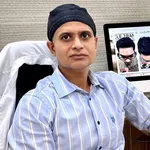
Written by: Dr. Sandeep Mahapatra
Senior Dermatologist, Hair Transplant Surgeon & Founder – Neo Follicle Hair Transplant Clinic, Bangalore
Dr. Sandeep Mahapatra is a senior dermatologist and hair transplant surgeon in Bangalore with extensive experience in hair restoration, dermatology, and aesthetic treatments. As the founder of Neo Follicle Hair Transplant Clinic, he has successfully performed over 10,000 hair transplant procedures and regularly guides patients on safe, ethical, and natural-looking hair restoration.
Medically reviewed by: Dr. Sandeep Mahapatra
Senior Dermatologist & Hair Transplant Surgeon
Date Reviewed: 2026-06-29
This article has been medically reviewed by Dr. Sandeep Mahapatra to ensure that the information is clinically accurate, patient-friendly, and aligned with safe hair transplant practices. The content is intended for educational purposes and should not replace a personal consultation with a qualified hair transplant surgeon.
References:
- A New Regimen Utilizing Growth Factor Concentrate for Hair Restoration – PMC / National Library of Medicine
URL: https://pmc.ncbi.nlm.nih.gov/articles/PMC11283646/ - Effectiveness of Exosome Treatment in Androgenetic Alopecia – PMC / National Library of Medicine
URL: https://pmc.ncbi.nlm.nih.gov/articles/PMC11588828/ - Exosomes and Hair Regeneration: A Systematic Review of Clinical Evidence – PMC / National Library of Medicine
URL: https://pmc.ncbi.nlm.nih.gov/articles/PMC12433634/ - QR678 & QR678 Neo Hair Growth Formulations – PMC / National Library of Medicine
URL: https://pmc.ncbi.nlm.nih.gov/articles/PMC7489598/ - Hair Loss: Diagnosis and Treatment – American Academy of Dermatology
URL: https://www.aad.org/public/diseases/hair-loss/treatment/diagnosis-treat/
Share this article :