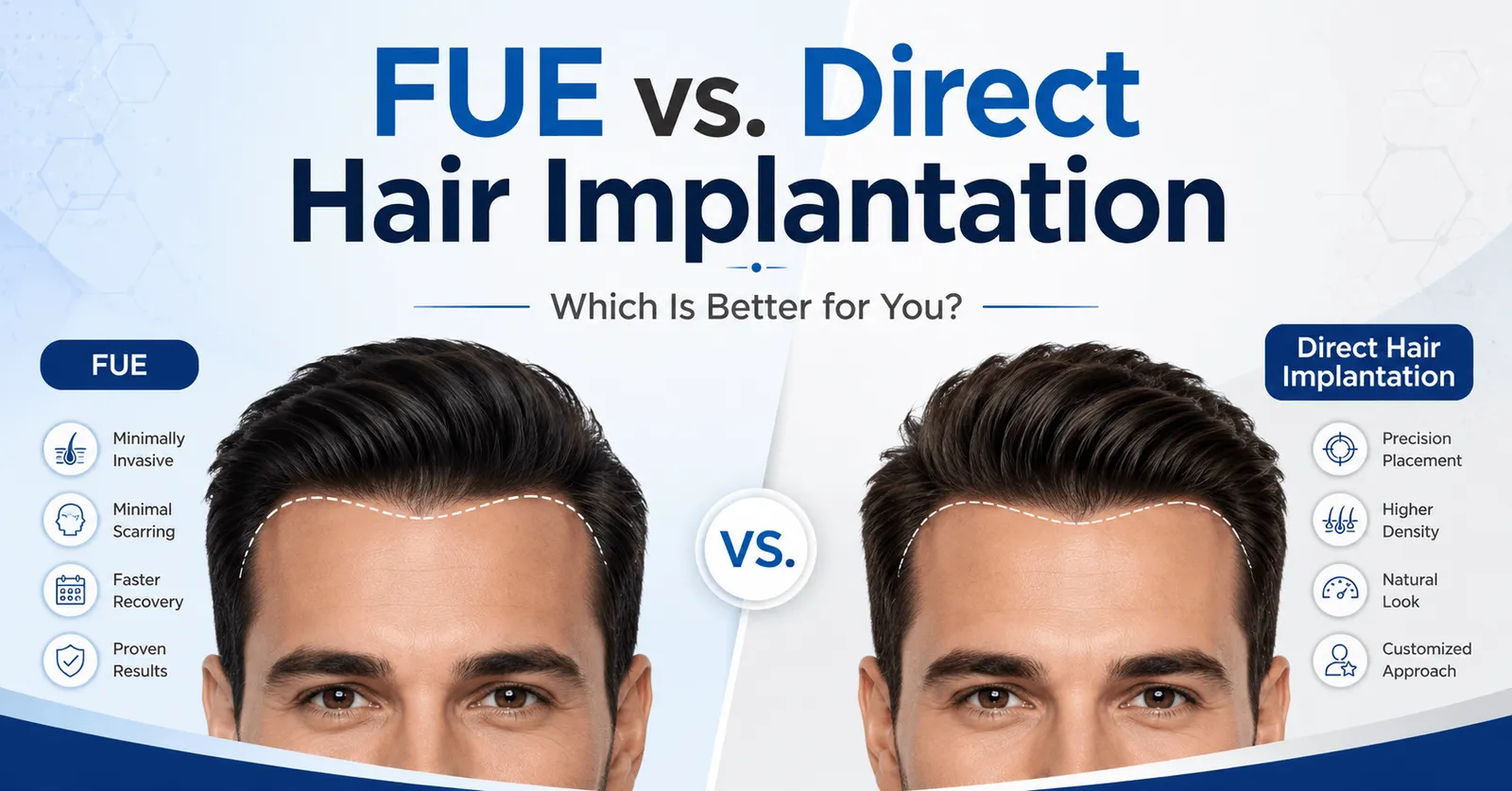
Blog Summary: FUE and Direct Hair Implantation can both deliver natural results; neither is universally better for every patient. The right choice depends on baldness grade, donor strength, graft count, hairline density goals, and how the grafts are implanted. At Neo Follicle Hair Transplant Clinic in Bangalore, Dr Sandeep Mahapatra recommends a personalized scalp assessment before choosing.
Introduction
When patients visit me at Neo Follicle Hair Transplant Clinic in Marathahalli, Bangalore, one common question comes up again and again.
“Doctor, should I choose FUE or Direct Hair Implantation?”
Many patients already know these names before consultation. They see videos. They read clinic websites. They compare packages. Some are told that Direct Hair Implantation is “scarless,” “painless,” “premium,” or “more advanced” than FUE.
But as a hair transplant surgeon, I always tell my patients one thing.
The best technique is not the one with the best marketing.
It is the one that suits your scalp, donor area, baldness grade, and long-term hair plan.
Both FUE and Direct Hair Implantation can give excellent results. Both can also give poor results if done badly. The tool matters. But the surgeon’s planning, graft handling, hairline design, and implantation skill matter even more.
In this blog, I will explain the real difference between FUE and Direct Hair Implantation in simple language.
No gimmicks. No fear. No hard selling.
Just the science.
What Is FUE Hair Transplant?
FUE stands for Follicular Unit Extraction.
In FUE, we remove individual hair grafts from the donor area. Usually, this is the back and sides of the scalp. These hairs are genetically more resistant to baldness.
At Neo Follicle Hair Transplant Clinic, we use a fine micro-punch to extract these grafts. A graft may contain one, two, three, or sometimes four hair follicles.
Think of it like carefully removing tiny plants from a nursery. Each plant must be lifted with its root intact. If the root is damaged, the plant may not grow well after replanting.
The same principle applies to hair grafts.
After extraction, the grafts are cleaned, sorted, and preserved in a special solution. Then the recipient area is prepared.
This is where the bald or thinning area is marked. Small slits or channels are created in the scalp. These channels decide the angle, direction, depth, and density of the new hair.
Finally, the grafts are placed into these channels manually. This is usually done using fine forceps.
So, traditional FUE has three major steps:
- Graft extraction
- Channel or slit creation
- Graft placement
FUE has been used successfully for many years. It has an excellent track record. It is especially useful for large bald areas and high-grade baldness.
For example, if a patient needs 3,500 to 5,000 grafts for front, mid-scalp, and crown coverage, FUE often becomes a very practical and efficient option.
What Is Direct Hair Implantation?
Direct Hair Implantation is a method where the extraction step is similar to FUE.
The grafts are still removed one by one from the donor area. The difference is mainly in the implantation step.
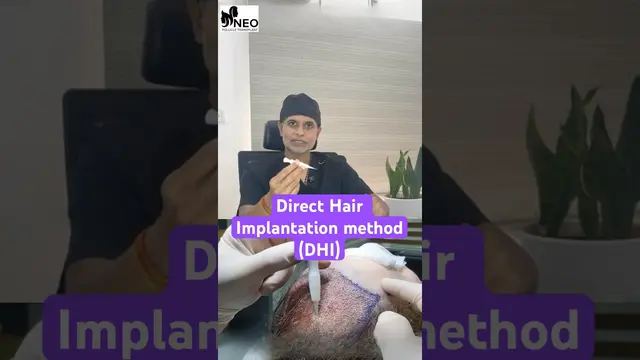
Instead of first making channels and then placing grafts with forceps, the grafts are loaded into a special implanter pen. One common example is the Choi-type implanter.
This pen-like device holds the graft inside a hollow needle. When the surgeon presses the plunger, the tool creates the channel and places the graft at the same time.
Think of it like using a precision planting tool. Instead of digging a hole first and then placing a seed, the tool opens the soil and deposits the seed in one controlled movement.
This gives the surgeon control over:
- Depth
- Angle
- Direction
- Placement pattern
- Hairline refinement
This can be very useful in selected cases. Especially when we are working on the frontal hairline, temples, or smaller zones needing high precision.
Many working professionals coming to our Marathahalli clinic from Whitefield, Bellandur, Sarjapur Road, Electronic City, Indiranagar, Koramangala, and HSR Layout ask me if the implanter pen technique offers faster recovery.
In selected patients, it may reduce tissue trauma during implantation. But that does not mean it is always the best option for every patient.

FUE vs. Direct Hair Implantation: Quick Comparison
| Parameter | Traditional FUE | Direct Hair Implantation / Implanter Pen |
|---|---|---|
| Extraction Method | Individual graft extraction using micro-punch | Similar individual graft extraction using micro-punch |
| Implantation Tool | Forceps after channel creation | Pre-loaded implanter pen |
| Channel Creation | Channels are made first, then grafts are placed | Channel creation and graft insertion happen together |
| Graft Handling Time | May be slightly longer, depending on team efficiency | Can be reduced if workflow is well managed |
| Angle & Direction Control | Excellent in experienced hands | Excellent, especially for hairline refinement |
| Best Suited For | Large-area coverage, high-grade baldness, megasessions | Hairline density, smaller zones, precision work |
| Bleeding During Implantation | Mild bleeding may occur during channel creation | Often less bleeding during implantation |
| Procedure Time | Usually faster for large graft numbers | May take longer for large sessions |
| Cost | Usually more economical | Often priced higher due to tool and time |
| Result Quality | Excellent with proper planning | Excellent with proper planning |
The Real Difference Is Not Extraction. It Is Implantation.
This is important to understand.
Many people think FUE and Direct Hair Implantation are completely different surgeries. They are not.
In both methods, grafts are usually extracted one by one.
The real difference lies in how those grafts are placed.
In FUE, channels are created first. Then grafts are inserted.
In Direct Hair Implantation, the implanter pen creates the channel and inserts the graft simultaneously.
So when a clinic says, “We do DHI, not FUE,” that statement can be misleading. Direct implantation often still uses FUE-style extraction. The difference is the implantation device.
This is why I prefer explaining the technique clearly to patients. A patient should know what is actually being done.
Graft Handling Time: Why It Matters
Hair grafts are living tissue.
Once they are removed from the donor area, they should be handled gently. They should also be kept hydrated and protected.
The time grafts spend outside the body is called out-of-body time.
Shorter out-of-body time can be helpful. But it is not the only factor.
What also matters is:
- How gently the grafts are extracted
- How they are stored
- Whether they dry out
- How much trauma occurs during placement
- Whether implantation is done at the correct depth
Direct implantation may reduce handling in selected workflows. But a well-trained FUE team can also maintain excellent graft survival.
So, the issue is not just the name of the technique. It is the quality of the entire surgical protocol.
Bleeding, Healing, and Recovery
Many patients from busy Bangalore hubs ask me about recovery.
This is especially common among professionals from Whitefield, Bellandur, Electronic City, Koramangala, and HSR Layout. They want to return to work quickly. They do not want long downtime.
In Direct Hair Implantation, since channel creation and graft insertion happen together, there may be less bleeding in some cases. The implantation can be more controlled. This may help healing in selected patients.
In traditional FUE, channels are created first. Mild bleeding can happen from these small sites. But in experienced hands, this is usually well controlled.
In both techniques, most patients can return to desk work within a few days. Redness, swelling, and scabbing depend on the number of grafts, skin sensitivity, and post-operative care.
Neither technique is magic. Both need proper aftercare.
Which Technique Gives Better Density?
Density is not created by the tool alone.
Density depends on:
- Donor availability
- Graft quality
- Baldness grade
- Hair thickness
- Scalp laxity
- Recipient area size
- Safe spacing between grafts
- Long-term hair loss planning
Direct Hair Implantation can be very useful for dense packing in selected hairline cases. It allows refined control over angle and placement.
But if a patient has advanced baldness and needs coverage over a large area, traditional FUE may be more efficient.
For example, a young professional from Sarjapur Road may want a very dense front hairline. But if he also has thinning over the mid-scalp and crown, we must plan carefully.
If we use too many grafts in the front, the crown may look empty later.
A good hair transplant is not just about today’s density. It is about how the hair will look five, ten, or fifteen years later.
Which Is Better for High-Grade Baldness?
For high-grade baldness, coverage becomes very important.
Patients with Norwood Grade 5, 6, or 7 often need a larger number of grafts. In such cases, traditional FUE is often more practical.
It allows efficient extraction and placement of a higher graft count. It can cover the front, mid-scalp, and sometimes crown in a planned way.
Direct implantation can still be used. But for very large sessions, it may increase procedural time. It may also increase cost significantly.
This is where patient counselling becomes very important.
If someone has extensive baldness, I do not believe in selling an expensive package just because it sounds premium.
The right question is not:
“Which technique is more expensive?”
The right question is:
“Which technique gives this patient the safest, most natural, and most sustainable result?”
When Direct Hair Implantation May Be a Good Choice
Direct implantation may be useful when:
- The patient needs hairline refinement
- The bald area is limited
- High precision is needed
- Existing hair needs careful placement around it
- The patient wants dense frontal work
- The donor area is good
- The graft count is moderate
- The surgeon has strong implanter experience
For example, a patient from Indiranagar or Koramangala may come with early frontal recession. He may not need large coverage. He may only need hairline restoration.
In such cases, implanter-based placement can be a good option.
But again, this must be decided after scalp examination.
When FUE May Be the Better Choice
FUE may be better when:
- The bald area is large
- The patient needs maximum coverage
- The graft count is high
- Cost efficiency matters
- The patient has high-grade baldness
- The crown also needs coverage
- Donor planning must be conservative
- A megasession is required
Many patients from Electronic City, Whitefield, and Bellandur come with advanced thinning because they delayed treatment for years.
In such cases, the goal is not only hairline design. The goal is overall coverage and long-term balance.
FUE often works very well here.
The Biggest Myth: DHI Is Always Better Than FUE
This is simply not true.
Direct Hair Implantation is a useful technique. But it is not automatically superior.
A poorly planned implanter pen surgery can still look unnatural. The hairline may look harsh. The density may be uneven. Grafts may be wasted.
Similarly, a well-planned FUE surgery can look extremely natural. It can give excellent coverage. It can last for many years.
So please be careful when a clinic says:
“This technique is 100% scarless.”
“This is the only advanced method.”
“FUE is outdated.”
“DHI guarantees better results.”
These are red flags.
A good clinic will examine your scalp first. Then they will explain your options. They will not push one costly package without reason.
Can Both Techniques Be Combined?
Yes, in selected cases.
At Neo Follicle, we may combine approaches depending on the patient’s needs.
For example, we may use implanter-based placement for the frontal hairline. This helps with angle, softness, and direction.
Then we may use traditional FUE placement for larger areas behind the hairline. This helps with coverage and efficiency.
This hybrid planning can be very useful in megasessions.
The goal is not to be loyal to one tool.
The goal is to be loyal to the patient’s result.
My Practical Advice as a Hair Transplant Surgeon
Do not choose a technique only because it sounds advanced.
Choose based on:
- Your baldness grade
- Your donor capacity
- Your age
- Your future hair loss risk
- Your desired density
- Your budget
- Your surgeon’s experience
- Your long-term plan
During consultation, I always explain what is realistically possible. Sometimes the patient wants a very low hairline. But the donor area cannot safely support it. Sometimes the patient wants full crown density. But the priority should be frontal framing.
Hair transplant is not just a procedure. It is planning, design, biology, and surgical execution.
The right technique is only one part of the journey.
Final Thoughts
FUE and Direct Hair Implantation are both valuable techniques.
FUE is time-tested, efficient, and excellent for large-area coverage. It is especially useful in high-grade baldness and megasessions.
Direct Hair Implantation uses a specialized implanter pen. It can offer excellent control during implantation. It is especially useful for precise hairline work and selected high-density zones.
But neither technique is universally better.
The best technique is the one that matches your scalp, donor area, baldness pattern, and long-term goals.
At Neo Follicle Hair Transplant Clinic in Marathahalli, Bangalore, my team and I focus on honest assessment first. Whether you are coming from Whitefield, Bellandur, Electronic City, Sarjapur Road, Indiranagar, Koramangala, or HSR Layout, the most important step is a proper medical evaluation.
A good hair transplant should not look like a transplant.
It should look like you.
Natural. Balanced. Age-appropriate. And planned for the future.
FAQs: FUE vs. Direct Hair Implantation
1. Is Direct Hair Implantation completely scarless compared to traditional FUE?
No. This is a common misconception.
Both techniques usually involve FUE-style extraction from the donor area. That means tiny punch sites are created to remove grafts.
These marks are very small. They usually heal well. But no surgical extraction is truly “scarless.”
Direct Hair Implantation mainly changes the implantation method. It does not eliminate the extraction sites.
So, it is better to say both methods are minimally invasive. Not completely scarless.
2. Why do some clinics charge significantly more for DHI or implanter pen surgeries in Bangalore?
There are a few reasons.
Implanter pen surgery may require special instruments. It may also need more loading assistance and more procedural time. The workflow can be more demanding.
However, higher cost does not always mean better results.
Some clinics use the term “DHI” as a premium marketing label. Patients should ask what exactly is included.
Ask these questions:
- Who will extract the grafts?
- Who will implant the grafts?
- How many grafts are planned?
- What tool will be used?
- Why is this technique better for my case?
- Is my baldness suitable for this method?
A transparent clinic will answer clearly.
3. Which technique gives a more natural looking hairline - FUE or DHI?
Both can give a natural looking hairline.
The naturalness depends more on design and execution than the tool.
A natural hairline needs:
- Correct height
- Soft irregularity
- Single-hair grafts in front
- Proper angle
- Correct direction
- Age-appropriate planning
- Balanced density
Direct implantation can help with precise angle control in selected cases. But an experienced FUE surgeon can also create a very natural hairline using slit creation and forceps placement.
The surgeon’s skill matters more than the label.
4. Can FUE and Direct Implantation techniques be combined in a single megasession?
Yes, they can be combined.
In selected megasessions, we may use implanter pen placement for the frontal hairline. Then we may use traditional FUE placement for larger areas like the mid-scalp.
This approach can balance precision and efficiency.
But it is not needed for every patient.
The decision depends on graft count, baldness grade, donor quality, density goals, and surgical planning.
A personalised plan is always better than a fixed package.
Blog Author & Medical Reviewer

Written by: Dr. Sandeep Mahapatra
Senior Dermatologist, Hair Transplant Surgeon & Founder – Neo Follicle Hair Transplant Clinic, Bangalore
Dr. Sandeep Mahapatra is a senior dermatologist and hair transplant surgeon in Bangalore with extensive experience in hair restoration, dermatology, and aesthetic treatments. As the founder of Neo Follicle Hair Transplant Clinic, he has successfully performed over 10,000 hair transplant procedures and regularly guides patients on safe, ethical, and natural-looking hair restoration.
Medically reviewed by: Dr. Sandeep Mahapatra
Senior Dermatologist & Hair Transplant Surgeon
Date Reviewed: 2026-06-21
This article has been medically reviewed by Dr. Sandeep Mahapatra to ensure that the information is clinically accurate, patient-friendly, and aligned with safe hair transplant practices. The content is intended for educational purposes and should not replace a personal consultation with a qualified hair transplant surgeon.
References
- International Society of Hair Restoration Surgery (ISHRS) – FUE Hair Transplant: Benefits, Process & Recovery
URL: https://ishrs.org/fue-what-is-it/ - NIH / PMC – Follicular Unit Extraction Hair Transplant
URL: https://pmc.ncbi.nlm.nih.gov/articles/PMC2956961/ - NIH / PMC – Direct Hair Transplantation: A Modified Follicular Unit Extraction Technique
URL: https://pmc.ncbi.nlm.nih.gov/articles/PMC3764754/ - PubMed – Advancements in Graft Placement Techniques
URL: https://pubmed.ncbi.nlm.nih.gov/37879353/ - American Academy of Dermatology – A Hair Transplant Can Give You Permanent, Natural-Looking Results
URL: https://www.aad.org/public/diseases/hair-loss/treatment/transplant
Share this article :