
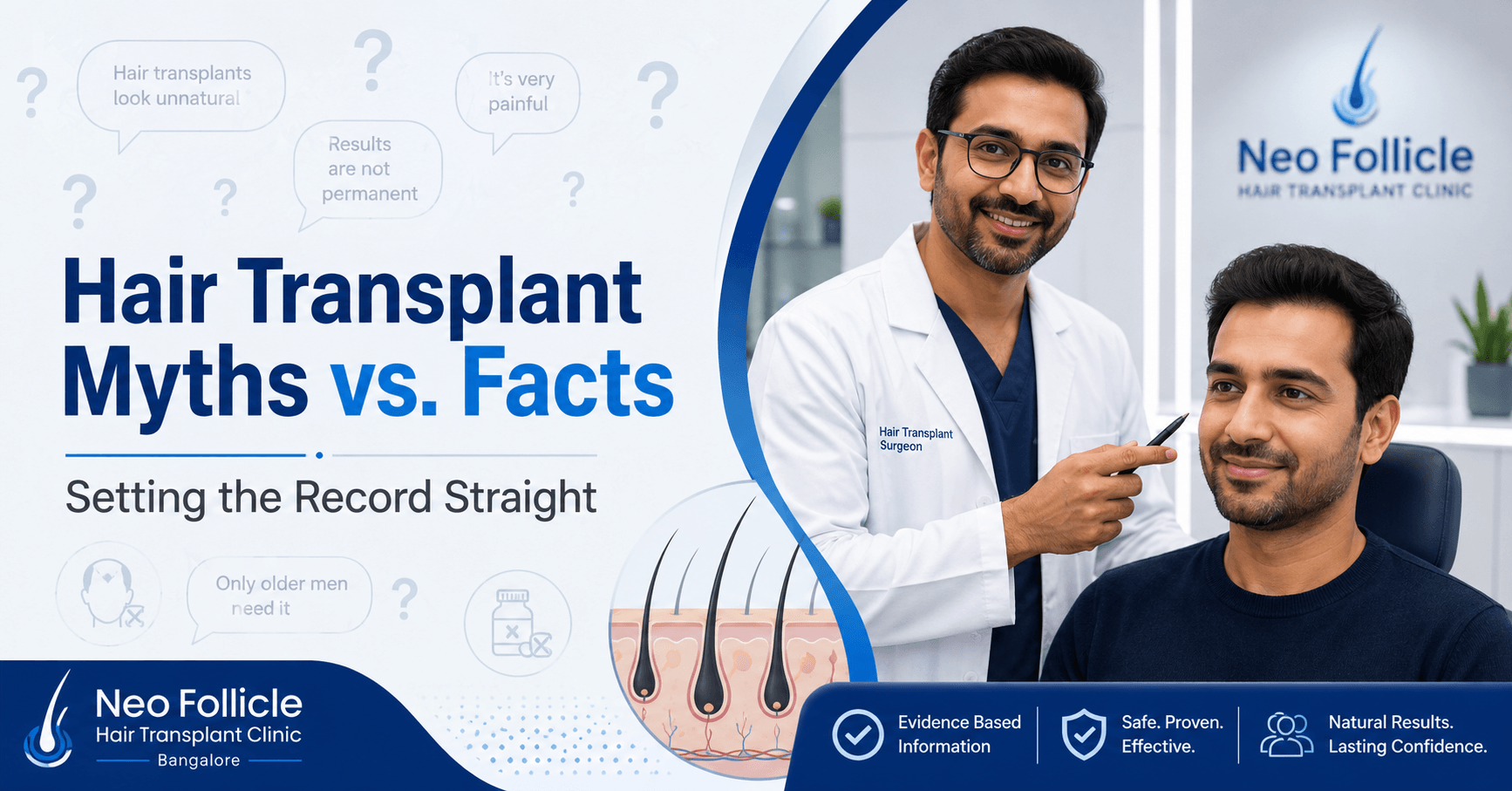
Hair transplant is one of the most misunderstood cosmetic medical procedures today.
Almost every week, I meet patients at Neo Follicle Hair Transplant Clinic in Marathahalli, Bangalore, who walk into my consultation room with a worried face and a phone full of screenshots.
Some are from YouTube comments.
Some are from WhatsApp forwards.
Some are from random internet forums.
And some are from that one “expert friend” who has never entered a hair transplant OT but has very strong opinions.
Many software engineers from Whitefield, Bellandur, Electronic City, HSR Layout, and Marathahalli tell me the same thing:
“Doctor, I wanted to do something about my hair loss years ago, but I got scared after reading online myths.”
I understand this fear.
Hair loss already affects confidence. Add misinformation on top of it, and the patient becomes confused, anxious, and sometimes completely frozen.
As a dermatologist and hair transplant surgeon who has performed over 10,000 hair transplants, my goal in this blog is simple: let us separate fear from fact.
No drama.
No overpromising.
No marketing gimmicks.
Just clear medical truth.
Hair transplant is a visual procedure. People see before-after photos, celebrity transformations, viral reels, and clinic advertisements. But they rarely see the science behind the result.
That gap creates room for myths.
And in Bangalore, especially among young professionals from IT and corporate hubs like Koramangala, Indiranagar, Whitefield, Bellandur, HSR Layout, and Electronic City, online research is usually the first step.
Research is good. But random internet opinions are not the same as medical advice.
A good hair transplant is not magic.
It is also not dangerous science fiction.
It is a planned medical procedure where healthy hair roots are moved from the safe donor area to thinning or bald areas of the scalp.
Now let us bust the most common myths one by one.
MYTH:
“Hair transplant can affect the brain, eyes, nerves, or memory.”
THE REAL MEDICAL FACT:
A hair transplant is performed only at the scalp skin level. It does not go anywhere near the brain.
Let me explain this simply.
Your scalp is like the top layer of soil in a garden. During a hair transplant, we work only in this superficial skin layer where the hair roots live. We do not enter the skull. We do not touch the brain. We do not operate near the eyes.
The procedure is done under local anaesthesia, which means only the scalp area is numbed. You are awake, comfortable, and medically monitored.
Some patients may notice temporary swelling around the forehead or near the eyes after surgery. This can happen because fluid moves down due to gravity. It is usually temporary and settles in a few days.
It is not eye damage.
It is not brain damage.
It is a normal post-procedure swelling pattern in some patients.
At Neo Follicle Hair Transplant Clinic, I explain this carefully before surgery because fear reduces when you understand anatomy.
MYTH:
“My brother, father, friend, or someone with thick hair can donate hair to me.”
THE REAL MEDICAL FACT:
Hair transplant uses your own hair only. This is called an autologous transplant.
In a hair transplant, the donor and recipient must be the same person.
Why?
Because your body recognizes foreign tissue. If hair follicles are taken from another person, your immune system will treat them as foreign and reject them.
This is not like wearing someone else’s cap.
Hair follicles are living tissue. They carry your biological identity.
That is why we usually take grafts from your own permanent donor zone, commonly the back and sides of the scalp. In selected cases, beard or body hair may be considered, but again, it must come from your own body.
So, no, your cousin from Malleswaram with dense hair cannot donate a few thousand grafts to you.
I know it sounds convenient. But the human immune system does not accept such jugaad.
MYTH:
“Hair transplants look artificial, pluggy, or doll-like.”
THE REAL MEDICAL FACT:
Old, poorly done hair transplants can look fake. Modern, well-planned hair transplants should look completely natural.
This myth comes from outdated techniques and poorly designed results.
Earlier, large hair plugs were sometimes used. They could create an unnatural “toothbrush” or “doll hair” appearance.
Modern hair transplant is very different.
Today, we use refined techniques such as FUE, careful graft selection, proper angle control, density planning, and artistic hairline design.
A natural result depends on:
At Neo Follicle Hair Transplant Clinic, I always tell patients: a good hair transplant should not announce itself.
People should say, “You look fresher,” not “You had a transplant.”
A natural hairline is not a straight ruler line. It has soft irregularities, age-appropriate placement, and single-hair grafts in the front.
Hair transplant is science, but hairline design is art.
MYTH:
“Transplanted hair falls out permanently after a few years.”
THE REAL MEDICAL FACT:
Hair transplanted from the permanent donor zone is generally long-lasting because those follicles are genetically more resistant to DHT-related hair loss.
In male pattern baldness, the hair on the front and crown is more sensitive to DHT, a hormone linked with genetic hair loss.
But the hair at the back and sides of the scalp is usually more resistant. That is why many men lose hair on the top but still retain hair at the back.
In a hair transplant, we move these stronger follicles to the thinning area.
The location changes.
The genetic nature of the follicle remains.
So, if the donor hair is selected properly, transplanted hair can continue to grow for many years, often lifelong.
However, there is one important point.
Your existing native hair around the transplanted area can continue to thin if your hair loss is progressive. That is why medical maintenance may be needed.
The transplanted hair may stay. But the surrounding non-transplanted hair still needs protection.
MYTH:
“Hair transplant is only for elderly men with full baldness.”
THE REAL MEDICAL FACT:
Hair transplant can help suitable men and women at different stages of hair loss, not just older men.
Many of my patients are young professionals in their late 20s, 30s, and 40s from places like Indiranagar, Koramangala, Bellandur, Whitefield, HSR Layout, and Electronic City.
They are not completely bald. Many have:
Women can also benefit in selected cases, especially when the donor area is strong and the diagnosis is suitable.
But every young patient is not automatically a candidate.
This is where medical judgment matters.
If a 22-year-old has aggressive, unstable hair loss, I may first recommend medical treatment and observation before surgery. A good surgeon does not rush every patient to transplant.
The right question is not, “Am I too young or too old?”
The right question is, “Am I the right candidate at this stage?”
MYTH:
“After hair transplant, I will be in bed for weeks with severe pain.”
THE REAL MEDICAL FACT:
Most patients return to desk work within a few days, depending on the procedure, healing, and type of job.
Hair transplant is minimally invasive. It is not like major surgery requiring hospital admission or long bed rest.
Most patients can walk out the same day.
Usually, the first few days need care and discipline. You may have mild soreness, tightness, swelling, or discomfort. These are manageable with medicines and instructions.
For desk jobs, many patients from Bangalore’s IT and corporate sectors return to work in a few days, especially if they can work from home.
However, I usually advise patients to avoid:
So yes, you can attend Zoom calls.
But no, you should not do deadlifts on day three to prove your toughness.
Your grafts need respect.
MYTH:
“I will walk out of the clinic with full permanent hair immediately.”
THE REAL MEDICAL FACT:
Hair transplant results take time. The transplanted hair often sheds in the first few weeks. New growth usually starts around 3 to 4 months, and full results commonly take 9 to 12 months.
This is one of the biggest expectation-related myths.
Immediately after transplant, the implanted area may look filled because the hair shafts are visible. But after a few weeks, many transplanted hairs shed.
Patients panic at this stage.
They think, “Doctor, my transplant failed!”
I tell them, “No, this is the sleeping phase.”
Think of it like planting seeds. You do not plant seeds in the morning and expect a mango tree by evening.
The root is alive under the skin. The visible shaft may fall. Then the follicle enters a resting phase and later starts producing new hair.
A typical timeline looks like this:
Check out our blog “The Ultimate Hair Transplant Recovery Timeline: What to Expect Month by Month“.
Patience is part of the treatment.
MYTH:
“After hair transplant, I can never cut, wash, style, or dye my hair normally.”
THE REAL MEDICAL FACT:
Once transplanted follicles have healed and matured, they behave like your natural hair.
After the initial healing period, transplanted hair can be:
In the early post-transplant period, we give specific washing and care instructions because grafts are newly placed. That period is temporary.
Once the grafts are secure and growth is established, the transplanted hair is your own natural hair.
It does not need a VIP security protocol forever.
MYTH:
“Once I do a hair transplant, I can stop worrying about hair loss permanently.”
THE REAL MEDICAL FACT:
Hair transplant restores lost hair in selected areas, but it does not stop future genetic hair loss in existing native hair.
This is a very important point.
Hair transplant is not a cure for the genetic tendency of hair loss. It is a redistribution of permanent hair.
If you are prone to male or female pattern hair loss, your non-transplanted native hair can continue to thin over time.
That is why many patients need a maintenance plan.
This may include:
The goal is not just to plant new hair.
The goal is to protect the whole scalp for the long term.
At Neo Follicle Clinic, we do not see hair transplant as a one-day event. We see it as part of a long-term hair restoration strategy.
MYTH:
“Hair transplant is only for celebrities, actors, or very rich people.”
THE REAL MEDICAL FACT:
Hair transplant cost varies widely, but in India, especially in medical hubs like Bangalore, high-quality treatment has become more accessible than many people think.
Yes, hair transplant can be expensive in some countries.
But India has become a strong destination for hair restoration because of:
At Neo Follicle Hair Transplant Clinic in Bangalore, we regularly meet patients from India and abroad who choose treatment here because they want quality, safety, and affordability together.
But please remember one thing.
Affordable is good.
Suspiciously cheap can be dangerous.
Check out our blog “How to Choose the Best Hair Transplant Clinic in Bangalore“.
A hair transplant is surgery. It should not be chosen like a flash sale.
MYTH:
“Every clinic does FUE, so the result will be the same everywhere.”
THE REAL MEDICAL FACT:
The technique name may be similar, but the result depends on the surgeon, team, planning, instruments, graft handling, hygiene, and implantation quality.
This is like saying every restaurant uses rice, so every biryani tastes the same.
Not true.
In hair transplant, small differences create big visual outcomes.
Important factors include:
Two clinics may both advertise “advanced FUE,” but the final result can be completely different.
Technology supports skill. It does not replace it.
MYTH:
“The clinic giving me the highest graft number is the best clinic.”
THE REAL MEDICAL FACT:
The right graft number matters more than the highest graft number.
Donor hair is limited.
Once donor grafts are damaged or overharvested, they do not magically return.
A responsible surgeon thinks not only about today’s hairline but also about your future hair loss pattern.
If a young patient demands very low, dense hairline and all donor grafts are used aggressively, it may look good for one year but create problems later.
Good planning means:
In hair transplant, greed for grafts can become regret later.
MYTH:
“Hair transplant means only fixing the front hairline.”
THE REAL MEDICAL FACT:
Hair transplant planning depends on the full pattern of hair loss.
Some patients need frontal hairline correction.
Some need crown coverage.
Some need mid-scalp density.
Some need beard, moustache, eyebrow, or scar correction.
Some need repair of a previous failed transplant.
A good consultation includes:
The hairline is important, but it is only one part of the story.
A beautiful front hairline with a neglected crown may not satisfy every patient. Similarly, covering the crown first while ignoring a severely receded front may not create the best visual change.
Planning is everything.
MYTH:
“I want the same hairline as this actor or influencer.”
THE REAL MEDICAL FACT:
Your hairline must suit your face, age, donor strength, hair type, and future hair loss risk.
I often tell patients, “Bring inspiration, not instructions.”
Celebrity photos can help me understand your preference. But copying someone else’s hairline blindly is not medical planning.
A natural hairline depends on:
A hairline that suits a 25-year-old actor under studio lighting may not suit a 38-year-old corporate professional from Jayanagar or Vijaynagar who wants a mature, natural, boardroom-friendly look.
The best hairline is not the lowest hairline.
It is the one that looks like it always belonged to you.
MYTH:
“If the clinic has good Instagram photos and many reviews, it must be safe.”
THE REAL MEDICAL FACT:
Photos and reviews are useful, but they are not enough. You must verify medical credentials, consultation quality, OT standards, doctor involvement, and realistic planning.
Before choosing a hair transplant clinic in Bangalore, ask:
A good clinic will educate you.
A risky clinic will pressure you.
That difference is important.
When you read something online, use this rule.
If a claim says, “Hair transplant will damage your brain,” it is probably fear-based misinformation.
If a claim says, “Guaranteed full hair in 30 days,” it is probably marketing-based misinformation.
Medical truth usually sits in the middle.
Hair transplant is safe when done correctly, but it is still a medical procedure. It has risks, limitations, healing time, and candidate selection criteria.
The safest patients are not the ones who believe everything.
They are the ones who ask the right questions.
You may consider meeting a qualified hair transplant surgeon if you have:
But do not self-diagnose only from Google images.
Hair loss can happen due to many reasons, including genetic baldness, thyroid issues, nutritional deficiencies, dandruff, stress, post-illness shedding, autoimmune conditions, and hormonal imbalance.
The first step is diagnosis.
The second step is treatment planning.
Do not let myths delay your treatment for years.
Also, do not let flashy advertisements push you into surgery tomorrow.
Both fear and excitement can lead to bad decisions.
Take time to understand:
At Neo Follicle Hair Transplant Clinic in Bangalore, my team and I meet patients from Marathahalli, Whitefield, Bellandur, Electronic City, HSR Layout, Indiranagar, Koramangala, Malleswaram, Vijaynagar, Jayanagar, and across India.
Many come with myths.
They leave with clarity.
And clarity is where good treatment begins.
No. A hair transplant does not trigger cancerous growths on the scalp.
Hair transplant involves moving your own hair follicles from one part of the scalp to another. It does not introduce cancer cells or alter your DNA.
However, if you already have an unusual scalp lesion, mole, non-healing wound, or suspicious growth, it should be examined by a dermatologist before any procedure.
No. Once healing is complete, you can cut, trim, style, and even shave your hair.
In the early healing phase, you must follow specific instructions to protect the grafts. But after proper healing, transplanted hair behaves like your natural hair.
No. The word “FUE” or “advanced technique” does not guarantee the same quality everywhere.
The final outcome depends on doctor involvement, graft handling, hairline design, OT hygiene, team training, implantation angle, donor management, and aftercare.
A low-cost clinic may reduce cost by compromising on time, staff, sterilization, planning, or doctor supervision. Always verify before choosing.
Ask four questions:
If something sounds extremely scary or unbelievably perfect, verify it with a qualified doctor.
Yes, the visible transplanted hair shafts often shed in the first few weeks. This is normal.
The follicle remains under the skin and later starts producing new hair. Early growth usually starts around 3 to 4 months, with fuller results developing over 9 to 12 months.
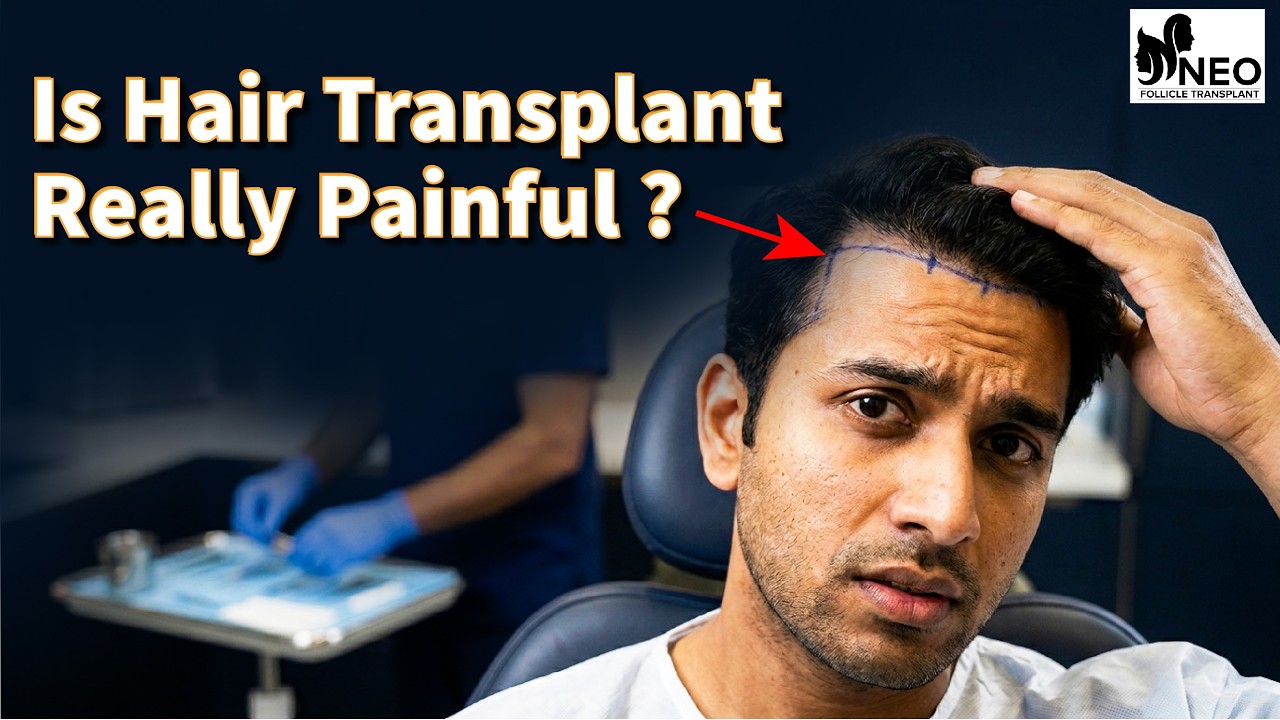
Most patients tolerate the procedure well because it is done under local anaesthesia.
You may feel injections at the beginning and mild soreness after the procedure, but severe pain is uncommon when the surgery and aftercare are properly managed.
Check out our blog “Is a Hair Transplant Painful? What to Honestly Expect Before, During, and After“.
Yes, selected women can undergo hair transplant.
But the cause of hair loss must be diagnosed properly first. Female hair loss can be due to genetic thinning, hormonal imbalance, nutritional deficiency, thyroid issues, traction hairstyles, or other scalp conditions.
The treatment plan must be individualized.
They serve different purposes.
Medicines like minoxidil or finasteride help slow ongoing hair loss and protect existing hair. Hair transplant restores hair in areas where follicles are already lost or severely miniaturized.
Many patients need both for the best long-term result.
Not immediately.
You should avoid pressure, friction, and sweating in the early healing period. Your surgeon will guide you on when it is safe to resume helmet use, depending on your healing and procedure details.
This is especially important for patients commuting across Bangalore on two-wheelers.
For some patients, one session may be enough. For others, future sessions may be needed if hair loss progresses or if larger areas need coverage.
A responsible surgeon will plan according to your current hair loss and future risk.
In many cases, yes.
Repair may involve redesigning the hairline, adding density, removing wrongly placed grafts, improving unnatural angles, or using beard/body hair in selected cases.
However, repair is usually more complex than a first transplant. That is why choosing the right clinic the first time matters.
The biggest myth is that hair transplant is either dangerous or magical.
It is neither.
It is a safe and effective medical procedure when done by a qualified team on the right candidate with realistic expectations.
The goal is not just to grow hair.
The goal is to restore confidence safely, naturally, and responsibly.

Written by: Dr. Sandeep Mahapatra
Senior Dermatologist, Hair Transplant Surgeon & Founder – Neo Follicle Hair Transplant Clinic, Bangalore
Dr. Sandeep Mahapatra is a senior dermatologist and hair transplant surgeon in Bangalore with extensive experience in hair restoration, dermatology, and aesthetic treatments. As the founder of Neo Follicle Hair Transplant Clinic, he has successfully performed over 10,000 hair transplant procedures and regularly guides patients on safe, ethical, and natural-looking hair restoration.
Medically reviewed by: Dr. Sandeep Mahapatra
Senior Dermatologist & Hair Transplant Surgeon
Date Reviewed: 2026-06-17
This article has been medically reviewed by Dr. Sandeep Mahapatra to ensure that the information is clinically accurate, patient-friendly, and aligned with safe hair transplant practices. The content is intended for educational purposes and should not replace a personal consultation with a qualified hair transplant surgeon.
1.American Academy of Dermatology Association – Hair Transplant:
https://www.aad.org/public/diseases/hair-loss/treatment/transplant
2. International Society of Hair Restoration Surgery – Surgical Treatments for Hair Loss:
https://ishrs.org/patients/treatments-for-hair-loss/surgical-treatments/
3. International Society of Hair Restoration Surgery:
https://ishrs.org/
4. Mayo Clinic – Hair Loss: Diagnosis and Treatment:
https://www.mayoclinic.org/diseases-conditions/hair-loss/diagnosis-treatment/drc-20372932
5. NHS – Hair Transplant:
https://www.nhs.uk/tests-and-treatments/cosmetic-procedures/cosmetic-surgery/hair-transplant/
6.Complications of Hair Transplant Procedures—Causes and Management
https://pmc.ncbi.nlm.nih.gov/articles/PMC8719980/