Blog Summary: FUE hair transplant is a modern, minimally invasive way to restore natural-looking hair without a linear scar. At Neo Follicle Hair Transplant Clinic in Bangalore, Dr Sandeep Mahapatra, Hair Transplant Surgeon, carefully extracts and implants individual grafts to protect roots and improve survival. A detailed consultation helps confirm suitability and realistic results.
Introduction to FUE Hair Transplant
Hair loss is not just cosmetic.
For many men and women, it affects confidence. It affects photographs. It affects how they feel in meetings, social events, and daily life.
I meet many patients at Neo Follicle Hair Transplant Clinic in Marathahalli, Bangalore, who tell me the same thing:
“Doctor, I want my hair back. But I am scared of surgery.”
That fear is completely natural.
My goal in this guide is simple. I want to explain FUE hair transplant in a clear, honest, and reassuring way. No confusing medical language. No exaggerated promises. Just a step-by-step explanation of what really happens during an FUE hair transplant.
I am Dr. Sandeep Mahapatra, Senior Dermatologist, Hair Transplant Surgeon, and Founder of Neo Follicle Hair Transplant Clinic in Bangalore. Over the years, my team and I have performed more than 10,000 successful hair restoration surgeries.
FUE is one of the most preferred modern hair transplant techniques. It is precise. It heals fast. It does not leave a long linear scar. But like every medical procedure, the final result depends on planning, skill, donor management, and surgical discipline.
Let me walk you through it.
What Is FUE Hair Transplant?
FUE stands for Follicular Unit Extraction.
In simple words, we remove hair roots one by one from the donor area. Usually, this is the back and sides of the scalp. These areas are genetically stronger. The hair here is usually more resistant to baldness.
Each natural group of hair is called a follicular unit. One follicular unit may contain one, two, three, or sometimes four hairs.
In FUE, we extract these units individually. Then we implant them into the bald or thinning area.
Think of it like carefully shifting healthy plants from a dense garden area to a sparse area. We do not simply pull them out. We remove them with the root structure intact. Then we place them in the right direction, depth, and spacing.
That is why FUE is not just a mechanical procedure.
It is both science and design.
Why FUE Has Replaced Older Strip Surgery?
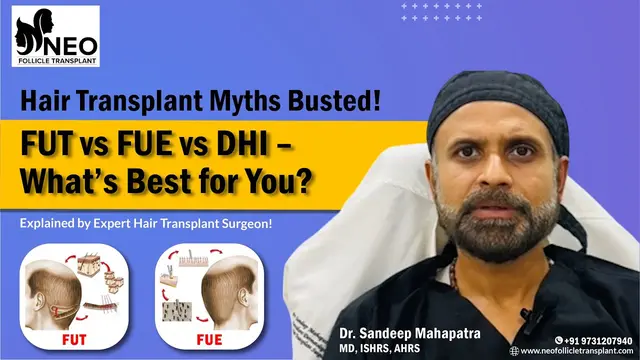
Earlier, FUT or strip surgery was commonly used.
In FUT, a strip of skin is removed from the back of the scalp. Hair grafts are then separated from that strip. This can work well in selected cases. But it usually leaves a linear scar.
FUE changed this approach.
In FUE, we do not remove a strip of skin. We extract individual follicular units using tiny circular punches.
This gives patients some important advantages:
- No long linear scar.
- Faster healing.
- Less visible donor marks.
- Shorter downtime.
- More comfort after surgery.
- Easier return to work.
- Better option for short hairstyles.
This is one reason many professionals from Whitefield, Bellandur, Outer Ring Road, Electronic City, HSR Layout, Indiranagar, and Koramangala choose FUE at our Marathahalli clinic.
They want natural results. They also want faster recovery. Many want to return to office work within a weekend.
FUE helps make that possible in suitable patients.
Who Is a Good Candidate for FUE?
FUE is suitable for many patients. But not everyone is automatically ideal.
You may be a good candidate if:
- You have stable hair loss.
- Your donor area is strong.
- You have realistic expectations.
- Your scalp health is good.
- You understand future hair loss.
- You follow aftercare properly.
You may need careful evaluation if:
- Hair loss is rapidly progressing.
- Donor area is weak.
- You have diffuse thinning.
- You have uncontrolled dandruff or scalp inflammation.
- You have unrealistic density expectations.
- You already had a failed transplant.
At Neo Follicle Hair Transplant Clinic, we do not recommend surgery blindly. Sometimes medical treatment comes first. Sometimes PRP, GFC, or other hair loss treatments may support the plan. Sometimes we advise waiting.
The right timing matters.
The FUE Surgery Day: What Actually Happens?
Many patients feel calmer when they know the exact sequence.
So let me explain the typical FUE surgery day at Neo Follicle Clinic.
The process usually has four main phases:
- Donor area preparation and anesthesia.
- Precision extraction.
- Slitting or channel creation.
- Graft implantation.
Each step matters.
Each step affects the final result.
Phase 1: Donor Area Preparation and Local Anesthesia
The first step is planning.
Before surgery begins, I examine the donor area carefully. We assess:
- Donor density.
- Hair thickness.
- Hair direction.
- Scalp laxity.
- Baldness grade.
- Future hair loss risk.
- Number of grafts required.
Then we mark the hairline and recipient area.
This is not rushed.
The hairline must suit your age, face, forehead, and future hair loss pattern. A very low hairline may look exciting today. But it may look unnatural later.
After planning, we prepare the donor area.
Local anesthesia is then given.
Many patients worry about pain. I understand that. The anesthesia is given slowly and carefully. Once the area becomes numb, you should not feel surgical pain during extraction.
You may feel mild pressure or movement. But not sharp pain.
Most patients are surprised by how comfortable it feels.
Some even listen to music. Some rest during the procedure.
Our goal is simple:
Make the procedure as calm and pain-free as possible.
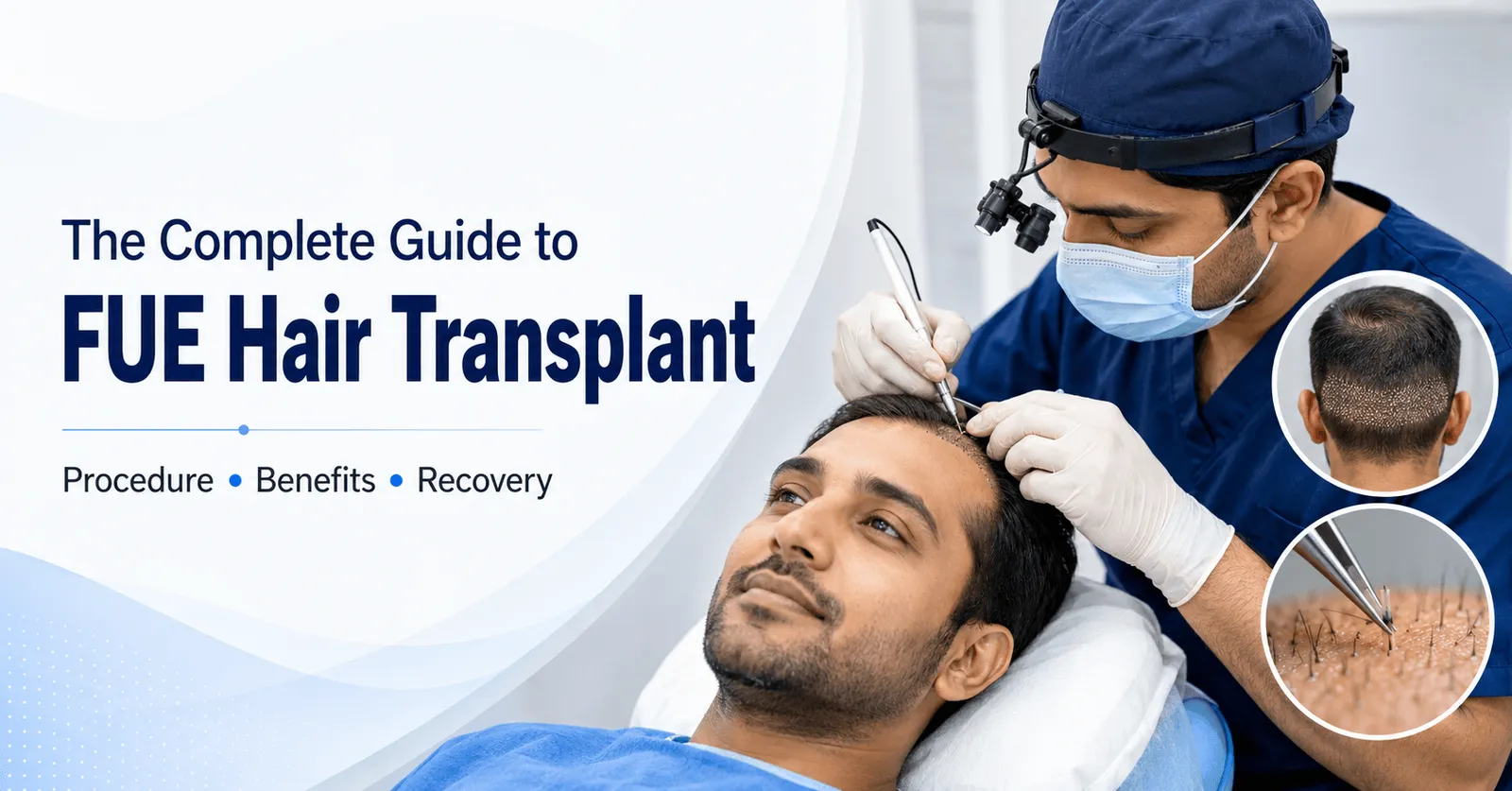
Phase 2: Precision Extraction of Hair Follicles Using Micro-Punches
This is one of the most critical steps.
In FUE, we use small circular punches, usually under 1 mm, to isolate each follicular unit. The punch goes around the hair root. It separates the graft from the surrounding skin.
Then the graft is gently extracted.
This sounds simple. But it requires skill.
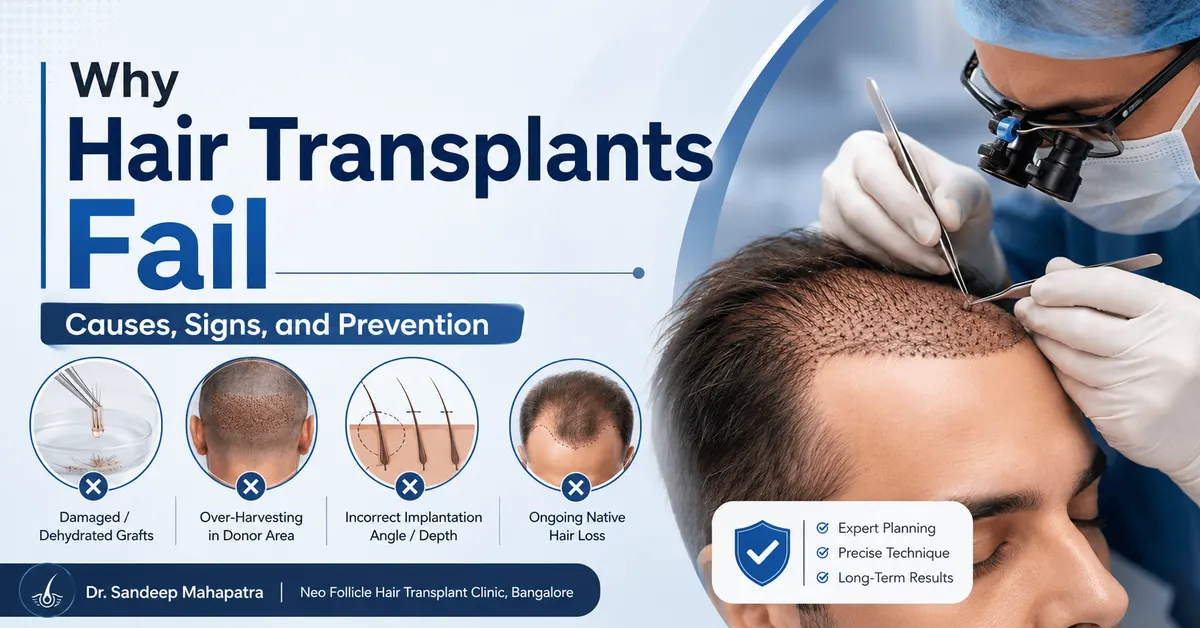
Hair roots are not always straight. Under the skin, they may curve. If the punch angle is wrong, the root can be cut. This is called graft transection.
A transected graft may not grow properly.
This is where many poor results happen.
One major red flag is when clinics allow untrained or poorly supervised technicians to extract grafts blindly. This can damage many roots before anyone notices. The patient may only realize months later, when growth is poor and donor hair is wasted.
At Neo Follicle Hair Transplant Clinic, we treat extraction as a surgical step.
A qualified surgeon oversees the critical stages. My team works with strict protocols. Grafts are handled gently. Donor spacing is planned carefully. We avoid overharvesting.
The aim is not just to extract grafts.
The aim is to extract healthy, viable grafts.
What Makes Good Extraction Different?
Good extraction protects three things.
First, it protects the graft.
Second, it protects nearby hair.
Third, it protects donor appearance.
During extraction, we look at:
- Punch size.
- Hair angle.
- Skin thickness.
- Graft curl.
- Spacing between extractions.
- Bleeding control.
- Graft hydration.
- Graft handling time.
We do not overharvest one area.
We spread extraction evenly.
This avoids patchy donor thinning.
This matters if you keep short hair.
It also matters for future procedures.
Your donor area is like savings.
It must be used wisely.
Phase 3: Slitting and Channel Creation
This is the artistic phase.
Once grafts are extracted, the recipient area is prepared.
Tiny channels are created where the grafts will be implanted. These channels decide the final direction, angle, depth, and density of the hair.
This step shapes the result.
If channels are made too deep, grafts may sit poorly. If they are too shallow, grafts may pop out. If the angle is wrong, the hair may grow unnaturally.
Natural hair does not grow straight upward.
At the front, hair usually grows at a soft forward angle. At the temples, the direction changes. In the crown, the pattern may form a swirl.
This is why hairline design is not just drawing a line.
It is facial architecture.
At Neo Follicle, we focus on:
- Age-appropriate hairline design.
- Natural temple angles.
- Correct density planning.
- Proper depth control.
- Direction matching.
- Long-term donor conservation.
A natural result should not shout, “I had a transplant.”
It should simply look like you.
Phase 4: Graft Implantation
After channel creation, grafts are implanted into the recipient area.
This step needs patience.
Each graft must be placed carefully. The root should not be crushed. The graft should not dry out. The direction must match the channel. The spacing must look natural.
Single-hair grafts are usually placed in the hairline. Two- and three-hair grafts are placed behind for density.
This creates softness in front and fullness behind.
That is how nature works.
Graft survival depends on many factors:
- Gentle extraction.
- Minimal root trauma.
- Proper graft hydration.
- Correct implantation depth.
- Good surgical planning.
- Patient aftercare.
- Healthy scalp environment.
A professionally performed FUE transplant can have a high graft survival rate, often around 90% or more in suitable candidates. But this depends on donor quality, surgical technique, medical condition, and post-operative care.
No ethical surgeon should promise 100% growth.
Good medicine means honest expectations.
What Happens Immediately After FUE?
After implantation, we clean the area.
We check the grafts.
We explain aftercare.
You go home the same day.
You may have mild swelling.
You may feel tightness.
You may see tiny scabs.
This is expected.
Most patients are comfortable.
Pain is usually manageable.
You must avoid touching grafts.
You must sleep carefully.
You must follow washing instructions.
The first 7 to 10 days are important.
The grafts are settling.
Treat them gently.
FUE Recovery Timeline
Recovery is usually faster than older strip surgery.
But healing still needs care.
Here is a general timeline.
First 24 to 48 Hours
You rest.
You avoid sweating.
You avoid bending forward.
You avoid touching grafts.
Mild swelling can happen.
This is temporary.
Days 3 to 7
Scabs become more visible.
Donor area heals quickly.
You may resume light work.
Many desk professionals can return soon.
This depends on comfort and swelling.
Days 7 to 10
Scabs start clearing.
The transplanted area looks cleaner.
The donor area usually looks much better.
Weeks 2 to 6
Shedding may begin.
Do not panic.
This is normal shock shedding.
The roots remain inside.
New growth takes time.
Months 3 to 4
Early growth starts.
It may look thin initially.
That is expected.
Months 6 to 9
Visible improvement appears.
Density improves.
Texture becomes better.
Months 12 to 15
Final maturity develops.
Hair becomes thicker.
Styling improves.
Patience is essential.
Hair growth is biological.
It cannot be rushed.
Advantages of FUE Hair Transplant
FUE has many patient-friendly benefits.
The major advantages include:
- No linear donor scar.
- Faster visible recovery.
- Less donor tightness.
- Suitable for shorter hairstyles.
- Natural graft-by-graft planning.
- Useful for beard and eyebrow restoration.
- Comfortable local anesthesia procedure.
- Quicker return to routine work.
- Better cosmetic donor-area appearance.
This is why many Bangalore patients prefer it.
Especially working professionals.
Someone from Electronic City or Whitefield may not want long downtime. A business owner from Indiranagar or Koramangala may want discreet healing. A corporate employee from Bellandur or ORR may want weekend-based recovery planning.
FUE supports these goals.
But only when done well.
How We Plan FUE at Neo Follicle
At Neo Follicle Hair Transplant Clinic in Bangalore, we focus on medical planning before surgery.
My consultation usually includes:
- Scalp examination.
- Donor area assessment.
- Hairline planning.
- Graft requirement estimation.
- Future hair loss prediction.
- Medical history review.
- Expectation setting.
- Technique selection.
- Post-operative care explanation.
I also explain what FUE can do.
And what it cannot do.
This avoids disappointment.
It creates trust.
A hair transplant should not be sold.
It should be planned.
The Biggest FUE Red Flags
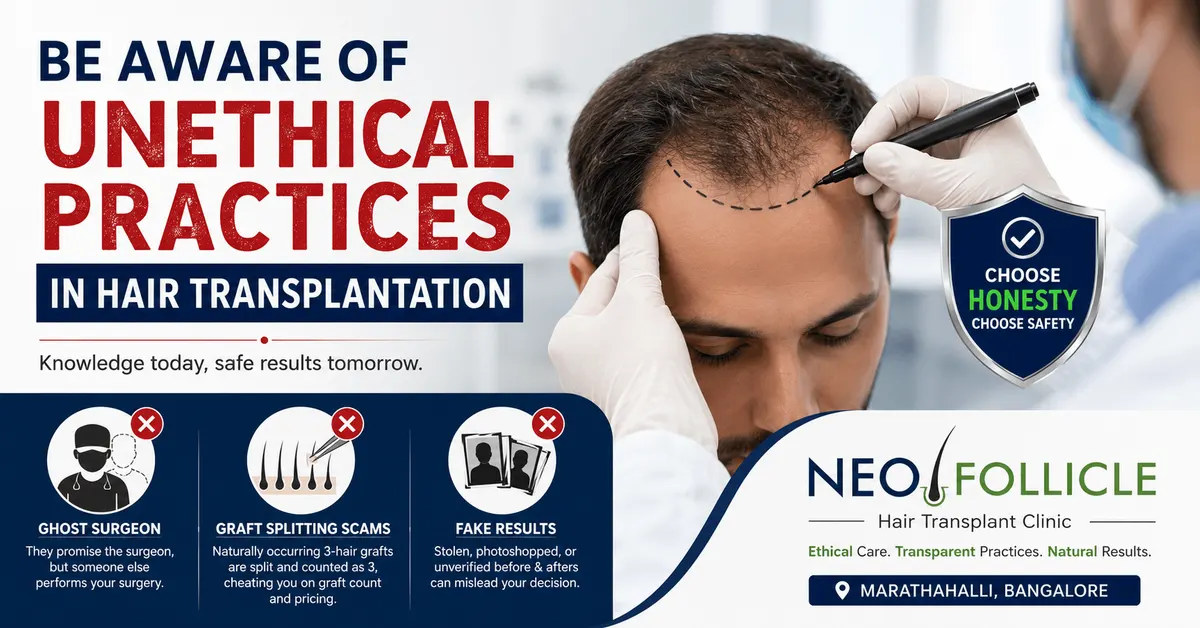
Red Flags When Choosing an FUE Clinic
FUE results depend heavily on skill and ethics.
Be careful if a clinic says:
- “Unlimited grafts.”
- “Guaranteed 100% growth.”
- “No doctor needed.”
- “Technicians will do everything.”
- “Same density as teenage hair.”
- “No need to check donor area.”
- “Cheapest package only today.”
These are warning signs.
A good clinic should explain:
- How many grafts you really need.
- How many grafts your donor can safely give.
- Who performs extraction.
- Who designs the hairline.
- How grafts are stored.
- What results are realistic.
- What aftercare is needed.
Your donor area is precious.
Once damaged, it cannot be easily replaced.
FUE vs Other Hair Transplant Procedures
Here is a simple comparison.
| Feature | FUE Hair Transplant | FUT / Strip Surgery | Direct Implantation Techniques | Robotic FUE |
|---|---|---|---|---|
| Donor harvesting method | Individual follicular units are extracted using micro-punches | A strip of scalp is surgically removed | Grafts are usually extracted like FUE, then implanted using implanters | Machine-assisted follicular extraction |
| Scar type | Tiny dot-like healing marks | Linear scar at donor area | Tiny dot-like healing marks | Tiny dot-like healing marks |
| Stitches required | Usually no stitches | Yes, stitches or staples | Usually no stitches | Usually no stitches |
| Recovery time | Faster for most patients | Slightly longer donor healing | Similar to FUE | Similar to FUE |
| Suitable for short hairstyles | Better suited | Linear scar may show | Better suited | Better suited |
| Surgeon skill required | Very high | Very high | Very high | Still requires surgeon planning |
| Risk if poorly performed | Graft transection, overharvesting, poor density | Wide scar, tightness, poor graft handling | Poor angle control, graft trauma | Overdependence on machine |
| Naturalness depends on | Extraction quality, channel design, implantation | Graft preparation, channel design, implantation | Implantation angle, depth, density | Planning, extraction, implantation |
| Best for | Patients wanting no linear scar and faster healing | Selected patients needing larger graft harvest | Selected cases with controlled implantation | Selected clinics with strong surgeon oversight |
FUE is not superior just because it is newer.
It is superior when planned correctly. It is safe when performed responsibly. It is natural when designed artistically.
What Results Can You Expect From FUE?
FUE gives natural and permanent-looking improvement when done properly.
But results depend on your starting point.
Important factors include:
- Donor hair quality.
- Baldness grade.
- Hair thickness.
- Curl or wave.
- Scalp contrast.
- Number of grafts.
- Hairline design.
- Existing miniaturization.
- Medical treatment support.
- Post-surgery care.
A person with thick, wavy hair may get better coverage with fewer grafts.
A person with thin, straight hair may need more planning.
This is why comparison is harmful. Your result is personal. Your plan must be personal too.
My Philosophy at Neo Follicle
I believe hair transplant should be honest.
It should never be rushed.
It should never be overpromised.
At Neo Follicle Hair Transplant Clinic in Marathahalli, Bangalore, my team and I focus on three things.
I want patients to feel informed.
Not confused.
I want them to know the science.
Not just the sales pitch.
FUE is a beautiful technique. But only in trained hands.
The tool does not create the result. The planning does. The surgeon does. The team does.
And your aftercare matters too.
Frequently Asked Questions About FUE Hair Transplant
1. Does FUE leave tiny dot scars on the back of my head, and are they visible?
Yes, FUE can leave tiny dot-like healing marks.
But in well-performed FUE, these are usually very small. They are generally not visible once healed, especially when the donor area is planned properly.
Visibility depends on several factors.
These include punch size, extraction spacing, skin healing, hair density, and hairstyle length.
If the donor area is overharvested, dots may become more noticeable.
That is why ethical extraction matters.
2. How long does a standard FUE hair transplant surgery take at Neo Follicle?
A standard FUE procedure can take several hours.
The exact time depends on graft count.
Small sessions may take less time.
Larger sessions may take most of the day.
At Neo Follicle Clinic, we do not rush.
Rushing can damage grafts.
The goal is not speed.
The goal is safe extraction, careful graft handling, natural channel creation, and proper implantation.
3. What is the average graft survival rate of a professionally performed FUE transplant?
A professionally performed FUE transplant can achieve high graft survival.
In good conditions, survival is commonly expected to be above 85% to 90%. In many well-managed cases, it can be higher.
But no surgeon should promise 100%.
Survival depends on graft quality, extraction skill, hydration, storage, implantation technique, scalp health, smoking status, and aftercare.
The surgery must be precise.
The patient must also follow instructions.
4. How many days of rest do I need after an FUE procedure before heading back to work?
For desk work, many patients take 2 to 4 days.
Some prefer a week for social comfort.
This depends on swelling, scabbing, travel, and workplace comfort.
Patients from Whitefield, Bellandur, ORR, Electronic City, HSR Layout, Indiranagar, and Koramangala often plan FUE around a weekend or short leave.
If your job involves dust, sweating, helmets, heavy lifting, or outdoor work, you may need more rest.
I will guide you based on your job.
Final Thoughts
FUE hair transplant is a refined procedure.
It can create natural, long-lasting results.
It can heal quickly.
It can avoid a linear scar.
But it must be planned carefully.
The donor area is precious.
The hairline must look natural.
The grafts must be handled gently.
The extraction must be controlled.
The surgeon must be involved.
If you are considering FUE hair transplant in Bangalore, do not choose only by price or graft number. Choose by planning, safety, transparency, and trust.
At Neo Follicle Hair Transplant Clinic in Marathahalli, my team and I will help you understand your options clearly. We will guide you with honesty, medical judgment, and realistic expectations.
Because the best hair transplant is not the most aggressive one.
It is the most natural one.
And the safest one for your future.
Blog Author & Medical Reviewer

Written by: Dr. Sandeep Mahapatra
Senior Dermatologist, Hair Transplant Surgeon & Founder – Neo Follicle Hair Transplant Clinic, Bangalore
Dr. Sandeep Mahapatra is a senior dermatologist and hair transplant surgeon in Bangalore with extensive experience in hair restoration, dermatology, and aesthetic treatments. As the founder of Neo Follicle Hair Transplant Clinic, he has successfully performed over 10,000 hair transplant procedures and regularly guides patients on safe, ethical, and natural-looking hair restoration.
Medically reviewed by: Dr. Sandeep Mahapatra
Senior Dermatologist & Hair Transplant Surgeon
Date Reviewed: 2026-06-25
This article has been medically reviewed by Dr. Sandeep Mahapatra to ensure that the information is clinically accurate, patient-friendly, and aligned with safe hair transplant practices. The content is intended for educational purposes and should not replace a personal consultation with a qualified hair transplant surgeon.
References:
- International Society of Hair Restoration Surgery (ISHRS) – FUE Hair Transplant: Benefits, Process & Recovery
URL: https://ishrs.org/fue-what-is-it/ - International Society of Hair Restoration Surgery (ISHRS) – Follicular Unit Transplantation & Extraction
URL: https://ishrs.org/follicular-unit-transplantation-extraction/ - American Academy of Dermatology – A Hair Transplant Can Give You Permanent, Natural-Looking Results
URL: https://www.aad.org/public/diseases/hair-loss/treatment/transplant - Indian Journal of Dermatology / PMC – Follicular Unit Extraction Hair Transplant
URL: https://pmc.ncbi.nlm.nih.gov/articles/PMC2956961/ - Dermatologic Surgery / PubMed – Hair Transplantation: Basic Overview
URL: https://pubmed.ncbi.nlm.nih.gov/33905785/
Share this article :