Hair loss can feel frightening. Many patients who visit me at Neo Follicle Hair Transplant Clinic in Marathahalli come with the same fear: “Doctor, do I need a hair transplant now?”
My answer is often reassuring.
No, a hair transplant is not always the first step.
In many early and moderate stages of hair thinning, we can slow hair fall, strengthen weak follicles, improve hair thickness, and delay or even avoid surgery with the right medical treatment plan. The key is early diagnosis.
As a dermatologist and hair transplant surgeon, I have treated thousands of patients with different stages of hair loss. One lesson is very clear: the earlier we treat the biological cause, the better we can protect existing hair.
A transplant can restore lost hair in bald areas. But medical treatment protects the hair you still have.
That is why medical management is the foundation of scientific hair restoration.
Hair thinning is usually not sudden. It is a slow biological process.
In common male and female pattern hair loss, the hair follicle gradually becomes smaller. This is called miniaturization. A thick, healthy hair becomes thinner, shorter, weaker, and less visible over time. DHT, a hormone linked to genetic hair loss, plays a major role in this process.
This is why waiting too long can reduce your options.
When follicles are weak but still alive, medical treatment can often help them recover. But once a follicle is completely inactive for a long time, medicines cannot create a new follicle there. At that stage, a hair transplant may be needed.
At Neo Follicle Hair Transplant Clinic, we use clinical examination, scalp analysis, and trichoscopy to understand whether the follicles are weak, miniaturized, inflamed, nutritionally affected, or permanently lost.
Many software engineers visiting our Marathahalli clinic from Whitefield, Bellandur, Sarjapur Road, and Electronic City assume they need an immediate hair transplant.
But sometimes, a quick trichoscopy shows that their follicles are not dead. They are simply weak or “sleeping” and can be revived with the right medical plan.
Medical treatment is not one single product. It is a structured plan.
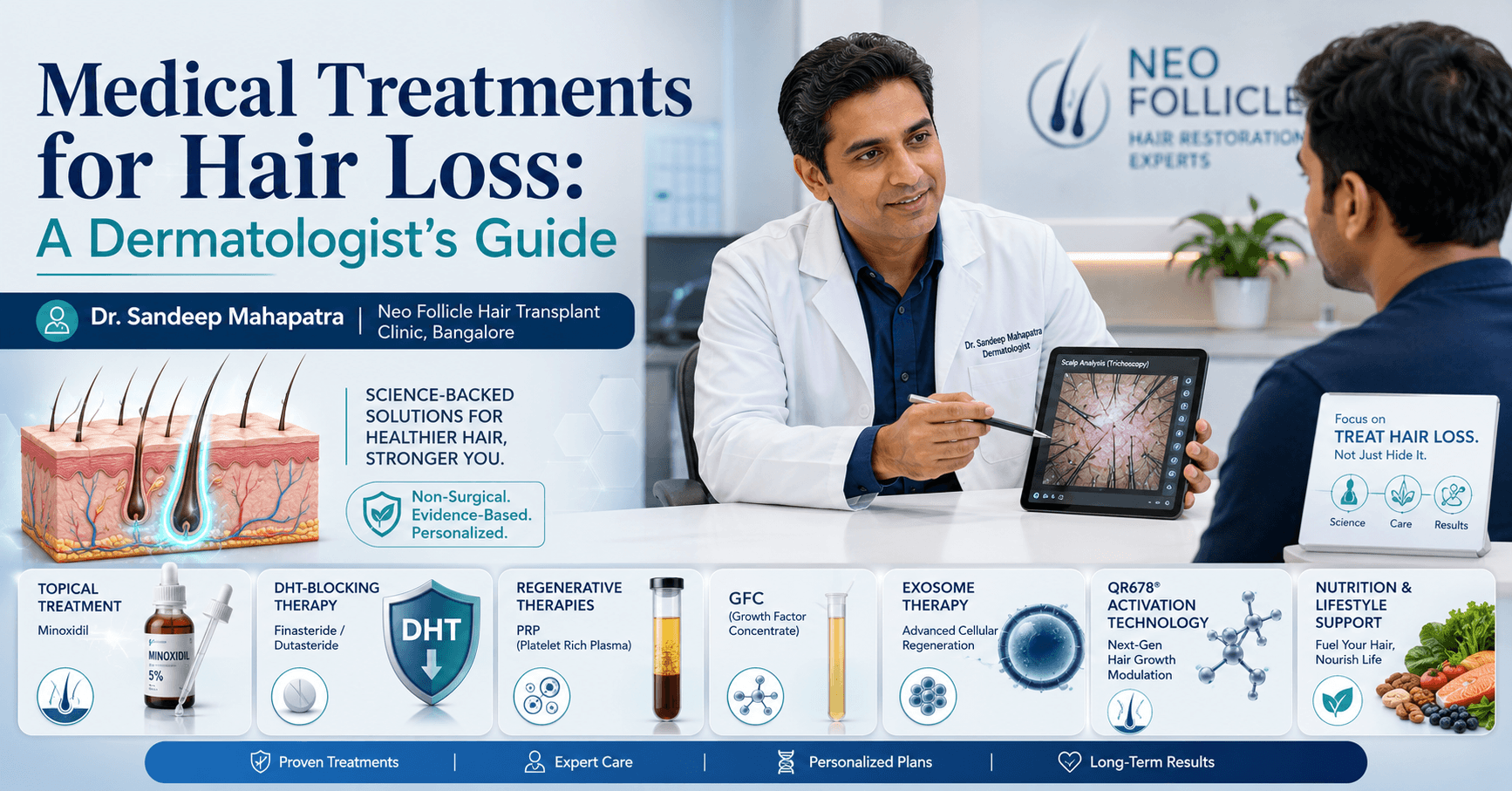
Depending on the cause and stage of hair loss, we may use:
The goal is simple: reduce hair fall, improve hair thickness, protect existing follicles, and create a healthier scalp environment.
Minoxidil is one of the most widely used treatments for pattern hair loss. Topical minoxidil is US-FDA approved for androgenetic alopecia and is considered a first-line treatment in suitable patients.
In simple words, minoxidil helps stimulate weak follicles. It improves the growth phase of the hair cycle and supports better blood flow around the follicle area. This can help hair grow thicker and stay in the growth phase for longer.
Minoxidil is available as foam, lotion, or solution. Some patients also ask about oral minoxidil. It is important to understand that oral minoxidil for hair loss is generally an off-label treatment and should only be used under dermatologist supervision.
Do not self-medicate with oral minoxidil. It may not be suitable for people with certain heart, blood pressure, or swelling-related concerns.
With minoxidil, consistency matters. Many patients stop too early because they do not see results in a few weeks. Hair biology is slow. Early improvement may begin after a few months, while visible density changes take longer.
In genetic hair loss, DHT gradually weakens sensitive hair follicles. Finasteride and dutasteride work by reducing the formation of DHT. This helps slow follicle miniaturization and protects hair from further thinning.
Oral finasteride is US-FDA approved for male pattern hair loss. Clinical studies have shown that finasteride can slow progression and improve hair growth in many men with androgenetic alopecia.
Dutasteride is also used in selected patients, but it is generally considered an off-label option for hair loss in many regions. It may be considered only after proper medical evaluation.
I always explain this clearly to my patients: DHT blockers are not “vitamins.” They are prescription medical treatments. They should be started only after understanding your age, stage of hair loss, family history, expectations, risk profile, and comfort level.
Some patients worry deeply about side effects. That fear is understandable. Most patients tolerate finasteride well, but side effects can occur in a small percentage of users.
This is why dermatologist supervision is important. We can choose the right dose, route, frequency, or alternative plan depending on the patient.
Medicines are not the only option. In many patients, we combine medical treatment with advanced in-clinic regenerative therapies.
These treatments are designed to support weak follicles, improve scalp biology, and help hair stay longer in the active growth phase.
At Neo Follicle Clinic, we may recommend these therapies for patients with early thinning, diffuse hair fall, weak miniaturized follicles, or as support before and after a hair transplant.
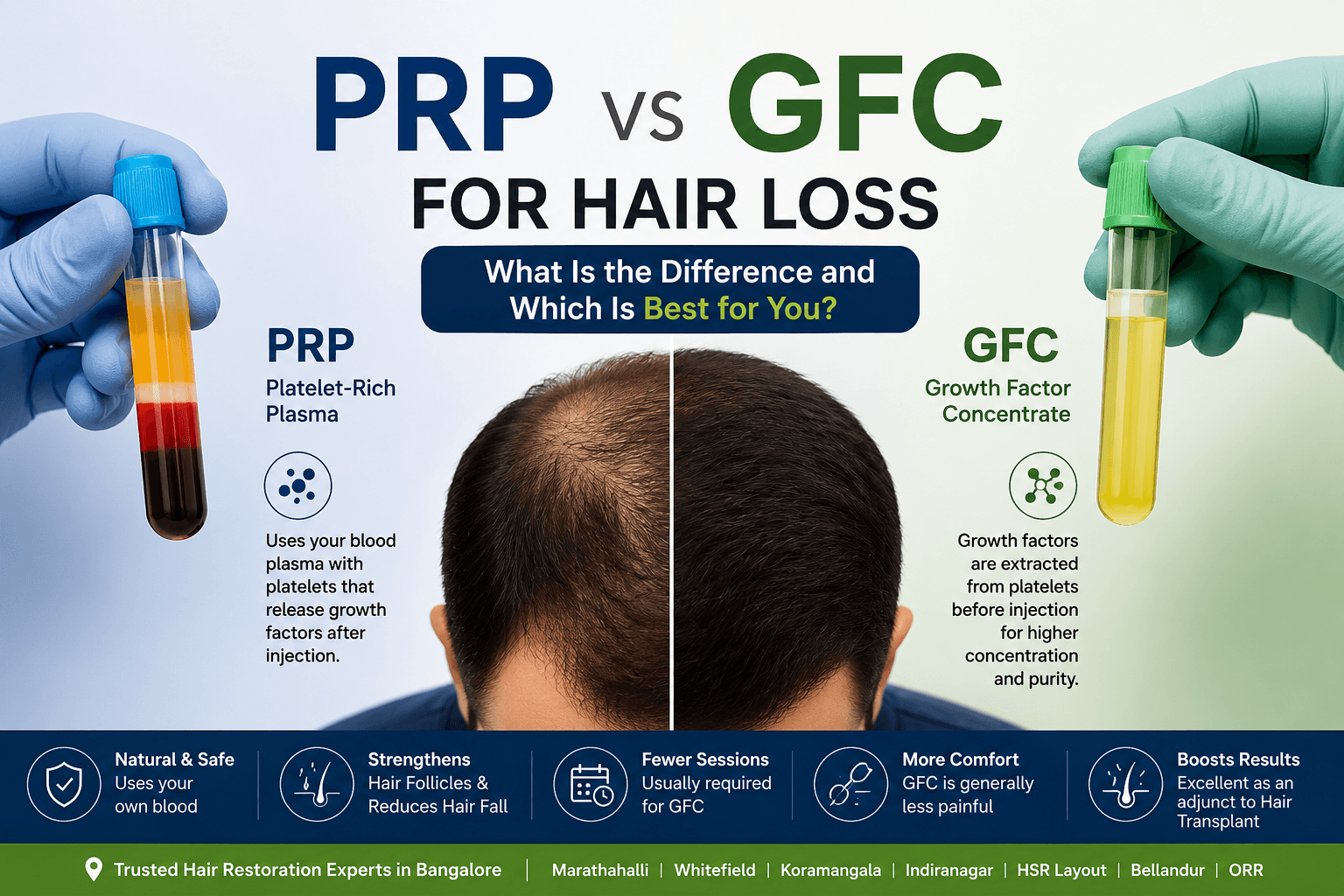
PRP uses a small sample of your own blood. The blood is processed to concentrate platelets, which contain natural growth factors. These growth factors are then injected into targeted thinning areas of the scalp.
PRP can help improve follicle activity, reduce shedding, and support thicker hair in suitable patients. It works best when follicles are weak but still alive. The American Academy of Dermatology notes that studies show PRP can be a safe and effective option for some types of hair loss.
PRP is not a magic injection. It works best when the diagnosis is correct and when it is combined with the right medical plan.
GFC, or Growth Factor Concentrate, is a more refined growth-factor-based treatment prepared from the patient’s own blood.
The aim is to deliver a concentrated solution of growth factors directly to weak follicles. These signals may help improve the scalp environment and support healthier hair growth.
At Neo Follicle Hair Transplant Cinic, I often consider GFC for patients with early-stage thinning, stress-related shedding, diffuse hair fall, and patients who need scalp strengthening before or after a hair transplant.
GFC is especially useful when we want a cleaner, more concentrated regenerative approach compared to traditional PRP.
Exosome therapy is one of the newer regenerative treatments being explored in hair restoration.
Exosomes are tiny messenger particles released by cells. They carry growth signals that may help improve communication between cells, reduce inflammation, and support follicle activity.
Early studies suggest that exosome-based treatments may improve hair density and thickness in some patients with androgenetic alopecia. However, current research is still evolving, and more standardized long-term studies are needed.
This is why I explain Exosome Therapy very carefully to my patients.
It is promising, but it should not be sold as a miracle cure. It must be used only after proper scalp diagnosis, by trained medical professionals, and with realistic expectations.
For the right patient, Exosome Therapy may be used as part of a broader medical hair restoration plan, especially when follicles are weak but not permanently lost.
QR678 is another advanced injectable hair regrowth treatment developed around the concept of delivering specific growth factors into the scalp.
It is used in selected cases of androgenetic alopecia, female pattern hair loss, and diffuse thinning where follicles are still active. Published clinical literature has discussed QR678 and QR678 Neo as growth factor formulations used for hair regrowth, with studies suggesting benefit in selected patients.
In simple words, QR678 aims to give weak follicles targeted growth signals.
But like PRP, GFC, and Exosome Therapy, QR678 is not a replacement for diagnosis. It cannot bring back hair in completely bald areas where follicles are no longer active.
At Neo Follicle, we decide whether QR678 is suitable only after examining the scalp, understanding the stage of hair loss, and checking whether the follicles still have recovery potential.
There is no single “best” treatment for everyone.
The right choice depends on:
For some patients, minoxidil and nutrition correction may be enough. For others, PRP or GFC may be useful. In selected cases, Exosome Therapy or QR678 may be considered. For advanced baldness, these treatments may support existing hair, but a transplant may still be needed for visible coverage.
The goal is not to choose the most expensive treatment.
The goal is to choose the treatment your follicles actually need.
Not all hair loss is genetic.
Many young professionals from Indiranagar, Koramangala, Jayanagar, Whitefield, and Bellandur come to us with sudden heavy hair fall. They often say, “Doctor, hair is falling everywhere — on my pillow, in the bathroom, and while combing.”
This may be telogen effluvium.
Telogen effluvium is a shedding phase that can happen after stress, illness, crash dieting, poor sleep, low protein intake, rapid weight loss, hormonal changes, or nutritional deficiencies.
Common deficiencies we check include:
Random biotin gummies do not fix every type of hair fall. Biotin helps only when there is a true deficiency, which is not the most common cause in every patient.
This is why testing and diagnosis matter.
A good medical hair care plan may include nutrition correction, protein guidance, sleep improvement, scalp inflammation control, and stress management along with medicines or clinical therapies.
This is one of the most important points I explain to patients.
A hair transplant moves healthy follicles from the donor area to the bald area. But it does not stop the natural progression of genetic hair loss in the existing non-transplanted hair.
So, even after a successful transplant, untreated native hair can continue thinning.
That is why medical treatment is often used as a baseline plan:
A transplant gives new hair in bald zones. Medical treatment protects the surrounding hair.
The best results come when both are planned scientifically.
I say this with empathy because I understand the emotional pain of hair loss.
But please do not waste your golden window of treatment on unproven shortcuts.
Many patients lose 1 to 2 valuable years trying:
These may make the hair feel soft temporarily. But they usually do not treat the biological root cause of progressive hair thinning.
A shampoo cannot block DHT inside the follicle. A hair spa cannot reverse miniaturization. A gummy cannot regrow hair lost due to advanced baldness.
The earlier you meet a dermatologist, the more hair we may be able to save.
At Neo Follicle Hair Transplant Clinic in Marathahalli, my approach is never to push every patient toward surgery.
My first goal is diagnosis.
We look at:
Only after this do we create a plan.
For one patient, the right answer may be topical minoxidil and nutrition correction. For another, it may be PRP or GFC. For someone with active DHT-related thinning, a supervised DHT blocker may be useful. For advanced baldness, medicines may stabilize existing hair, while transplant restores bald areas.
Every scalp is different. So treatment should never be copied from a friend, YouTube video, pharmacy suggestion, or online forum.
Medical treatment can reduce hair fall, improve thickness, and strengthen weak follicles. In early stages, it can give very satisfying improvement.
But it has limits.
If an area is completely bald and follicles are no longer active, medicines cannot fully recreate dense hair there. In such cases, a hair transplant may be the right option.
The purpose of medical treatment is not to promise miracles. The purpose is to use science at the right time.
When started early, it can protect your future hairline, delay surgery, improve transplant planning, and maintain long-term results.
For genetic hair loss, long-term maintenance is often needed because the tendency for thinning remains active. If treatment is stopped, the protected hair may gradually start thinning again.
However, this does not mean every patient needs the same medicine forever. At Neo Follicle, we review progress and adjust the plan based on stability, results, side effects, age, and patient comfort.
For temporary shedding conditions like telogen effluvium, treatment may be needed only for a limited period.
Finasteride can cause side effects in some patients, including sexual, mood-related, or breast tenderness symptoms. Most side effects are uncommon and often improve after stopping or adjusting treatment, but persistent symptoms have been reported by some patients.
That is why I do not recommend casual self-use. A dermatologist should explain benefits, risks, alternatives, dose options, and monitoring before starting treatment.
The right decision is a shared decision between doctor and patient.
Usually, no.
Medical treatments work best when follicles are still alive but weak. In advanced bald areas where follicles are no longer active, medicines may not create enough visible density.
In such cases, medical treatment can still help protect existing hair, but a hair transplant may be needed to restore coverage in bald zones.
Hair growth is slow. Most patients need at least 3 to 6 months to notice visible improvement. Reduced shedding may happen earlier in some cases.
For density improvement, we usually assess results over 6 to 12 months. Consistency is very important. Stopping treatment too early is one of the most common reasons for poor results.
Hair loss treatment is not only about transplant surgery.
In fact, for many patients, the first and most important step is medical stabilization. If we diagnose early, protect weak follicles, correct deficiencies, reduce DHT impact, and improve scalp health, we can often preserve a lot of natural hair.
At Neo Follicle Hair Transplant Clinic in Bangalore, my team and I believe in honest, science-backed hair restoration. Sometimes that means medicines. Sometimes it means PRP or GFC. Sometimes it means transplant. Very often, it means a thoughtful combination.
The best treatment is not the most aggressive one.
The best treatment is the one your scalp truly needs.

Written by: Dr. Sandeep Mahapatra
Senior Dermatologist, Hair Transplant Surgeon & Founder – Neo Follicle Hair Transplant Clinic, Bangalore
Dr. Sandeep Mahapatra is a senior dermatologist and hair transplant surgeon in Bangalore with extensive experience in hair restoration, dermatology, and aesthetic treatments. As the founder of Neo Follicle Hair Transplant Clinic, he has successfully performed over 10,000 hair transplant procedures and regularly guides patients on safe, ethical, and natural-looking hair restoration.
Medically reviewed by: Dr. Sandeep Mahapatra
Senior Dermatologist & Hair Transplant Surgeon
Date Reviewed: 2026-07-05
This article has been medically reviewed by Dr. Sandeep Mahapatra to ensure that the information is clinically accurate, patient-friendly, and aligned with safe hair transplant practices. The content is intended for educational purposes and should not replace a personal consultation with a qualified hair transplant surgeon.