
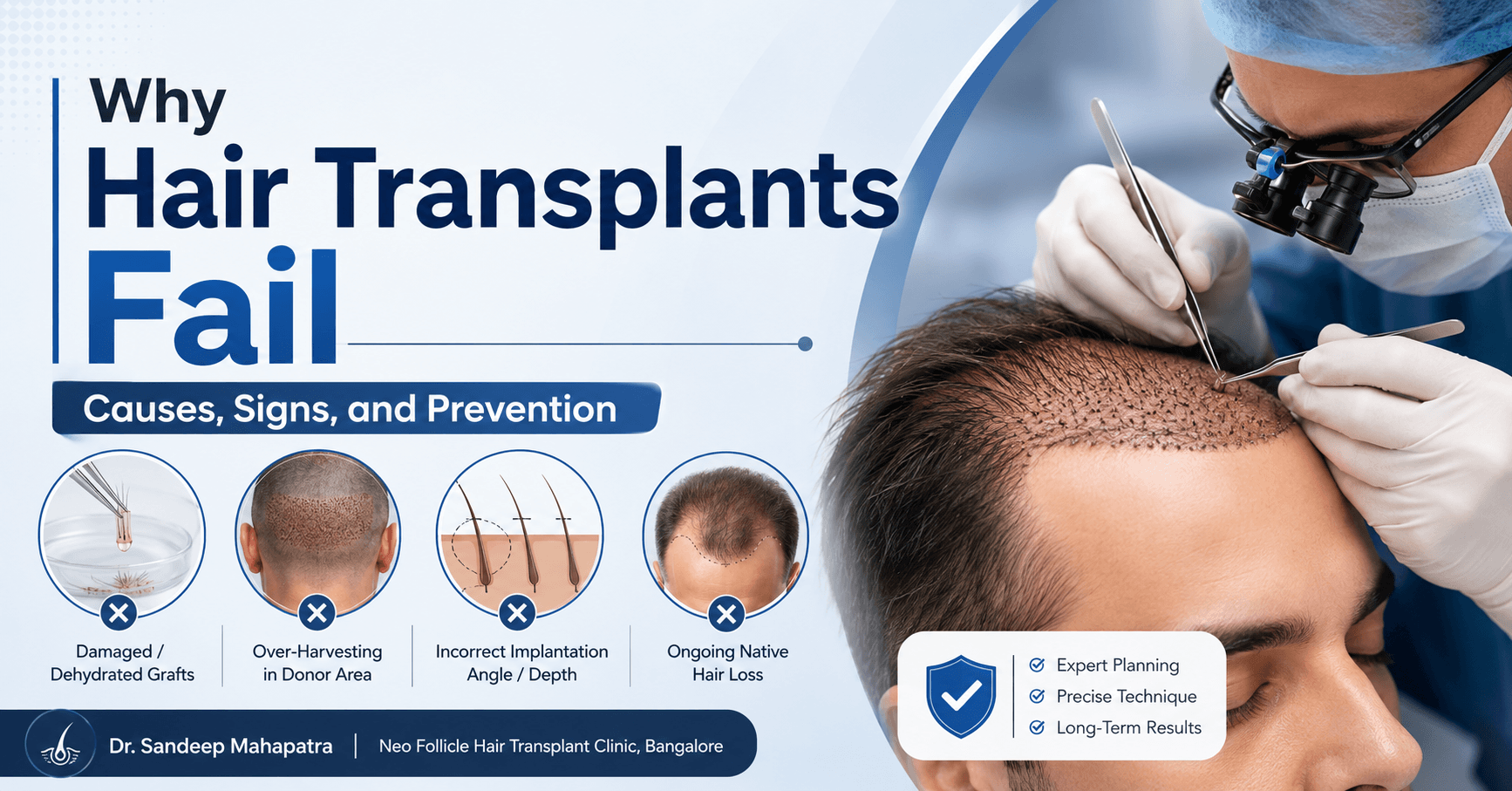
A hair transplant can be life-changing when it is planned and performed correctly. It can restore not just hair, but confidence, facial balance, and peace of mind.
But I also understand the fear many patients carry before surgery.
“What if the transplant fails?”
“What if I lose my donor hair permanently?”
“What if I spend my hard-earned money and still do not get a natural result?”
These are valid questions. As a hair transplant surgeon and dermatologist, I believe patients deserve honest answers before they make any decision.
At Neo Follicle Hair Transplant Clinic in Marathahalli, Bangalore, my team and I regularly meet patients from Whitefield, Bellandur, Sarjapur Road, Electronic City, Indiranagar, Koramangala, and Jayanagar who come to us either for their first transplant or for correction after a poor result elsewhere.
In most failed hair transplant cases, the problem is not “bad luck.” It is usually poor planning, poor graft handling, unsafe extraction, wrong implantation technique, or lack of medical stabilization.
The good news is this: most failures can be prevented with the right medical protocol.
A failed hair transplant does not always mean that “nothing grew.”
It may mean:
In simple words, a successful hair transplant is not just about placing grafts. It is about making sure the grafts survive, grow naturally, and continue to look appropriate as your hair loss progresses with age.
A failed transplant usually happens when one or more stages of the transplant lifecycle are mishandled.
Every successful hair transplant depends on three core pillars.
The grafts must be removed without damaging the roots. This requires correct punch size, correct angle, controlled depth, and surgeon-led planning.
Once grafts are outside the body, they are living tissue. They must be protected from dehydration, heat, crushing, contamination, and long processing delays.
The grafts must be implanted at the right depth, right angle, right direction, and right density. This is what creates natural-looking growth.
When any of these pillars is compromised, the risk of poor growth increases.
This is one of the most important causes of poor graft survival.
A graft is not just a “hair.” It is a delicate living unit containing the hair root, surrounding tissue, and growth-supporting cells. Once it is removed from the scalp, it becomes vulnerable.
If grafts are left dry, exposed to heat, handled roughly, or kept outside the body for too long, survival can drop.
Common graft handling mistakes include:
Many patients do not see this part of the surgery. That is why they may not realize how important it is.
At Neo Follicle, we treat every graft like a limited natural resource. Your donor hair is precious. Once it is damaged, it cannot be recreated. This is why we follow strict graft hydration, temperature control, and handling protocols during every procedure.
The donor area is usually the back and sides of the scalp. These hairs are more resistant to male pattern baldness and are used for transplantation.
But the donor area is not unlimited.
One of the biggest red flags I see in commercial hair transplant marketing is the promise of “unlimited grafts.” This is medically misleading. Every patient has a different donor capacity. If too many grafts are removed, the donor area can become thin, patchy, and permanently damaged.
Over-harvesting can lead to:
A good surgeon does not simply ask, “How many grafts can we take today?”
A good surgeon asks, “How many grafts can we safely take while protecting the patient’s donor area for life?”
This difference is critical.
Many software engineers and corporate professionals visiting our Marathahalli clinic from Whitefield, Bellandur, and Sarjapur Road tell me they chose a clinic earlier because the package promised a very high graft count at a low price. Later, they realized the donor area had been overused.
Prevention starts with ethical donor planning.
Transection means cutting or damaging the hair root during extraction.
In FUE hair transplant, each graft is extracted using tiny punches. The surgeon or trained extraction team must understand the natural angle of the hair under the skin. Hair does not always grow straight below the surface. The root may curve.
If the punch angle is wrong, the root can be cut.
A transected graft may not grow well after implantation. Even if it is placed properly, the damage has already happened.
Transection risk increases when:
This is why patients must ask who is actually performing the extraction. In some high-volume centres, the doctor may only appear briefly while most critical manual steps are handled by rotating technicians.
That is not how safe surgical care should work.
Implantation depth is a fine balance.
If grafts are placed too deep, they may cause:
If grafts are placed too shallow, they may not receive enough support from the surrounding tissue. This can affect survival and growth.
Correct depth depends on the graft size, skin thickness, recipient area, and surgical technique. It cannot be guessed casually.
This is why implantation must be controlled, precise, and supervised. A natural result is not created only by density. It is created by thousands of small decisions made correctly.
A natural hair transplant must match the natural direction of hair growth.
The frontal hairline grows at a very different angle from the crown. Temple hair has a different direction. The crown has a spiral pattern. If these details are ignored, the result may look artificial even if the grafts survive.
Incorrect angle can create:
A successful transplant should not announce itself. People should not look at you and think, “He has had a transplant.” They should simply feel you look better, younger, and more balanced.
The hairline is the most visible part of a hair transplant. It must suit your age, facial shape, forehead height, donor capacity, and future hair loss risk.
A very low hairline may look attractive in marketing photos. But it can be unsafe if your donor area is limited or your baldness is progressive.
Poor hairline planning can cause long-term problems such as:
At Neo Follicle, I always explain that the best hairline is not the lowest hairline. The best hairline is the one that looks natural today and remains sensible years later.
This is a very common reason patients feel their transplant has “failed.”
Sometimes the transplanted hair survives well. But the native hair behind it continues to fall.
This creates a strange gap or island effect. The transplanted zone remains, but the surrounding hair keeps thinning.
Hair transplant does not stop progressive male pattern hair loss. It restores lost hair in selected areas. That is why medical stabilization is important.
Depending on the patient, stabilization may include dermatologist-guided treatment such as approved medications, PRP, GFC, lifestyle correction, dandruff control, or treatment of scalp inflammation.
The exact plan must be personalized.
A responsible surgeon should not simply transplant hair without checking whether ongoing hair loss is active.
Not every poor result looks the same. Some are obvious early. Others become visible after 8 to 12 months.
Watch for these signs.
This happens when grafts are placed in straight rows, with thick multi-hair grafts at the front. A natural hairline should have irregularity, softness, and single-hair grafts in the frontal edge.
Final growth usually takes several months. But if density remains very poor after the expected growth period, graft survival may have been compromised.
Patchy areas may occur because of poor implantation, infection, poor graft handling, or uneven distribution.
This is a warning sign of over-harvesting. The back of the scalp may look uneven, thin, or scarred.
Small scabs are normal after surgery. But persistent bumps, pits, ridging, or scars may indicate wrong depth, poor healing, or technique-related problems.
If the transplanted hair grows in an odd direction, it may become difficult to style naturally.
Many patients panic when transplanted hair sheds after surgery.
I want to reassure you. Early shedding is often normal.
After a transplant, the hair shaft may fall in the first few weeks. The root usually remains inside the skin. New growth then begins gradually over the coming months.
This is called shock shedding or post-transplant shedding.
However, you should contact your surgeon if you notice:
The difference between normal shedding and failure is best judged through follow-up examination, photographs, and growth tracking.
I say this with concern, not judgment. Many patients are not trying to find the cheapest clinic. They are trying to make a practical financial decision. That is understandable.
But hair transplant is a medical procedure. It should not be sold like a discount package.
Please be careful if a clinic:
A successful hair transplant is not about maximum grafts at minimum cost. It is about safe planning, graft survival, natural design, and long-term donor preservation.
Patients from Electronic City, Koramangala, Indiranagar, and Jayanagar often tell me they were attracted by a “limited period offer.” Later, they came seeking correction.
My advice is simple. Choose medical ethics over commercial discounts.
Before you choose any clinic, ask these questions clearly.
A good clinic will not become defensive when you ask these questions. A good clinic will welcome them.
At Neo Follicle Hair Transplant Clinic in Marathahalli, our approach is built around one principle: every graft matters.
We focus on safety, survival, and naturalness.
We do not plan surgery only by looking at the bald area. We assess donor density, hair calibre, baldness grade, scalp condition, age, family history, and future hair loss risk.
We do not believe in unsafe “maximum graft” promises. We plan the number of grafts based on what your donor area can safely provide.
Extraction requires patience and precision. My team follows a protocol designed to reduce transection and protect the donor area.
Grafts are living tissue. We protect them from drying, heat exposure, and unnecessary handling. Temperature control and hydration are maintained throughout the process.
Sterility is non-negotiable. Clean surgical conditions reduce infection risk and support healing.
The most important steps of the procedure cannot be treated casually. Hairline design, donor planning, extraction strategy, implantation pattern, angle, depth, and density require medical judgment.
We focus on direction, angle, depth, and distribution. The goal is not just growth. The goal is growth that looks natural.
A transplant should be planned for your future, not only your next selfie. We guide patients on medical stabilization and follow-up care when needed.
In most cases, yes.
The best way to prevent failure is to choose the right clinic before the first surgery. Repair is possible in many cases, but prevention is always better because donor hair is limited.
A safe transplant requires:
When these are followed, the chances of a natural and successful outcome improve significantly.
I know how emotional this decision can be. Hair loss affects confidence, relationships, social life, and professional presence. Many patients who visit us from Marathahalli, Whitefield, Bellandur, Sarjapur Road, Electronic City, Indiranagar, Koramangala, and Jayanagar have waited years before finally seeking help.
My message is this: do not rush your decision out of fear or discount pressure.
A hair transplant is not just about today’s hairline. It is about protecting your donor area, your appearance, your confidence, and your future options.
At Neo Follicle Clinic, my team and I believe a successful transplant starts with honesty. We will tell you what is possible, what is not advisable, and what is safest for you.
That transparency is the foundation of good surgical results.
Yes, many failed hair transplants can be improved, but the repair plan depends on the condition of your donor area, existing graft placement, scarring, and remaining hair loss. If the donor area has been severely over-harvested, correction becomes more difficult. At Neo Follicle, we first examine the donor and recipient areas carefully before advising repair.
Shedding in the first few weeks is often normal. The visible hair shaft may fall, but the root can remain alive under the skin. True failure is suspected when there is poor growth after the expected growth timeline, patchy density, infection, or obvious graft loss. Follow-up photos and clinical examination help confirm the difference.
Post-operative care is very important. Patients must avoid scratching, rubbing, sweating heavily, smoking, alcohol, poor hygiene, and missed medicines during the early healing phase. Even a well-performed transplant needs proper aftercare. At Neo Follicle, we give clear instructions and follow-up support to protect the grafts after surgery.
Our extraction protocol focuses on donor safety, low root damage, careful graft handling, hydration, temperature control, and surgeon-supervised planning. We avoid aggressive over-harvesting and rushed extraction. The goal is to preserve each graft from the moment it is removed until it is implanted, because graft survival begins with safe extraction.

Written by: Dr. Sandeep Mahapatra
Senior Dermatologist, Hair Transplant Surgeon & Founder – Neo Follicle Hair Transplant Clinic, Bangalore
Dr. Sandeep Mahapatra is a senior dermatologist and hair transplant surgeon in Bangalore with extensive experience in hair restoration, dermatology, and aesthetic treatments. As the founder of Neo Follicle Hair Transplant Clinic, he has successfully performed over 10,000 hair transplant procedures and regularly guides patients on safe, ethical, and natural-looking hair restoration.
Medically reviewed by: Dr. Sandeep Mahapatra
Senior Dermatologist & Hair Transplant Surgeon
Date Reviewed: 2026-07-07
This article has been medically reviewed by Dr. Sandeep Mahapatra to ensure that the information is clinically accurate, patient-friendly, and aligned with safe hair transplant practices. The content is intended for educational purposes and should not replace a personal consultation with a qualified hair transplant surgeon.