
One of the most common questions patients ask me is simple.
“Doctor, how many grafts do I need?”
I hear this almost every day at Neo Follicle Hair Transplant Clinic in Marathahalli, Bangalore.
Many patients visit me from Whitefield, Bellandur, Outer Ring Road, Electronic City, HSR Layout, Indiranagar, and Koramangala.
Some are IT professionals. Some are business owners. Some are young men worried about a receding hairline. Some are older patients with extensive baldness.
Most of them have already checked online graft calculators. Some have received very different estimates from different clinics.
One clinic may say 2,500 grafts. Another may say 4,500 grafts. A third may offer an “unlimited grafts package.”
Naturally, the patient becomes confused.
That is why I always explain one thing clearly.
Graft calculation is not guesswork. It is not a marketing number. It is a scientific and surgical calculation.
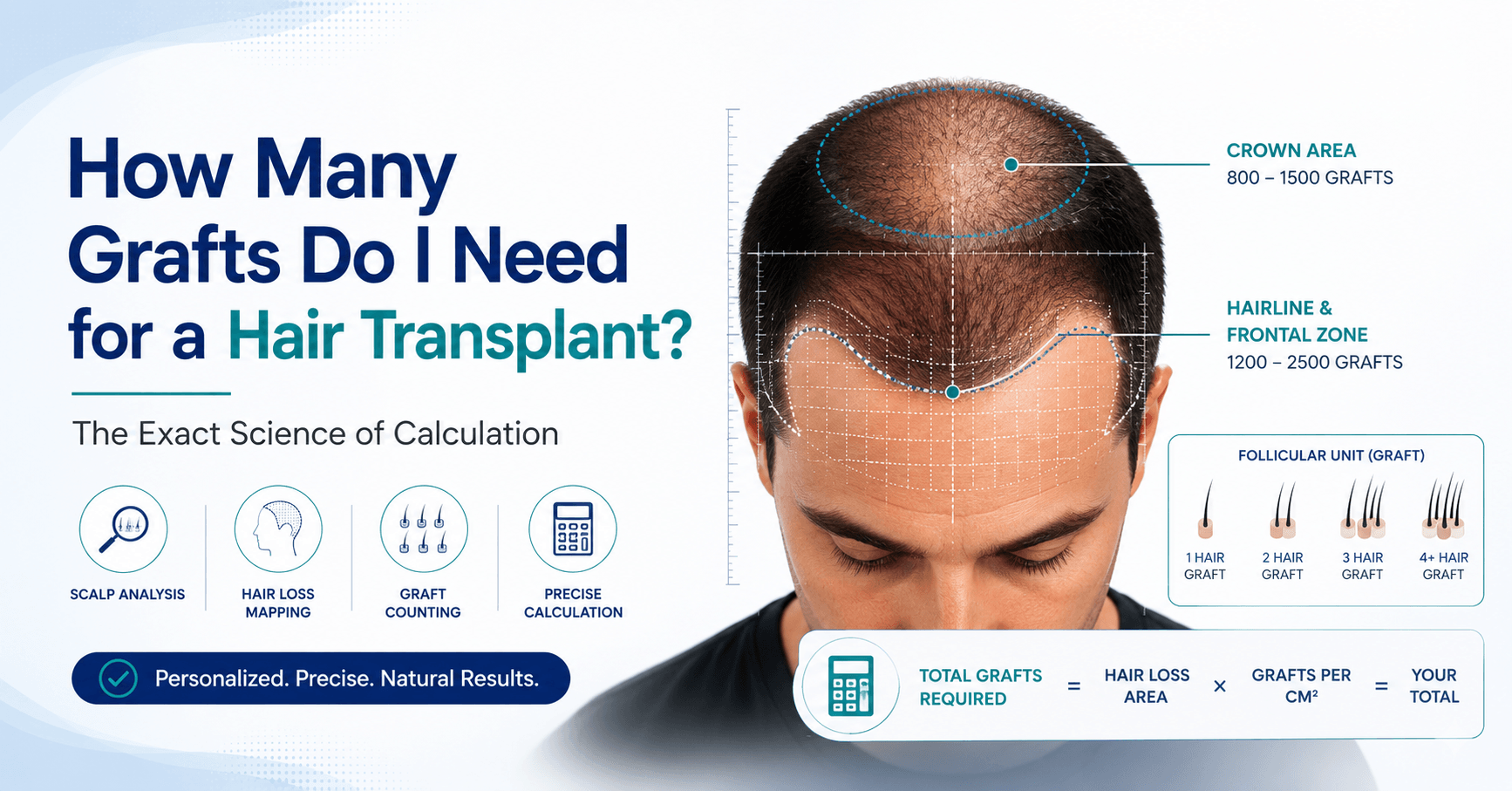
The right graft number depends on your bald area, donor strength, hair thickness, density requirement, and long-term hair loss pattern.
In this blog, I will explain how I calculate grafts for a hair transplant, why the number differs from person to person, and how you can protect yourself from inflated pricing or unsafe over-harvesting.
This is the most important starting point.
A hair graft is also called a follicular unit.
One graft may contain:
So, when we say 2,000 grafts, it does not mean only 2,000 hairs.
It may mean approximately 4,000 to 5,000 hair strands, depending on your natural follicular unit composition.
For example:
| Graft Type | Hair Count |
|---|---|
| Single-hair graft | 1 hair |
| Double-hair graft | 2 hairs |
| Triple-hair graft | 3 hairs |
| Four-hair graft | 4 hairs |
This distinction is very important.
Some clinics use the words grafts, follicles, and hair strands interchangeably. This can confuse patients.
For example, a clinic may say, “We will transplant 5,000 hairs,” while another says, “We will transplant 2,500 grafts.”
Both may sound different. But they may actually mean a similar amount of hair.
This is why, during consultation, I always clarify whether we are discussing grafts or hair strands.
At Neo Follicle Hair Transplant Clinic, we discuss grafts transparently. We also explain the expected hair yield based on your donor area.
Because ethical pricing starts with clear language.
Many IT professionals visiting my Marathahalli clinic from Whitefield, Bellandur, and ORR bring online graft calculator results.
They often say, “Doctor, this calculator says I need 3,000 grafts.”
I understand why they use these tools. They want clarity before making a decision.
But I always explain this gently.
A digital calculator cannot replace physical examination and trichoscopy.
A calculator cannot measure your donor density accurately.
It cannot assess hair shaft thickness.
It cannot check miniaturization.
It cannot predict future baldness.
It cannot judge whether your donor area is safe for extraction.
A proper graft calculation requires medical evaluation. It needs visual assessment, magnification, donor analysis, and surgical judgment.
The Norwood Scale helps classify male pattern baldness.
It gives us a broad idea of hair loss severity.
But it is only a starting point.
Here is a general benchmark.
| Norwood Stage | Typical Hair Loss Pattern | Estimated Graft Range |
|---|---|---|
| Stage 2–3 | Receding hairline and temples | ~1,500 to 2,000 grafts |
| Stage 4 | Hairline recession with crown thinning | ~2,500 to 3,500 grafts |
| Stage 5–6 | Extensive baldness in front, mid-scalp, and crown | ~4,000 to 5,500+ grafts |
| Advanced Stage 6–7 | Large bald area with limited donor supply | May need staged surgery, body hair support, or conservative planning |
Please remember one thing.
These are estimates.
Two patients with Norwood Stage 4 hair loss may need different graft counts.
Why?
Because their bald area, hair thickness, donor quality, and cosmetic goals may be completely different.
When I calculate grafts, I look at four main variables.
These are the real pillars of planning.
The first question is simple.
How much bald area needs coverage?
We measure this in square centimeters.
A small temple recession may need fewer grafts.
A large frontal bald area needs more grafts.
A combined frontal and crown area needs even more.
For example, a patient with only hairline recession may need 1,500 to 2,000 grafts.
But a patient with frontal loss, mid-scalp thinning, and crown thinning may need 4,000 or more grafts.
The larger the bald area, the higher the graft requirement.
But this does not mean we blindly fill every bald centimeter.
We must also protect the donor area.
That is where surgical planning becomes important.
The second factor is density.
Density means how many grafts we place in each square centimeter.
Natural hair density is usually higher than what we recreate surgically.
In hair transplant surgery, we aim for cosmetic density.
Cosmetic density means the hair looks naturally fuller to the eye.
It does not always mean matching original teenage density.
In the hairline, we need careful design and soft density.
In the frontal zone, we may increase density for visual impact.
In the crown, we often use a more conservative approach.
Why?
Because the crown consumes many grafts. It has a spiral pattern. It can require a large number of grafts for moderate visual coverage.
So, we prioritize.
Usually, the frontal hairline and front scalp create the strongest cosmetic improvement.
The crown can be planned based on donor availability.
Not all hair gives the same coverage.
This is a very important point.
A person with thick, wavy, coarse hair may get better visual coverage with fewer grafts.
A person with very thin, straight hair may need more grafts for the same visual effect.
Why?
Because thicker hair shafts block more light from reflecting off the scalp.
Curly or wavy hair also gives better coverage.
Fine hair may require higher density to achieve the same appearance.
This is why two patients may both need hairline restoration, but one may need 1,700 grafts while another may need 2,200 grafts.
The difference is not random.
It depends on hair caliber and texture.
The donor area is the back and sides of the scalp.
This is where grafts are extracted from.
It is the “bank” from which we borrow hair.
But this bank is limited.
Every patient has a different donor reserve.
Some have excellent donor density.
Some have average donor density.
Some have weak donor zones due to diffuse thinning.
Before planning surgery, my team and I examine:
This is critical.
Because a good hair transplant is not just about today’s coverage.
It is about how your scalp will look 10 years later.
Many patients assume that more grafts means better results.
This is not always true.
More grafts can help only if they are:
A reckless high-graft surgery can damage the donor area.
It can also reduce survival if too many grafts are handled poorly.
Hair transplant is not a numbers game.
It is a planning game.
The goal is not to extract the maximum.
The goal is to create the best long-term result with the safest number of grafts.
I want to be very clear here.
Over-harvesting is one of the biggest dangers in hair transplant surgery.
Over-harvesting happens when too many grafts are removed from the donor area.
This can leave the back of the head looking patchy, thin, moth-eaten, or scarred.
And in many cases, this damage is permanent.
This is especially risky when clinics promise:
No ethical surgeon should promise unlimited grafts.
Your donor area is limited.
Your donor area must be respected.
At Neo Follicle, I always tell my patients:
We do not chase numbers. We protect your donor area first.
Because once grafts are extracted, they do not grow back in the donor site.
That is why safe extraction planning is non-negotiable.
Another concern is inflated graft counting.
Some clinics may quote a higher graft number just to increase the cost.
Others may charge for 4,000 grafts but implant fewer.
Some may count hair strands as grafts.
Some may split grafts unnecessarily to increase the number on paper.
This is not ethical.
A patient has the right to know what is being done.
You should ask your clinic:
Transparent clinics will answer these questions calmly.
Commercial clinics may avoid them.
This situation is very common.
Especially in advanced baldness.
When a patient has Stage 5 or Stage 6 baldness, the bald area may demand 5,000+ grafts.
But the safe donor area may allow only 3,500 grafts in the first session.
In such cases, we should not force extraction.
Instead, we plan wisely.
Options may include:
This is where experience matters.
The best result is not always achieved in one sitting.
Sometimes, staged planning gives safer and more natural results.
A large session can be safe in selected patients.
But not for everyone.
Before performing more than 4,000 grafts in one session, we must assess many things.
These include donor density, scalp health, surgical duration, graft handling capacity, team experience, and patient fitness.
A poorly planned megasession can reduce graft survival.
It can also stress the donor area.
So, I do not recommend large sessions just because the patient wants everything done quickly.
Safety comes first.
Natural results come second.
Speed comes last.
At Neo Follicle Hair Transplant Clinic in Bangalore, my approach is simple.
First, we assess.
Then, we calculate.
Then, we explain.
Only after that, we plan surgery.
For patients coming from Marathahalli, Whitefield, Bellandur, ORR, Electronic City, HSR Layout, Indiranagar, and Koramangala, I often explain that a good consultation should reduce confusion, not increase it.
You should leave the consultation knowing:
A hair transplant is a permanent surgical decision.
So, the graft calculation must be honest.
The question is not only, “How many grafts do I need?”
The better question is:
“How many grafts do I need safely, scientifically, and ethically?”
A good hair transplant should improve your appearance.
But it should also protect your donor area.
It should look natural today.
And it should still look balanced years later.
If a clinic gives you a graft number without examining your scalp properly, be careful.
If someone promises unlimited grafts, be careful.
If someone refuses to explain the difference between grafts and hair strands, be careful.
Your graft count should be calculated, not sold.
That is the science.
And that is the ethics.
A single hair graft, or follicular unit, usually contains 1 to 4 hair strands.
Some grafts have one hair. Some have two. Some have three or four.
This is why 2,000 grafts may produce more than 2,000 hair strands.
The exact number depends on your natural follicular unit pattern.
If your donor area is limited, we should not over-harvest it.
Instead, we create a priority plan.
Usually, we first restore the hairline and frontal scalp. This gives the biggest cosmetic improvement.
The crown can be planned later if donor supply allows.
In selected patients, beard or body hair may support coverage.
A staged surgery may also be safer.
It can be safe in selected patients.
But only after proper donor assessment.
Large sessions require strong donor density, good scalp health, careful graft handling, and an experienced surgical team.
It should not be done as a routine marketing package.
If the donor area is weak, a staged approach is safer.
You can ask the clinic for transparency.
Ask whether grafts are counted during extraction and implantation.
Ask for the final graft count after surgery.
Ask whether they are counting grafts or hair strands.
Also ask who is handling and implanting the grafts.
A transparent clinic will be comfortable explaining this.
Ethical hair transplant surgery should never hide the numbers from the patient.

Written by: Dr. Sandeep Mahapatra
Senior Dermatologist, Hair Transplant Surgeon & Founder – Neo Follicle Hair Transplant Clinic, Bangalore
Dr. Sandeep Mahapatra is a senior dermatologist and hair transplant surgeon in Bangalore with extensive experience in hair restoration, dermatology, and aesthetic treatments. As the founder of Neo Follicle Hair Transplant Clinic, he has successfully performed over 10,000 hair transplant procedures and regularly guides patients on safe, ethical, and natural-looking hair restoration.
Medically reviewed by: Dr. Sandeep Mahapatra
Senior Dermatologist & Hair Transplant Surgeon
Date Reviewed: 2026-06-23
This article has been medically reviewed by Dr. Sandeep Mahapatra to ensure that the information is clinically accurate, patient-friendly, and aligned with safe hair transplant practices. The content is intended for educational purposes and should not replace a personal consultation with a qualified hair transplant surgeon.