
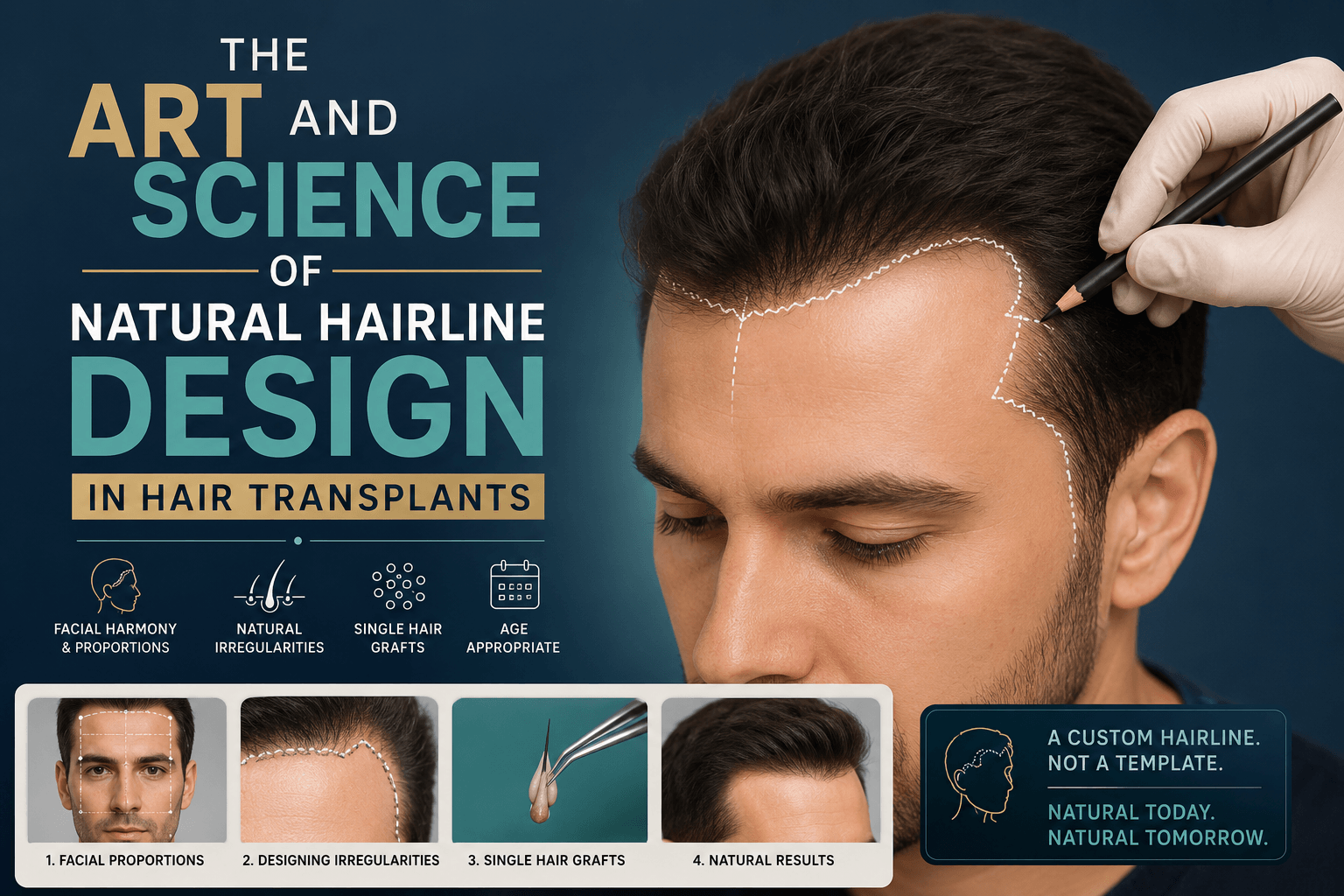
For many patients, the biggest fear before a hair transplant is not the surgery itself.
It is this question:
“Will my hairline look natural?”
As a hair transplant surgeon and dermatologist, I completely understand this fear. Most people do not want a dramatic, obvious transformation. They do not want a “fixed” or artificial look. They simply want to look like themselves again.
At Neo Follicle Hair Transplant Clinic in Bangalore, many young professionals, entrepreneurs, senior executives, and patients from Marathahalli, Whitefield, Outer Ring Road, Sarjapur Road, Indiranagar, Koramangala, and HSR Layout tell me the same thing during consultation:
“Doctor, I want my hairline back, but I don’t want anyone to know I had a transplant.”
That is a very valid expectation.
A good hair transplant should not announce itself.
It should quietly restore balance to the face.
It should make you look fresher, more confident, and naturally younger — not artificial.
And the most important factor behind that natural look is hairline design.
Hairline design is not just drawing a line on the forehead. It is a combination of medical planning, facial aesthetics, donor hair management, artistic judgment, and long-term vision.
In this blog, I will explain how I approach natural hairline design, why every patient needs a customized plan, and what mistakes you must avoid before choosing a hair transplant clinic.
The hairline is the frame of the face.
Even a beautifully dense transplant can look unnatural if the hairline is poorly designed. On the other hand, a carefully planned hairline can create a powerful visual improvement even when the number of grafts is limited.
When we look at someone, our eyes naturally notice the front hairline first. We may not consciously analyze it, but our brain immediately detects whether it looks natural or artificial.
A natural hairline has softness.
It has irregularity.
It has age-appropriate maturity.
It blends with the face.
An artificial hairline usually has one or more of these problems:
This is why I always tell my patients:
Hair transplant is not only about moving hair. It is about designing a result that will age gracefully with you.
Hairline design is one of the most creative parts of hair restoration surgery. But it is not imagination alone. It must be grounded in clinical principles.
At Neo Follicle, my team and I consider several factors before finalizing a hairline:
A patient from Whitefield working in a corporate leadership role may want a mature, professional look. A 28-year-old software engineer from ORR or Marathahalli may want a youthful correction of temple recession. A patient from Indiranagar or Koramangala may come with strong aesthetic expectations because hairstyle and appearance are important to their social or professional life.
But in every case, the principle remains the same:
The hairline must suit the person, not the trend.
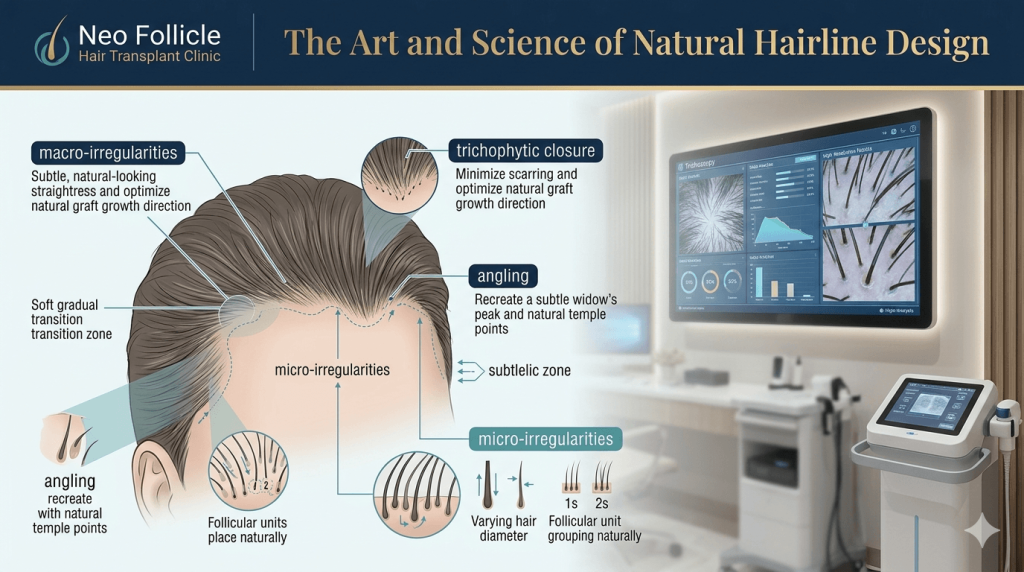
When I design a hairline, I follow three broad principles. These are not mechanical rules, but they guide the artistic and clinical decision-making process.
The human face is often assessed using the “rule of thirds.”
In simple terms, the face can be divided into three approximate vertical sections:
In a balanced face, these three zones are reasonably proportional.
When the hairline recedes, the upper third of the face becomes visually longer. This can make a person look older, tired, or less confident.
A hair transplant can restore balance by rebuilding the frontal frame. However, this does not mean we should bring the hairline too low.
A common mistake is to chase the teenage hairline. Patients sometimes bring old college photos and say, “Doctor, can you make it like this?”
I understand the emotion behind that request. Hair loss can make a person feel as though they have lost a part of their identity. But medically and aesthetically, recreating a very low childhood hairline on an adult man is often not the best choice.
A natural adult hairline should restore proportion without looking forced.
For most adult men, a mature hairline looks more natural than a flat, low, adolescent hairline.
One of the important measurements in hairline design is the distance from the eyebrows to the proposed central hairline.
This distance is not the same for everyone.
It depends on:
If the hairline is placed too high, the cosmetic improvement may be limited. The patient may feel that the transplant did not make enough difference.
If the hairline is placed too low, the result can look unnatural and may waste valuable donor grafts.
This balance is very important.
I usually explain it to patients like this:
A good hairline should make you look naturally younger, not surgically altered.
That is the difference between restoration and overcorrection.
A natural hairline is not a wall of hair.
It is a soft transition from forehead skin to thicker scalp hair.
In nature, the very front of the hairline has fine, irregular, single hairs. Behind this zone, the density gradually increases. This creates softness.
In a hair transplant, if thick grafts or multiple-hair grafts are placed right at the front, the hairline can look pluggy. It may appear like small tufts or rows of hair.
To avoid this, we create a transition zone.
At Neo Follicle, this front zone is planned very carefully. We use fine single-hair grafts at the leading edge of the hairline. These grafts help recreate the delicate, feathered appearance seen in natural hairlines.
Behind this soft zone, we gradually place stronger grafts to create density and visual coverage.
This layering is one of the most important secrets of a natural result.
One of the biggest misconceptions patients have is that a perfect hairline means a straight hairline.
Actually, the opposite is true.
A laser-straight hairline is one of the easiest ways to identify a bad hair transplant.
Natural hairlines are irregular. They have small ups and downs. They have soft breaks. They are never drawn like a ruler line.
When I design a hairline, I intentionally create irregularities.
These irregularities are of two types:
Both are important.
Macro-irregularity refers to the larger pattern of the hairline.
A natural hairline is not a flat horizontal line. It usually has a gentle central contour with slight recession or shaping around the temples.
The design must respect the patient’s original pattern and facial structure.
For example, a broad forehead may need a slightly different shape compared to a narrow forehead. A patient with strong temple recession may need careful temple angle planning. Someone with a round face may need a hairline that improves facial framing without making the face look smaller or crowded.
This is why template-based hairline design is risky.
A standardized hairline may look fine on paper but completely wrong on a real face.
Micro-irregularities are the tiny, delicate variations at the frontal edge of the hairline.
These are the small zig-zag patterns that prevent the hairline from looking artificial.
I manually design these fine irregularities because they make the result look organic. The goal is not to create a messy hairline. The goal is to recreate the randomness of nature in a controlled, artistic way.
This requires experience.
Too much irregularity can look untidy.
Too little irregularity can look artificial.
The correct balance creates softness.
This is where hair transplant becomes less like a procedure and more like medical artistry.
Each follicular unit may contain one, two, three, or sometimes four hairs.
In natural hairlines, the very front usually contains single hairs. These are finer and softer. They create a natural feathering effect.
If a surgeon places two-hair or three-hair grafts at the frontal edge, the hairline may look thick, pluggy, or unnatural.
That is why single-hair graft selection is critical.
During planning and implantation, my team and I pay close attention to the type of grafts used in different zones:
This is not random placement. It is a planned distribution.
The hairline should look soft in front and gradually become denser behind.
That is how natural hair grows.
That is how a natural transplant should be designed.
Many patients understandably want the lowest possible hairline.
They feel that a lower hairline will make them look younger. But a very low hairline does not always look better.
In fact, on a 35-year-old or 45-year-old man, a teenage-style straight hairline can look unnatural.
It may look acceptable immediately after design, but over the years it can become visually odd, especially if the surrounding native hair continues to thin.
This is one of the most important conversations I have with patients.
A 10-year-old boy’s hairline is not the correct model for a 30-year-old professional. A mature adult hairline can still be attractive, youthful, and confident. It does not need to be aggressively low.
A good hair transplant surgeon must think beyond the next six months.
We must think about:
This long-term planning is especially important in male pattern hair loss.
Hair loss is progressive. If we use too many grafts to create an unnecessarily low hairline, we may not have enough donor hair left for the mid-scalp or crown in the future.
That is why I always say:
A natural hairline is not just designed for today. It is designed for your future face.
Hair transplant does not stop genetic hair loss.
It restores hair in the transplanted area, but the native non-transplanted hair may continue to thin over time. This is why planning is critical.
If a patient has early hairline recession at 27, we cannot simply fill a very low hairline without considering what may happen over the next 10 to 20 years.
The surgeon must evaluate:
In suitable patients, medicines or regenerative treatments may be recommended to stabilize ongoing hair loss. The transplant design must work with the overall hair restoration plan.
At Neo Follicle, I often advise patients that the best result comes from combining surgical planning with medical hair loss management when needed.
This is how we protect both the current result and future options.
No two faces are the same. So no two hairlines should be exactly the same.
A good hairline is customized.
The shape of the face influences hairline design.
A person with a long face may need a design that visually reduces forehead length. A person with a round face may need careful temple framing to avoid making the face look too compact. A square face may need a slightly stronger hairline contour, while a softer face may need a gentler design.
The goal is not simply to add hair.
The goal is to restore facial harmony.
Different ethnic backgrounds can have different natural hairline characteristics.
Some patients naturally have flatter hairlines. Some have more temple recession. Some have higher foreheads. Some have thicker, darker hair with high contrast against the skin. Others have finer hair that creates a softer look.
In Bangalore, I see patients from across India and from different parts of the world. A patient from South India may have different hair characteristics compared to a patient from North India, the Middle East, Europe, or Africa.
Hairline design must respect these natural differences.
Trying to impose the same template on every patient is not good medicine and not good aesthetics.
The quality of the donor hair also influences the final design.
Important donor factors include:
For example, thick, coarse hair can provide excellent coverage, but if it is placed carelessly at the front, it can look harsh. Fine hair may look softer but may need more grafts for visible density.
Curly or wavy hair can create better visual coverage because it occupies more space. Straight hair may require more precise angulation and density planning.
This is why proper donor assessment is essential before finalizing the hairline.
Even a well-designed hairline can look unnatural if grafts are implanted at the wrong angle.
Natural hair does not grow straight out of the scalp like bristles. It emerges at specific angles and directions depending on the region of the scalp.
At the frontal hairline, the angle is usually low and forward-facing. The direction changes subtly across the hairline and temples.
If grafts are placed too upright, the result can look unnatural and difficult to style.
At Neo Follicle, we pay close attention to:
This is especially important for patients who want a natural hairstyle after transplant rather than a fixed combed-down look.
A natural hair transplant should allow flexibility in styling.
I want to gently but strongly caution patients here.
Not every hair transplant result is equal. Many unnatural results happen not because hair transplant is a poor procedure, but because the planning and execution were poor.
Here are the biggest red flags.
Hairline design should never be rushed.
If the clinic draws a quick line in a few seconds without studying your face, hair loss pattern, age, donor area, and future risk, you should be careful.
A proper hairline consultation includes discussion, measurement, artistic assessment, and patient education.
The patient should understand why the hairline is being placed at that level.
At Neo Follicle Hair Transplant Clinic, I encourage patients to participate in the design discussion. But I also explain what is medically and aesthetically advisable.
The final design should be a collaboration between the patient’s desire and the surgeon’s judgment.
A standardized hairline template is a major warning sign.
Your face is not standard.
Your age is not standard.
Your hair loss pattern is not standard.
Your donor area is not standard.
So your hairline should not be standard.
Template hairlines often produce artificial results because they ignore individuality.
A 26-year-old patient from HSR Layout with early temple recession and a 45-year-old executive from Whitefield with advanced frontal thinning cannot have the same design.
Customization is not a luxury in hair transplant. It is essential.
A too-low hairline is one of the most damaging mistakes.
It may look exciting during consultation because the patient sees a dramatic change. But surgically, it can create long-term problems.
A low hairline needs many grafts. This can deplete the donor area unnecessarily.
It may also look unnatural as the patient ages.
Most importantly, if future hair loss progresses behind the transplanted hairline, the patient may be left with an isolated low frontal band of hair and thinning behind it.
This is very difficult to manage later.
A responsible surgeon must know when to say no to an unrealistic hairline.
A straight line may look neat on a drawing, but it does not look natural on the human scalp.
A laser-straight transplanted hairline can look artificial even from a distance.
Natural hairlines have small breaks, curves, and irregularities. These must be recreated intentionally.
If a clinic promises a perfectly straight, sharp, “celebrity-style” line without explaining natural irregularity, be cautious.
The best hairline is not the sharpest hairline.
The best hairline is the one that looks like it was always yours.
This is one of the main reasons for a pluggy look.
The front row must be delicate. It should not be loaded with thick multiple-hair grafts.
When large grafts are placed at the front, the result can look like doll hair or plugs.
A natural hairline needs careful graft selection, especially single-hair grafts at the front.
During consultation, I first listen.
I ask the patient what bothers them most. Is it the receding temples? The high forehead? The thinning frontal zone? The loss of facial framing?
Then I assess the scalp and donor area.
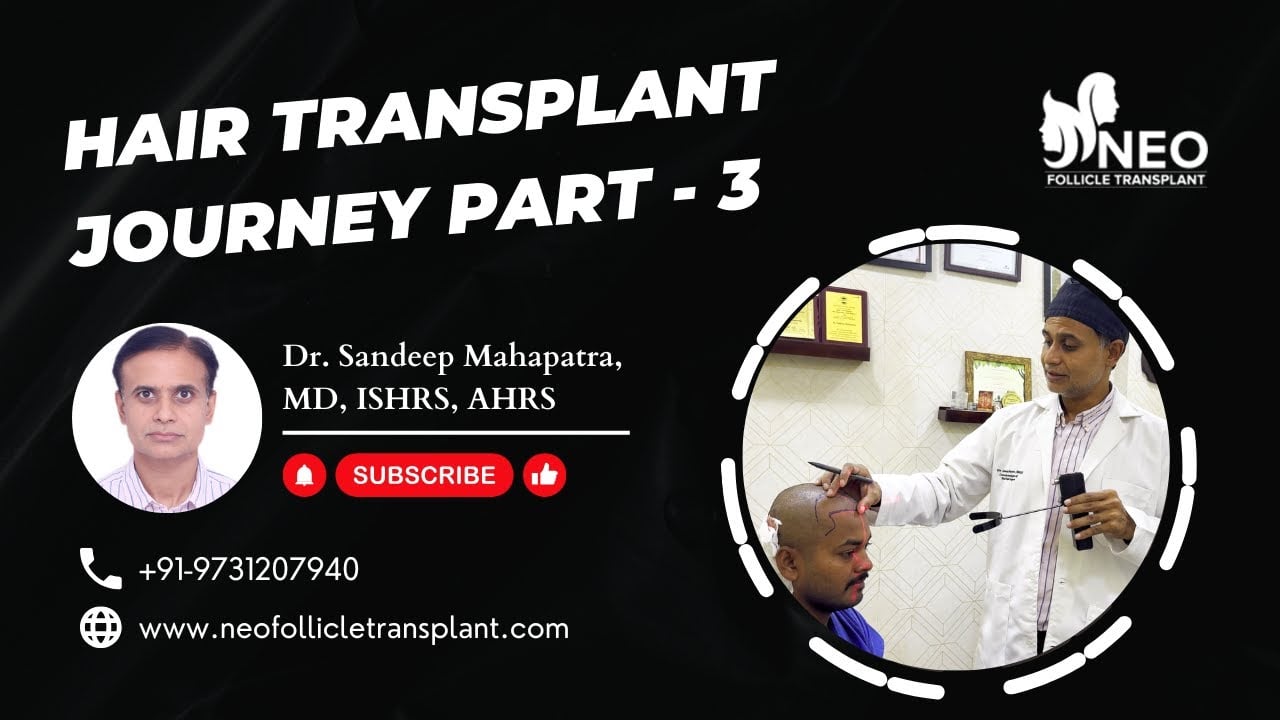
The design process typically includes:
Many patients bring reference photos. I welcome that because it helps me understand their aesthetic preference. But I also explain what is realistic and safe.
My goal is never to impose a design.
My goal is to guide the patient toward the most natural and sustainable result.
Bangalore is a city where appearance and confidence matter in subtle ways.
Many of my patients work in tech companies, startups, corporate offices, consulting firms, and leadership roles across Whitefield, Marathahalli, ORR, Sarjapur Road, Koramangala, Indiranagar, and HSR Layout.
They attend meetings, video calls, interviews, investor presentations, client discussions, social events, and weddings.
They do not want an artificial transformation. They want a natural improvement that fits their personality and lifestyle.
A good hairline can make the face look more balanced. It can reduce the tired or aged appearance created by frontal recession. It can restore confidence in photographs and professional interactions.
But the result must be subtle.
The best compliment after a hair transplant is not, “You had a hair transplant.”
The best compliment is, “You look fresh. Have you lost weight? Changed your hairstyle?”
That is the kind of natural result we aim for.
Hair loss is not just cosmetic.
For many men, the receding hairline is emotionally painful. It can affect confidence, self-image, social comfort, and even professional presence.
I have seen patients avoid photographs. I have seen them change hairstyles repeatedly to hide recession. I have seen young men lose confidence in meetings or social gatherings because they feel their face has changed too soon.
So when a patient asks for a youthful hairline, I do not dismiss that emotion.
I understand it.
But my responsibility is to help them choose a design that brings back confidence without creating future regret.
A mature, natural, customized hairline can still make a person look significantly younger. It does not need to be extreme.
In hairline design, restraint is often what creates beauty.
Hairline design is not just about drawing. It must be executed precisely during surgery.
Even the best design can fail if the implantation is poor.
The surgeon and team must maintain:
Hair transplant is a team procedure, but the vision must come from the surgeon.
At Neo Follicle Clinic, my role is to ensure that the artistic plan and surgical execution are aligned.
A natural hairline is created millimeter by millimeter.
Before finalizing your transplant, ask yourself and your surgeon these questions:
If these questions are answered properly, you are more likely to get a result that looks natural and lasts well over time.
My personal philosophy is simple:
A successful hair transplant should not look like a transplant.
It should look like natural hair growth.
The hairline should not be the first thing people notice. Instead, it should quietly improve the overall face.
When designing a hairline, I am not only thinking about density. I am thinking about how the patient will look in real life:
This is why I believe hairline design must be conservative, artistic, and deeply personalized.
A good hairline restores confidence.
A great hairline does so invisibly.
If you are considering a hair transplant in Bangalore, please remember this:
The goal is not to create the lowest hairline possible.
The goal is to create the most natural hairline possible.
A well-designed hairline should match your age, face, donor area, and future hair loss pattern. It should have softness, irregularity, correct angulation, and a gradual transition.
Avoid clinics that rush the design, use templates, promise unrealistic low hairlines, or create ruler-straight frontal lines.
At Neo Follicle Hair Transplant Clinic in Marathahalli, Bangalore, my team and I approach every hairline as a custom design. Whether you visit us from Whitefield, ORR, Sarjapur Road, Indiranagar, Koramangala, HSR Layout, or another part of Bangalore, our goal remains the same:
To give you a hairline that looks natural, age-appropriate, and truly yours.
Hairline design should be a collaborative process.
You can absolutely share your preference, old photographs, hairstyle goals, and expectations. In fact, I encourage patients to discuss what they want clearly.
However, the final hairline should be medically and aesthetically guided by the surgeon.
As a surgeon, I must consider your age, face shape, donor hair availability, degree of hair loss, and future hair loss risk. Sometimes, the hairline a patient wants may be too low or too aggressive. In such cases, I explain why a slightly more mature design will look better in the long term.
The best result comes when your expectations and the surgeon’s experience come together.
A properly designed hairline should age naturally with your face.
This is why age-appropriate planning is so important. If the hairline is too low or too straight, it may look unnatural as you grow older. If future hair loss progresses behind the transplanted area, the overall appearance can become unbalanced.
During planning, I consider how your hair loss may progress over time. I also assess whether medical treatment may be needed to stabilize existing hair.
The goal is to create a hairline that looks good not only after one year, but also many years later.
A straight hairline looks unnatural because real human hairlines are not straight.
Natural hairlines have small curves, breaks, and irregularities. The front edge is usually soft and slightly uneven. This is what makes it look organic.
When a transplanted hairline is designed like a ruler-straight line, the brain immediately detects it as artificial. It may look sharp initially, but it often lacks natural softness.
That is why I intentionally create micro-irregularities and use single-hair grafts in the frontal edge to mimic nature.
The number of single-hair grafts needed depends on the width of the hairline, the degree of recession, the desired density, and the patient’s hair characteristics.
In many cases, several hundred single-hair grafts may be used in the frontal transition zone. The exact number varies from patient to patient.
What matters is not only the number, but also the selection and placement of these grafts. Single-hair grafts must be placed at the correct angle, direction, and density to create a soft, natural-looking hairline.
A natural front hairline is not created by density alone. It is created by precision.

Written by: Dr. Sandeep Mahapatra
Senior Dermatologist, Hair Transplant Surgeon & Founder – Neo Follicle Hair Transplant Clinic, Bangalore
Dr. Sandeep Mahapatra is a senior dermatologist and hair transplant surgeon in Bangalore with extensive experience in hair restoration, dermatology, and aesthetic treatments. As the founder of Neo Follicle Hair Transplant Clinic, he has successfully performed over 10,000 hair transplant procedures and regularly guides patients on safe, ethical, and natural-looking hair restoration.
Medically reviewed by: Dr. Sandeep Mahapatra
Senior Dermatologist & Hair Transplant Surgeon
Date Reviewed: 2026-06-12
This article has been medically reviewed by Dr. Sandeep Mahapatra to ensure that the information is clinically accurate, patient-friendly, and aligned with safe hair transplant practices. The content is intended for educational purposes and should not replace a personal consultation with a qualified hair transplant surgeon.
The following medical and scientific sources were referred to while preparing this educational article on The Art and Science of Natural Hairline Design in Hair Transplants: