
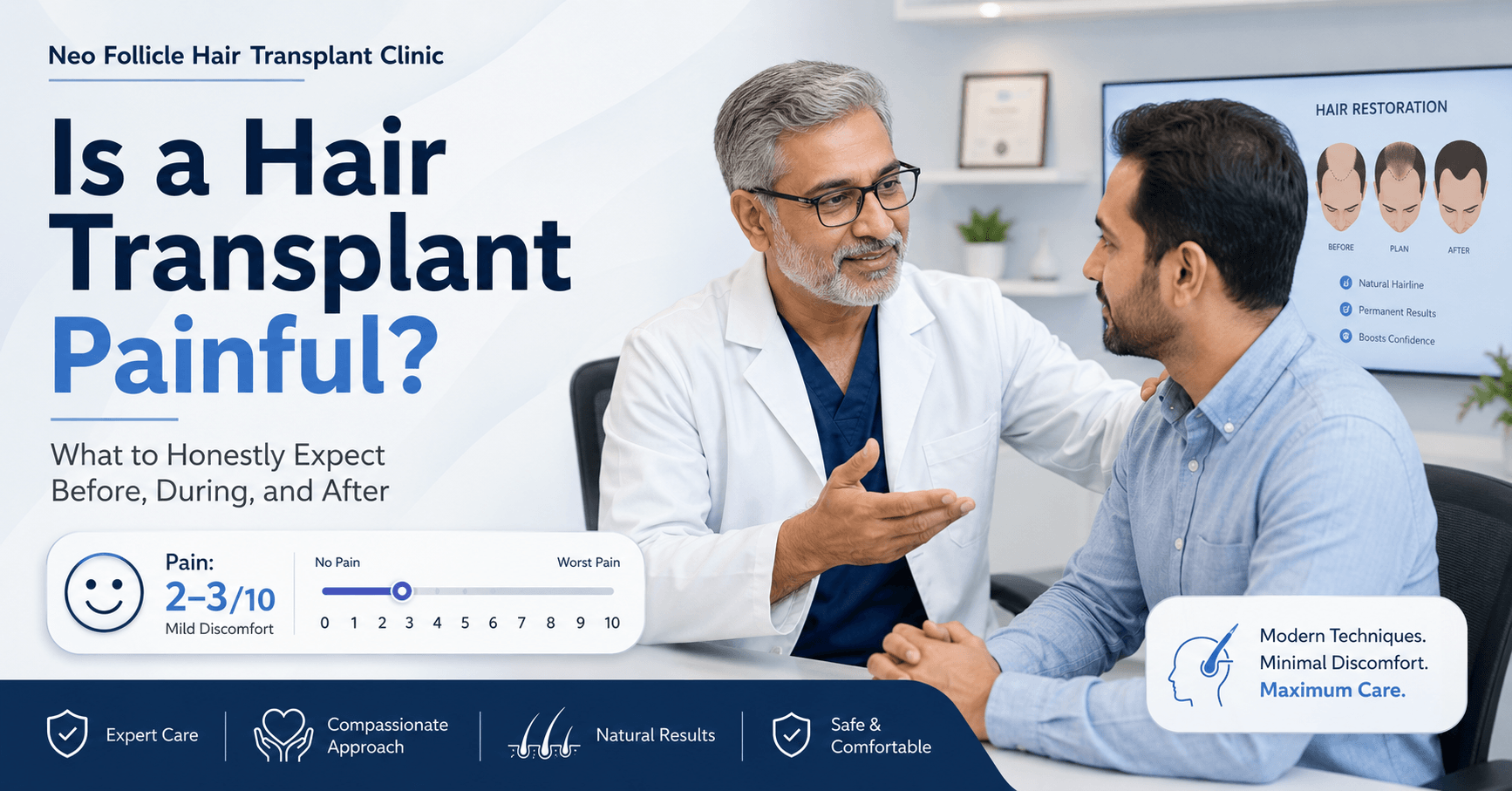
For many patients, the biggest fear before a hair transplant is not the result. It is not even the cost or the recovery.
It is one simple question:
“Doctor, will it hurt?”
As a hair transplant surgeon and dermatologist, I hear this question almost every day at Neo Follicle Hair Transplant Clinic in Bangalore. Many patients walk into my consultation room with visible anxiety. Some are afraid of needles. Some had a painful dental procedure in the past. Some have watched dramatic videos online and imagine that a hair transplant will be a painful surgical experience.
Let me reassure you honestly.
A well-performed hair transplant should not be painful during the procedure.
The only part where you may feel brief discomfort is during the initial local anesthesia injections. After that, the scalp becomes numb, and you should not feel pain during extraction or implantation.
But I also do not want to casually say, “Don’t worry, there is no pain,” because that can sound dismissive. Your fear is real. Needles can be scary. The scalp is a sensitive area. And yes, comfort during a hair transplant depends a lot on the surgeon’s technique, anesthesia planning, and post-operative care.
In this blog, I will walk you through exactly what you may feel before, during, and after a hair transplant, just as I explain it to my patients at Neo Follicle.
Most patients feel maximum anxiety before the procedure begins.
This is especially true for working professionals from areas like Whitefield, Bellandur, Marathahalli, Electronic City, Koramangala, Indiranagar, and Jayanagar, who often tell me:
“Doctor, I can manage work pressure, but I am scared of injections.”
I completely understand this.
At Neo Follicle, I always explain that the hair transplant itself is not the painful part. The only moment of real discomfort is usually the local anesthesia phase, which lasts only a few minutes.
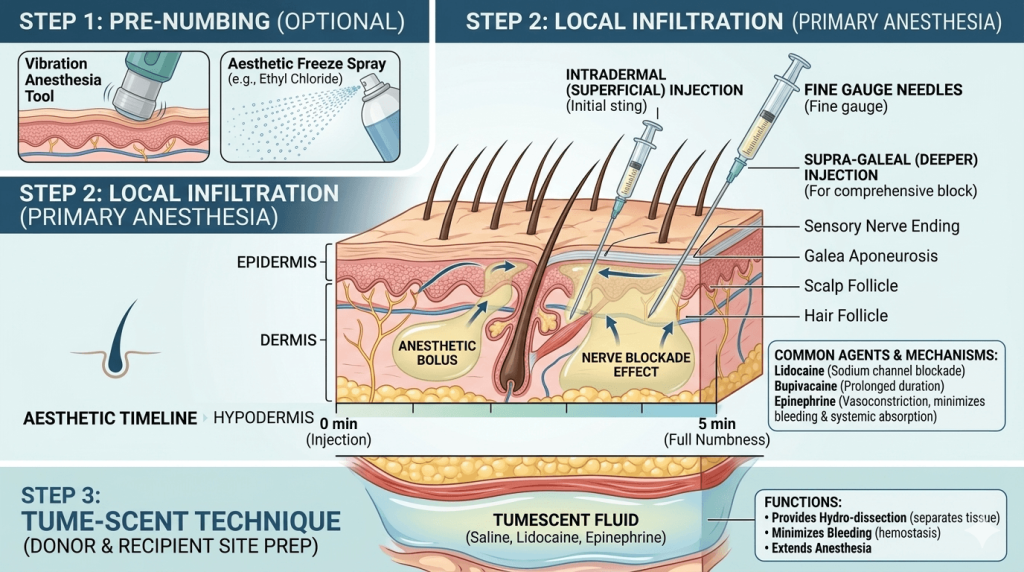
Local anesthesia is given to numb the donor and recipient areas of the scalp. During the first few injections, you may feel:
This discomfort is temporary. It usually settles quickly as the area begins to numb.
Most patients describe it as similar to a dental numbing injection, but on the scalp. Some say it feels like a few ant bites. Some say it is less painful than they expected.
The important point is this:
Once the local anesthesia starts working, the scalp becomes numb and the painful sensation stops.
A comfortable hair transplant starts with a careful anesthesia technique.
At Neo Follicle, my team and I focus on making this stage as gentle as possible. Depending on the patient, we may use comfort-focused methods such as:
These small details matter.
If anesthesia is rushed, injected too forcefully, or given without understanding scalp sensitivity, the experience can become unnecessarily painful. This is one reason why the skill of the surgeon and team is extremely important.
Many patients imagine the pain to be much higher than it actually is.
Here is a simple comparison I often use during consultation:
| Stage of Hair Transplant | What You May Feel | Pain Scale 1–10 |
|---|---|---|
| Anxiety before starting | Fear, nervousness, overthinking | 6–8 mentally |
| Local anesthesia injections | Brief pinch or stinging | 2–4 |
| Extraction of grafts | Pressure or movement, no sharp pain | 0–1 |
| Implantation of grafts | Touch, pressure, or vibration, no pain | 0–1 |
| First night after surgery | Mild soreness or tightness | 2–3 |
| Day 2–3 recovery | Mild discomfort, improving gradually | 1–2 |
Most patients are surprised by this. They come expecting severe pain, but once the anesthesia is complete, they often relax, watch a movie, listen to music, or even take a nap.
Once local anesthesia has taken effect, the donor and recipient areas become numb.
This means that during the actual hair transplant procedure, you should not feel sharp pain.
At Neo Follicle, we usually tell patients:
“You may feel that something is happening, but you should not feel pain.”
That is an important distinction.
During extraction, hair follicles are carefully taken from the donor area, usually the back or sides of the scalp.
You may feel:
But you should not feel cutting pain, burning pain, or sharp pain.
If a patient feels discomfort, we pause and check immediately. A top-up of anesthesia can be given wherever required. A good hair transplant team should never ask you to “adjust” or “tolerate” real pain during the surgery.
During implantation, grafts are placed into the recipient area where hair growth is needed.
Again, the area remains numb.
You may feel:
But the process should be comfortable.
Many patients spend this time watching movies, listening to music, or resting. Some patients are so relaxed that they sleep during parts of the procedure.
Many software engineers who visit our Marathahalli clinic from Whitefield, Bellandur, and Electronic City worry about whether they can return to laptop work soon.
I usually reassure them that the procedure is not physically exhausting like major surgery. Many patients can do light remote work from the next day, provided they avoid stress, sweating, bending, and unnecessary travel.
This is a very common fear.
The honest answer is: anesthesia can reduce over time, especially in longer sessions. But this is expected and manageable.
A skilled surgical team monitors patient comfort continuously. If the patient feels sensation returning, we simply give additional local anesthesia in that area.
You are not expected to silently tolerate discomfort.
At Neo Follicle, we keep checking with the patient throughout the procedure. If you feel anything more than pressure or mild awareness, you can inform us immediately.
The goal is simple:
You should remain comfortable from start to finish.
After the procedure, the local anesthesia slowly wears off.
This is when patients may start feeling mild discomfort. I prefer to describe this honestly as soreness or tightness, not severe pain.
Most patients say it feels like:
This is usually most noticeable on the first night and the next day.
For most patients, basic prescribed pain medication is enough. The discomfort usually reduces significantly within 2 to 3 days.
After a hair transplant, the following sensations can be normal:
These symptoms are temporary and part of the healing process.
Severe pain is not normal.
You should contact your clinic if you experience:
Proper post-operative instructions and medication protocols are important to prevent complications and keep recovery comfortable.
A hair transplant should be comfortable when done correctly. But unfortunately, some patients do have painful experiences elsewhere.
This usually happens because of avoidable reasons.
Pain can happen when:
This is why I always tell patients not to choose a hair transplant clinic only based on price or advertisements.
Comfort, safety, and natural results depend on the doctor’s judgment, team training, anesthesia protocol, and surgical discipline.
A good clinic will never make you feel embarrassed for being scared. A good surgeon will explain what you may feel, check your comfort repeatedly, and adjust the plan when needed.
Many patients from Bangalore’s busy professional hubs ask this question.
Patients from Whitefield, Marathahalli, Bellandur, Electronic City, Koramangala, Indiranagar, and Jayanagar often have packed work schedules. They want to know whether pain will affect their meetings, laptop work, or daily routine.
In most cases, the pain does not stop patients from doing light work.
Many patients can resume remote laptop work the next day, as long as they follow precautions:
If your work requires field visits, heavy travel, dust exposure, or helmet use, I may advise a few more days of rest.
If you are scared of pain, you are not weak. You are normal.
I have treated thousands of patients, including doctors, engineers, business owners, students, and professionals from across Bangalore and outside India. Many were extremely anxious before the procedure. Some even told me they almost cancelled because of fear.
But after the procedure, most of them say:
“Doctor, I was more scared than I needed to be.”
That is the truth.
The fear is usually bigger than the pain.
A hair transplant is not completely sensation-free. You may feel the initial anesthesia injections. You may feel pressure during the procedure. You may feel soreness after the anesthesia wears off.
But with the right technique, right anesthesia planning, and proper aftercare, the experience is very manageable and far more comfortable than most patients imagine.
At Neo Follicle Hair Transplant Clinic in Bangalore, my team and I focus not only on graft survival and natural results, but also on patient comfort. Because for us, a good hair transplant experience begins with trust.
Local anesthesia usually lasts for a few hours. The exact duration depends on the medicine used, the area treated, the session length, and individual patient response. In longer procedures, we may give small top-ups to maintain comfort throughout the surgery.
If you feel discomfort during the procedure, you should inform the team immediately. The surgeon can pause and give additional local anesthesia. You should not be asked to tolerate sharp pain during extraction or implantation.
You may feel mild soreness, tightness, or itching as the donor area heals. Itching is common during healing, but you should not scratch the area. If itching is disturbing, speak to your doctor. Do not apply random creams or oils without medical advice.
It is better to take only the pain medication prescribed by your hair transplant surgeon. Some over-the-counter painkillers may not be suitable for every patient and may increase bleeding risk or interact with other medicines. If discomfort is more than expected, contact your clinic instead of self-medicating.
So, is a hair transplant painful?
The honest answer is:
The anesthesia injections may cause brief discomfort, but the actual hair transplant should not be painful. After the procedure, most patients experience mild soreness or tightness for a few days, which is manageable with prescribed medication.
If fear of pain is stopping you from considering a hair transplant, speak to an experienced hair transplant surgeon. Once you understand the process clearly, the fear becomes much easier to handle.
At Neo Follicle Hair Transplant Clinic in Bangalore, we are here to guide you with honesty, comfort, and medical care at every step.

Written by: Dr. Sandeep Mahapatra
Senior Dermatologist, Hair Transplant Surgeon & Founder – Neo Follicle Hair Transplant Clinic, Bangalore
Dr. Sandeep Mahapatra is a senior dermatologist and hair transplant surgeon in Bangalore with extensive experience in hair restoration, dermatology, and aesthetic treatments. As the founder of Neo Follicle Hair Transplant Clinic, he has successfully performed over 10,000 hair transplant procedures and regularly guides patients on safe, ethical, and natural-looking hair restoration.
Medically reviewed by: Dr. Sandeep Mahapatra
Senior Dermatologist & Hair Transplant Surgeon
Date Reviewed: 2026-06-12
This article has been medically reviewed by Dr. Sandeep Mahapatra to ensure that the information is clinically accurate, patient-friendly, and aligned with safe hair transplant practices. The content is intended for educational purposes and should not replace a personal consultation with a qualified hair transplant surgeon.